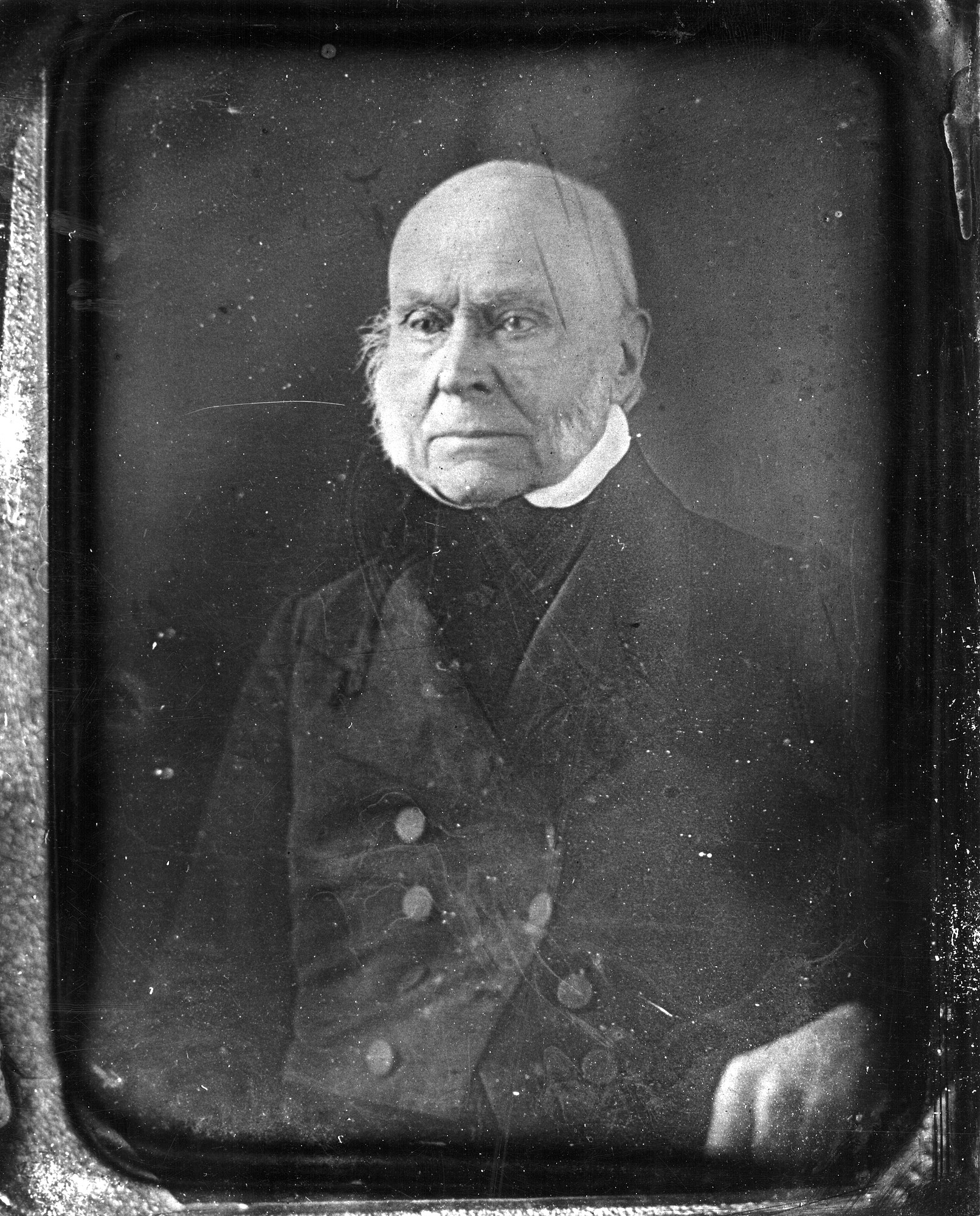
However, when it came to his treatment of Aaron Burr and Jean Laffite, he was not so upstanding. There, instead of fighting for the underdog -- the person whose rights had been trampled upon unfairly by the ruling party -- John Quincy Adams came out squarely in favor of the establishment.
When Aaron Burr had already been acquitted in his trial for treason earlier that year, John Quincy Adams, then serving in the Senate, made a motion on the floor toward the end of 1807 when he was forty years old concerning "the conspiracy of Aaron Burr and his associates against the peace, union and liberties of the United States". He was trying to expel John Smith of Ohio from the Senate on the grounds that he had been a supporter of Burr. (Kennedy 1999.378).
Senator Hillhouse of Connecticutt rose up to reply to Adams: "Where is the evidence whereon we can ground a vote which is to disrobe a Senator from his office and of his honor? ... Nothing but jealousy, ... that jealousy that frequently attaches itself to a charge of treason."
What was John Quincy Adams so jealous about, that it required him to charge Burr anew of the treason of which he had just been acquitted in a trial by his peers? Could it be that he held the election of 1800 against Burr in the same way that Jefferson did? Burr had soundly beaten John Adams, the Quincy's father, in votes to the presidency. He had tied with Jefferson. Could this have won him the enmity of both the younger Adams as well as his own running mate?
In Theodosia and the Pirates: The War Against Spain, Theodosia warns Jean Laffite that John Quincy Adams cannot be trusted.

At the time, John Quincy Adams was Secretary of State under President Monroe and he was negotiating a treaty with the Spanish Ambassador de Onis. The Adams-Onis Treaty set the western border between Spain and the United States at the Sabine River in return for Spain giving up Florida.

Effectively, what John Quincy Adams did was to trade Texas for Florida. There was just one problem: Texas did not belong to the United States. Texas was a separate sovereign nation, under the leadership of Jean Laffite.

When Patterson of the US Navy sent Kearney on The Enterprise to clear out the Laffites from Galveston, they were not doing it on behalf of the United States, as the United States had given up all claim to that territory. They were acting on behalf of Spain, as promised by John Quincy Adams!
It is perhaps a fitting biographical note that John Quincy Adams died of apoplexy suffered in 1848 while denying American servicemen recognition for their service in the Mexican-American War, to which he had been opposed. I believe that if John Quincy Adams had had his way, the United States would be much smaller than it currently is. He opposed the Burr expedition that was meant to liberate Texas from Spain. He opposed the right of Jean Laffite to govern Galveston, which Laffite was doing as a service to the United States. And he opposed every other territorial expansion in the western direction, if it meant taking territory that he had preemptively given away under his treaty with de Onis.


.jpg/1024px-Signing_of_Treaty_of_Ghent_(1812).jpg)

