Showing posts with label Panic of 1819. Show all posts

Tuesday, April 21, 2015

Free Enterprise, Capitalism and The Panic of 1819

There is an enormous difference between free enterprise and capitalism. In today's culture, those two systems are conflated, and this causes misunderstandings between and among people who might otherwise have found that they have common ground.

Image from the Wikipediahttps://upload.wikimedia.org/wikipedia/commons/thumb/6/6a/Pedal-driven-weaving-machine.jpg/640px-Pedal-driven-weaving-machine.jpg


Free enterprise is an economic system where  people are allowed to come to agreements and reach bargains amongst themselves without government interference. Free enterprise says nothing about whether businesses are small or large or whether capital is concentrated or diffuse.

Capitalism is an economic system where large amounts of capital are concentrated in the hands of a few controlling interests. Those who control the capital might be corporations or the government. They are usually not individuals. But either way, capitalism says nothing about whether people are free to arrive at their own bargains under terms agreeable to themselves.

It is theoretically possible to have both free enterprise and capitalism at the same time. It is also theoretically possible to have capitalism without free enterprise or free enterprise without capitalism.

However, in practice, capitalism tends to move a country away from free enterprise, as when only a very few control the means of production, they are able, in a democracy,  to pass laws that favor themselves and hurt the competition. In practice, in order for free enterprise to remain stable, a more diffuse dispersal of capital is optimal.

For independent people even of very modest means, it is important to be able to make business decisions unfettered, so what they really want is free enterprise. For others, industrialization implies capitalization, and industrialization creates more goods and feeds the masses, so they favor special legal breaks for corporations. However, when they see what inequality is brought about by this system of capitalization, they start crying out for redistribution.

In the 19th century, the United States moved from being a country characterized by free enterprise to becoming an industrialized nation whose economic system involved allowing a few interests to control more capital. The means whereby this happened was the spread of corporations.

Corporations are legal entities whose investors enjoy limited liability. This means that the corporation can cause harm to others, but the stockholders cannot be held accountable for more than their individual investment. Due to this lack of accountability, investors cede control of their funds to a few individuals who run the day to day business of a corporation without  owning the capital that they control. When things go smoothly, everybody is happy. But when things go badly, you get massive economic downturns, like the Panic of 1819.

In Theodosia and the Pirates: The War Against Spain, Edward Livingston explains the change from free enterprise to capitalism to Jean Laffite.


Protectionism at home for certain businesses against others breeds protectionism from abroad through tariffs and embargoes, and what started out as free enterprise becomes capitalism, and the government is recruited to help protect unviable businesses from bankruptcy.

Today, the people who cry out to expropriate the rich are really targeting individuals who own their businesses: the small family farm or ranch, the mom and pop store, the home seamstress or tailor. When they speak up in favor of the estate tax, they forget that corporations never die, and that if families lose their property every time a father or a mother passes away, then very soon all businesses will be run by large corporations, and nobody will have any choice but to be employed by corporate conglomerates who lobby the government for protection. Then  prices and wages will be fixed by government fiat, and goodbye free enterprise.

Jean Laffite did not want that result. He was against wage slavery. How about you?

Related Articles

The Corporate Entity

Edward Livingston

Thursday, December 4, 2014

Consequences of the Louisiana Purchase

I have finished reading Matthew Warshauer's book and have posted a review on Amazon.

Andrew Jackson and the Politics of Martial Law Review

In looking back on what I learned from reading about the refund debates, the biggest thing that stands out was what a mistake the Louisiana Purchase was and what a very big price we paid for it in both the loss of life in a war fought to keep it, the loss of our civil liberties under martial law imposed during the Battle of New Orleans and in the financial shenanigans that bankrupted our economy right after the War of 1812.

Please understand, I am not saying that the states which were once part of the Louisiana Purchase should not be part of the union. On the contrary, I think that they inevitably would have been, had we followed a constitutional course of action, But you cannot "purchase" land for mere money, and a country committed to civil liberties cannot possibly maintain ideological purity when it buys not only the land but the people who live on it.


The corrupting influence of the Louisiana Purchase can be seen in Andrew Jackson's belief that the people of Louisiana were not faithful to the United States, and hence there was a necessity to impose martial law on an unwilling population. He made it seem that if not for his heavy handed, dictatorial treatment of everyone in the city, the non-English speaking population would have embraced the British invaders.

It wasn't true. The people of Louisiana did not want the the British to win. Those of French descent particularly hated Britain and everything it stood for. The Battle of New Orleans was won through the voluntary donations and exertions of the French speaking Baratarian volunteers, Jean Laffite chief among them.

But sometimes the hidden sense of guilt that we have for being a conqueror can make us paranoid, because deep down inside we feel that if anyone had done to us what we did to our subject population, we ourselves would rebel. That's what happened to Andrew Jackson, and for a few months he ran roughshod over an entire population, just in case there might be some spies or turncoats or terrorists or saboteurs among them. And twenty-nine years later he returned to Congress and asked for an endorsement of those actions. And he got it! This precedent was in turn used to subdue civilian populations during the Civil War and during World War II and after 9/11 and ever since.

But there's also an economic price for the Louisiana Purchase that we are paying to this very day. The original notes for the purchase were made out to France, but Napoleon turned around and sold them to a British Bank, and when the payments came due, we paid almost all our gold and silver reserves to Britain, precipitating the Panic of 1819.

Today, people who are against a strong monetary system point at the business cycle's ups and downs and say that being off a hard specie standard is what keeps us from having crises like the one in 1819. But it was not the free market that caused the Panic of 1819. It was the Louisiana Purchase all over again.

So how should we go about getting new territories? The colonization of Texas by independent Americans is one example. Filibustering is the American way. It allows independent individuals to pursue their own interests, while keep the government out of it. This way any war that occurs is a private war, waged only by those who stand to gain from it.

The Neutrality Act should never have been passed. Americans should have been free to settle anywhere and fight for independence from European empires. Then, years later, when everyone who lived in the territory actually wanted to join the United States, they could petition to join the union.

This is how a government by the consent of the governed operates. It does not  put the union above the people. It waits to be asked nicely to join. And if we had lived by this creed of consent of the governed,  we would have been left free both in the economic sphere and in the matter of civil liberties  That's why I think repealing the Neutrality Act is the first step in regaining our freedom.


Sunday, August 24, 2014

What Was the War of 1812 About?

Two hundred years ago today the British burned down Washington. They invaded, and the Americans retreated. Dolley Madison saved the painting of George Washington, but that was a small consolation for all that was lost. Honor, hope, dreams.

http://www.washingtonpost.com/national/health-science/2014/08/23/abf407ae-24bd-11e4-86ca-6f03cbd15c1a_story.html

Nobody remembers the War of 1812 today, except for a handful of historians, largely because there is no consensus as to what this war was about. Other wars carry handy labels:

The American Revolution -- "No taxation without representation."

The Civil War -- On the winning side it is known as "the war to free the slaves". On the losing side, it is known as "The War Between the States", and the cause is "States' Rights."

World War I -- "The War to End All Wars." People laugh, but they still remember that.

World War II -- "The War against the Nazis." I know that is not an official label, and of course that Japan was also involved, but when certain people cite WWII as a "moral war", that seems to be what they mean.

The undeclared wars that happened after WWII are as problematic as the Quasi-War with France. So is the Spanish-American War. But the War of 1812 is the one most people will readily admit that they know nothing about and never really understood.

It may very well have been the war to pay for the Louisiana Purchase. It was the war that was won by privateers, but it was also the war that put an end to privateering. It may have been the war that put an end to our belief that we could live without a standing army. Some see it as the second war of American independence, but ultimately it was a war that had us very much a vassal of Britain for quite some time. It was a war that was won in the Battle of New Orleans but lost in Ghent with the signing of a treaty that pre-dated that battle.

The Signing of the Treaty of Ghent.
 
Admiral of  James Gambier is shaking hands with U.S. Ambassador  John Quincy Adams

None of the American aims in declaring the War of 1812 were accomplished. No reparations were made by the British for the damage they did during the war, both by burning Washington and in all their other forays on American soil, including most notably The Sack of Hampton.

The War of 1812 may be neglected by history teachers in the schools because the way it was managed was embarrassing, but it is well worth studying in order to understand how we came to be where we are today.

To learn more about the war itself, and the part Jean Laffite played in it, read this novel.

The Battle Against Britain

For a better understanding of the aftermath of that war, read this one.

The War Against Spain

Monday, April 7, 2014

President Monroe on Withholding from the Wants of Others

When we consider how very badly things turned out for most Americans in terms of economics in 1819, it might be a good idea to go back to President Monroe's first address to Congress and see the rosy forecast he gave and the ways in which he predicted there would be revenue to pay off the national debt.

In calling your attention to the internal concerns of our country the view which they exhibit is peculiarly gratifying. The payments which have been made into the Treasury show the very productive state of the public revenue. After satisfying the appropriations made by law for the support of the civil government and of the military and naval establishments, embracing suitable provision for fortifications and for the gradual increase of the Navy, paying the interest of the public debt, and extinguishing more than $18 million of the principal, within the present year, it is estimated that a balance of more than $6 million will remain in the Treasury on the first day of January applicable to the current service of the ensuing year.
The payments into the Treasury during the year 1818 on account of imposts and tonnage, resulting principally from duties which have accrued in the present year, may be fairly estimated at $20 million; the internal revenues at $2.5 million; the public lands at $1.5 million; bank dividends and incidental receipts at $500,000; making in the whole $24.5 million.
The annual permanent expenditure for the support of the civil government and of the Army and Navy, as now established by law, amounts to $11.8 million, and for the sinking fund to $10 million, making in the whole $21.8 million, leaving an annual excess of revenue beyond the expenditure of $2.7 million, exclusive of the balance estimated to be in the Treasury on the first day of January, 1818.
In the present state of the Treasury the whole of the Louisiana debt may be redeemed in the year 1819, after which, if the public debt continues as it now is, above par, there will be annually about $5 million of the sinking fund unexpended until the year 1825, when the loan of 1812 and the stock created by funding Treasury notes will be redeemable.
It is also estimated that the Mississippi stock will be discharged during the year 1819 from the proceeds of the public lands assigned to that object, after which the receipts from those lands will annually add to the public revenue the sum of $1.5 million, making the permanent annual revenue amount to $26 million, and leaving an annual excess of revenue after the year 1819 beyond the permanent authorized expenditure of more than $4 million.
The Louisiana Purchase and  the debt that came with it were not President Monroe's fault. That he could not predict that cotton prices would go down as soon as Europe recovered from the wars it had been embroiled in, and the bad harvest of the year without a summer (1816), was also not his fault.  Many of the problems he faced as a president were inherited from his predecessors. But to allow the banks to renege and default on their obligations to depositors and to hold the Second Bank of the United States above the laws of the states for purposes of the application of ordinary contract law was in my opinion bad policy as well as unconstitutional.

In President Monroe's Address from December of 1819, he spoke of the drop in the price of both goods and labor:
The great reduction in the price of the principal articles of domestic growth which has occurred during the present year, and the consequent fall in the price of labor, apparently so favorable to the success of domestic manufactures, have not shielded them against other causes adverse to their prosperity. The pecuniary embarrassments which have so deeply affected the commercial interests of the nation have been no less adverse to our manufacturing establishments in several sections of the Union.
So it seems that the price of unskilled labor, of staple goods and of manufactured goods all went down at the same time. If this was the case, you would think that people who had money would in fact be doing very well. Those of us with a positive net worth are supposed to thrive under these conditions of reduced prices. Let's remember who those people are. They are not all rich. Some are widows and orphans and retired people who happen to have a nest egg and who hope to use that money to live on for the rest of their lives. Often they deposit such money in the bank. In a depression, they should do really well, because there is plenty of food and other goods to be had at a highly reduced price. This means retired people ought to be suddenly able to afford a higher standard of living than they otherwise could.

 But guess what? The people who had money in the bank were not able to use the money to buy more things, because the banks would not release the money! This is an aspect of what happened during the Panic of 1819 and of every subsequent panic, including the one in 1929, that people don't tell you about. Depressions are not bad because the price of everything goes down. Lower prices are a good thing for the average person. Depressions are bad because the banks get to keep ordinary people's money, with the government's blessing.

But was President Monroe worried about people not being able to get to their savings? No, he was worried about the effect on businesses when the banks could not loan them money to take advantage in the fall in price of goods.
The great reduction of the currency which the banks have been constrained to make in order to continue specie payments, and the vitiated character of it where such reductions have not been attempted, instead of placing within the reach of these establishments the pecuniary aid necessary to avail themselves of the advantages resulting from the reduction in the prices of the raw materials and of labor, have compelled the banks to withdraw from them a portion of the capital heretofore advanced to them. That aid which has been refused by the banks has not been obtained from other sources, owing to the loss of individual confidence from the frequent failures which have recently occurred in some of our principal commercial cities.
The economy, even in the days of President Monroe, was seen as healthy when it was growing and unhealthy when it was not growing. But a non-interventionist policy ought in fact not to have cared whether there was growth. Debt fosters growth. The fact the Federal government was chronically in debt made it long for constant growth in the economy, and this in turn fostered a policy toward population growth and against hunter-gatherers.

Today, the same policies are still being applied, even while liberal-minded people give lip service to their concern about how the native American populations were expropriated of their lands. But President Monroe, in his first address to Congress, had no compunction about spelling it out. Hunter-gatherers had to stop hunting, because our mission is to expand the population to the max.
In this progress, which the rights of nature demand and nothing can prevent, marking a growth rapid and gigantic, it is our duty to make new efforts for the preservation, improvement, and civilization of the native inhabitants. The hunter state can exist only in the vast uncultivated desert. It yields to the more dense and compact form and greater force of civilized population; and of right it ought to yield, for the earth was given to mankind to support the greatest number of which it is capable, and no tribe or people have a right to withhold from the wants of others more than is necessary for their own support and comfort.
Wow! There in a nutshell is the idea that no one should be allowed to own land if that land could support more people if somebody else owned it! The "wants" of others trump your property rights!
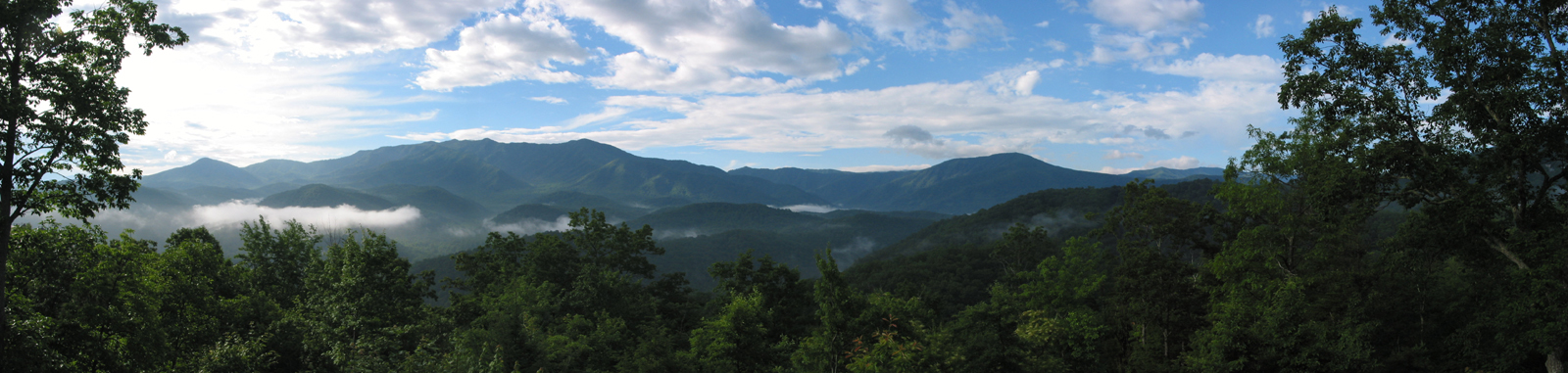
Photo compilation of Smoky Mountains by Reverie Hikes from Wikimedia Commons

"The earth was given to mankind to support the greatest number of which it is capable." James Monroe

The fiscal policy of wanting loans for large businesses but not having specie available to small depositors is the same as the land policy of  enabling the high yield of denser populations and overriding the rights of smaller, less productive landholders to decide what lifestyle they prefer.

Notice that this is not a racist policy. At no time did the race of the native inhabitants come into it. President Monroe applied the same essentially socialist policy to everybody. His goal was constant expansion in order to fuel a growing economy in order to produce ever greater revenues to pay off massive debts. We have been on the same trajectory ever since.

Sunday, April 6, 2014

When the Banks Renege -- The Panic of 1819

Jean Laffite always paid for his purchases in specie. He paid his debts in silver and gold. When he wanted to make change, he could cut up a coin or a bar into smaller pieces, because the value of the coin was in the metal it was made of, not the printing that was on it. Try making change by cutting up a dollar bill today. Not only will the little pieces not be worth a fraction of the whole, but also it's illegal to do so!

During the War of 1812, some merchants in New Orleans tried to blame the Laffites and their establishment at Barataria for a shortage of specie. It is typical of people who themselves deal in bank notes without cover that they try to blame others who are more fiscally responsible for their own problems.

The United States was not on a solid financial footing during the War of 1812, but after the war, things became much worse. In 1816 the Second Bank of the United States was established. And in 1819, we had our first major Panic, aptly named the Panic of 1819.

What were the causes of the Panic of 1819? Those in the know will name a few: a reduction in the price of staple goods like cotton due to a resurgence of production in Europe which hurt growers in  the U.S., the printing of bank notes without cover by various banks, and the eventual  tightening of the money supply when the United States needed to withdraw two million in specie from the Second Bank of the United States to make payments in October of 1818 on its notes for the Louisiana Purchase, promissory notes made out to France but now owned by an English bank.  After this withdrawal, there was not enough specie to cover the bank's obligations.

The problem for ordinary people was that while banks that were in debt were not forced to pay their creditors in specie, and the Bank of the United States, though a supposedly private entity, was exempt from the laws of the states and could not be foreclosed on, ordinary people still had to pay their own debts, or suffer the consequences.

When a tighter fiscal policy was enforced at Second Bank of the United States, the saying went that the bank was saved, but the people were ruined.

Now, many populist agitators see this as an issue between the "wicked rich" and the "victimized poor", but this way of conceptualizing the problem hides the real issue: that not all poor people are treated the same. If we go by net worth alone, the Second Bank of the United States and all the other reneging smaller banks that relied on it, were actually poorer than an ordinary person who had a few coins in his pocket, because they had a negative net worth. The banks, including the very biggest one,  should by rights have been allowed to collapse and their corpses fed to their creditors.

President Monroe is thought to have been a fiscally conservative president, because he did not pass relief for the "poor". But how fiscally conservative is it to allow a bank to reneg on its obligation to depositors? The very poorest of the poor were the banks themselves. They should have been allowed to fail.

Would the United States not have fared better under pirates who dealt exclusively in silver and gold and made change in bits and pieces?


the value of money used to be in the metal and people made change by cutting it