 |
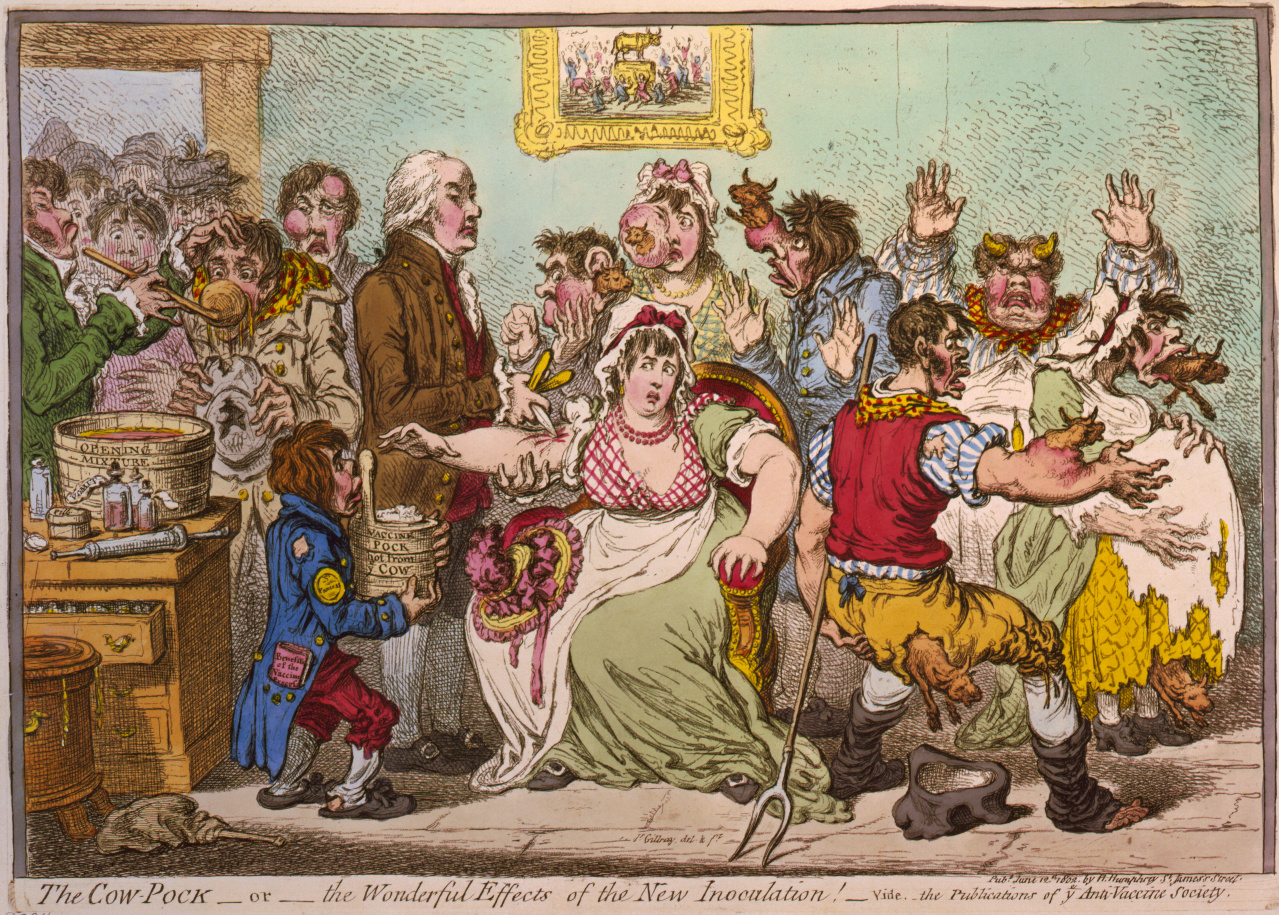
| From the Wikipedia: An 1802 caricature by James Gillray depicting the early controversy surrounding Jenner's vaccination theory |
 |
| Order here |
In 1798, Edward Jenner developed the first successful vaccine -- it was an inoculation against small pox. Jenner had noticed that milkmaids who had caught cow pox from their proximity to their cows did not come down with small pox. Variolae Vaccinae means small pox of the cow, and that is what the word vaccine derives from. The term vaccination to mean cow pox inoculation was coined in 1800 by Richard Dunning, a friend of Jenner's.
However, before vaccination came into vogue, inoculation against small pox was already practiced. While many lives were undoubtedly saved due to inoculation, there was also a sizable percentage of people inoculated who died of it. Among them was the great theologian Jonathan Edwards, the great grandfather of our heroine, Theodosia Burr Alston. He died of an inoculation he received in 1758.
How did this death affect the history of the United States? It left Aaron Burr four times an orphan. First he lost his parents to small pox. Then he lost his grandparents to a small pox inoculation. And finally, he lost his faith. For he concluded that you were damned if you do and damned if you don't.

There is an inherent risk in everything we do. It is risky not to vaccinate, because people do succumb to disease. But it is also risky to put all your trust in the medical establishment of the day, because they can't guarantee us a happy outcome. While vaccines may be safer today than they were in the past, there is always some risk. The idea of eliminating all risk is impossible.Sometimes people die because they were not vaccinated. Sometimes they die because they were. That is why people need to weigh the options for themselves and decide which risk they are most willing to live with. The right answer for one person may not be the right answer for another.
Even a theologian like Jonathan Edwards can be brought low by inoculation, and the implications of such a death affect entire families, and the legacy they leave to their nation. Fire and brimstone is what he preached. But sometimes you're damned if you do and damned if you don't.
How did this death affect the history of the United States? It left Aaron Burr four times an orphan. First he lost his parents to small pox. Then he lost his grandparents to a small pox inoculation. And finally, he lost his faith. For he concluded that you were damned if you do and damned if you don't.
There is an inherent risk in everything we do. It is risky not to vaccinate, because people do succumb to disease. But it is also risky to put all your trust in the medical establishment of the day, because they can't guarantee us a happy outcome. While vaccines may be safer today than they were in the past, there is always some risk. The idea of eliminating all risk is impossible.Sometimes people die because they were not vaccinated. Sometimes they die because they were. That is why people need to weigh the options for themselves and decide which risk they are most willing to live with. The right answer for one person may not be the right answer for another.
Even a theologian like Jonathan Edwards can be brought low by inoculation, and the implications of such a death affect entire families, and the legacy they leave to their nation. Fire and brimstone is what he preached. But sometimes you're damned if you do and damned if you don't.
