Showing posts with label Vacuum County. Show all posts

Thursday, April 19, 2018

Throwback Thursday

Once upon a time, decades and decades ago, I was a law student living in Waco, Texas.

A picture from the yearbook.
I was a good student, but I had poor social skills, and I often was innocent about what was going on all around me. For instance, I had no idea that there was a religious community just outside town that would someday be the victim of a Federally orchestrated massacre.

I was interested in constitutional law and the provision in the Texas Constitution against taking from one and granting another.

https://hubpages.com/politics/Taking-from-One-and-Granting-Another-Substantive-Due-Process-in-Marital-Property

Eventually, I would write a novel partly inspired by the vibes I got in Waco, Texas, without knowing how real the story I was inventing would turn out to be.


Today is the 25th anniversary of the massacre. Flags are at half mast in all Federal buildings. But it is not to mourn the fallen at Mt. Carmel. It's just a coincidence. It means nothing.

Some of the flyers I disseminated while in grad school at Rice

Saturday, February 10, 2018

The Interview with Julia Hanna about Vacuum County with Kelly Clear

Julia Hanna recently interviewed Kelly Clear and me about Vacuum County. It was via livestream, and each of us were live on our own channels. Here is the finished interview.


One of the insights from this interview: If you enjoy science fiction, there's a good chance you will like Vacuum County. For more insights, watch the entire interview. And here's a tip: the closed captioning on YouTube is really good. So if you are having trouble hearing any one of us while we talk or cannot understand something because were are interrupting each other, you can always turn on the cc and get a written version of what was said.


Kelly Clear: "[If you] enjoy sci-fi there's a good chance you will like Vacuum County."


To order the Audible version of Vaccuum County follow this link.  Or go to Audible.com and search for Vacuum County.

Vacuum County on Audible -- Get it now

Tuesday, January 30, 2018

You, too, Can Get Audible Vacuum County

On the 24th of January, an event was held at our Village computer center to help people learn how to download Audible Vacuum County. In preparation  for that event, I made a few videos to explain what Audible is and how to download the free book


My interest in Audible began with F.L. Light, so it was only right that my demonstration of how Audible works began with his translation of the Iliad. But as I thought more about it, I realized that the reason Light preferred to listen to Vacuum County rather than to read it with his eyes was his almost archaic insistence that poetry and literature are best appreciated as oral culture. However, the need for a simple tutorial about how to download a free book became apparent as the event approached.


The above tutorial was available on each computer at the computer center on the day of the event.


After the event was over, I shared the recorded livestream with Bow, so that he did not miss anything.


If you are reading this at home, you, too, can see everything that happened. And you, too, can get a free copy of Vacuum County.

Buy Now!


Saturday, January 13, 2018

New Publicity for Vacuum County

Kelly Clear and Audible Vacuum County have been in the news again.

Kelly Clear in the Grant County Journal 
This makes the second news article about Audible Vacuum County since it came out. I have compiled highlights of the clippings as a video, here:


I loved the way Vacuum County was characterized as a Western novel in the article by Kim Jorgensen in the Grant County Journal. I also noticed that she used the same font as the one in the title on the book cover. Since I have been having such trouble with genre identification, I really want to embrace the Western characterization. I even rethought how I might identify some of my other novels in terms of their position on a compass rose.


If Vacuum County is a Western, then Our Lady of Kaifeng  is an Eastern, in which case Theodosia and the Pirates must be a Southern, and that makes The Few Who Count a Northern.


Vacuum County really is a Western, if you take the long view of it. It is a Western in the same sense that the word "Western" is used in "History of Western Civilization". 

Wednesday, December 27, 2017

Two Ways to Get a Free Copy of Vacuum County on Audible

I was talking with someone yesterday about the new Audible Edition of Vacuum County. Having read the great coverage that we got in the Licking News, this person wished me success in my new endeavor. "You can get a free copy of it on Audible," I pointed out.

"What is Audible?" that person asked.

 And then I realized: Even someone who has read all the publicity, has seen the great video of the Making of Audible Vacuum County, and who wishes me all the greatest success in the world might not know what it is that I'm talking about. So I decided to try to explain it here.

What is Audible?

Here is a Wikipedia article about Audible:

https://en.wikipedia.org/wiki/Audible_(store)

While Audible started out independently, it is now a subsidiary of Amazon.

Here is a salient excerpt from the Wikipedia article:

Audible's content includes more than 200,000 audio programs from leading audiobook publishers, broadcasters, entertainers, magazine and newspaper publishers and business information providers.[30] Content includes books of all genres, as well as radio shows (classic and current), speeches, interviews, stand-up comedy, and audio versions of periodicals such as The New York Times and The Wall Street Journal.
In addition to the regular price charged for audiobooks, Audible offers subscriptions with the following benefits:
  • Credits: For a monthly subscription fee, a customer receives one or two audio credits. Most titles can be purchased with one of these credits. Some titles (usually larger books or collections of more than one book) may cost two credits, while others (usually very short works) cost only a third of a credit. (Users may also purchase a year's subscription at a time, for a discount, receiving all credits at once, but only in some countries.) Platinum subscribers also receive a complimentary subscription to the digital audio version of The New York Times or The Wall Street Journal.
  • Subscriber Discount: A subscriber may choose to purchase additional books without credits for a 30% discount.
Additionally, some content—particularly political speeches, government hearings, content such as the 9/11 Report Speech, excerpts, and short stories from books—are available for free.

How to Get a Free Copy of Audible Vacuum County 


There are two ways to get a free copy of Vacuum County, read by Kelly Clear on Audible.

https://www.audible.com/pd/Fiction/Vacuum-County-Audiobook/B078HSY28Z

1) For Audible Virgins: Join Audible and choose Vacuum County as your first, free book. Everyone is eligible.

2) For Audible Veterans: Ask Aya or Kelly to give you a free code. (There's a limited number of those, so show us that you write reviews.)


https://www.amazon.com/Vacuum-County/dp/B078HCL1MP

How to Prove You Review Books

If you are an Audible Veteran, please show us that you have reviewed some of the books you have listened to. There are two places where people typically review Audible Books.

1) On Audible

On Audible, when you review a book, they ask you questions, and you answer them. Here is an example of a book I reviewed on Audible.

http://www.audible.com/listener/A3PI5K5WPPW2PN?ref=a_pd_Classi_c15_rvlsni_2&asin=B00CZD294A

I don't know whether they don't trust people who listen to audiobooks to be able to write free style reviews, but on Audible, even if you are not the world's most prolific writer, they will prompt you with questions to cover the basic facts about the audiobook, including a separate critique of the content and of the reader.

2) On Amazon

On Amazon, you can write whatever you want, covering whatever aspects of the book that struck you. Here is an example of an Audible book that I reviewed on Amazon.

https://www.amazon.ca/Iliad-Unabridged-Audible-Homer/dp/1494770741#customerReviews

If you publish a lot of reviews on Amazon, send us a link to your reviewer profile. Here is mine:

Aya Katz, Amazon Reviewer

You might need to be signed in at Amazon to see that page. Amazon is very secretive, and not all my reviews show up on my reviewer page, nor can you get to my reviewer page from each of my reviews. The reason for this is not entirely clear.

Summary

Audible.com is a site owned by Amazon that specializes in Audiobooks. You can get a free copy of Audible Vacuum County there. If you have never joined Audible before, then you don't need to ask me and Kelly for anything. You can just choose Vacuum County as your first book and get it free. If you are already a member at Audible, show us that you write reviews, and we will send you a code you can use to get the book for free.

Any questions? Feel free to ask them in the comments.

RELATED


Biographical Vignettes


Here are some interesting Facts about Kelly Clear, who is the narrator of Vacuum County.


Here are some interesting facts about me:


The Making of Audible Vacuum County:


Monday, December 4, 2017

Conjuring Up Memory and Imagination

Do you remember your past, and if so, how do you remember it? Can you smell the cookies baking, or see the flies buzzing on the manure? Do you hear the voices of people who are long gone or feel your mother's touch as she fed you your oatmeal or soup before you were allowed to wield a spoon? Can you remember word for word an entire conversation that happened decades ago? And even if you don't actually remember, can you dig deeper into something that happened a long time ago and bring back dormant memories? Is it like re-watching an old episode of a favorite TV show, which you had forgotten all about, but now recall vividly?

My grandmother Klara, myself, and my grandfather Benzion Katz

Not all people have that kind of memory. Some can know things from the past, the same way we know historical facts, without having access to an image or a sound or a sequence of events that led to the conclusions that were drawn from the experience. Without access to the life event that led to a particular belief, it is not even possible to go back and reassess our conclusions.

Today, I posted an old memory of an interaction with my grandfather many years ago.


Without an episodic memory, I could still have told you about how old I was when I started reading, or where I learned English, but I could not have described the vivid experience of knowing how to read and being told not to read out loud what was clearly written on the page. I could not have remembered the pointer, or my grandfather's voice.

Today I came across an article about how some people can't see pictures in their imagination.  As a result, they might not enjoy reading fiction, and they might not be able to visualize objects at will. But I think this is not strictly an issue of visualizing. I think some people cannot re-experience any sensory memories in the sequence in which they happened. They can remember what an apple looks and tastes like well enough to recognize an apple the next time they see it, but they have no memories of specific apples, and how they felt and tasted, and who gave them those apples.

I know there are some people who enjoy nonfiction, because they feel it is factual and that they gain knowledge from it, but they get nothing whatever out of fiction. If the facts in the books are all made up, why even bother to memorize them, they think. But we don't set out to memorize fiction. The whole point is to experience it as raw events in the making. Then we are free to draw our own conclusions. We don't have to agree with the narrator, who may or may not be reliable

While it's true that nonfiction has an authoritative voice, it often presents us with fewer facts from which we may draw our own conclusions. Every news source is biased, and unless we learn to read between the lines, accounting for the idiosyncrasies of the unreliable narrator, then we are stuck with all our thinking done for us by somebody else.

I have never liked that. That's why I am not going to sit around watching the news, whether the source is CNN or Fox. I would much rather ferret out the truth for myself, by paying attention to the tell-tale facts that show up in my peripheral vision while I am experiencing life. And since I have great episodic memory, I can replay old episodes in my mind's eye years after they happened, until I can get a detail that escaped me before to come into focus.

The virtue of Vacuum County is that we can experience the story from multiple points of view. All of them are biased, but together they help us to build a consistent image of the truth that each narrator cannot help but also share. All people lie. But all people also tell the truth, if you know how to listen. Vacuum County is good training. Listen to Kelly  Clear tell you the story, and close your eyes to see what images your mind conjures up.


Friday, December 1, 2017

The Christmas Shopping Countdown

It's December already! This year, my marketing focus has been mostly on Vacuum County. That's because the Audible Edition of Vacuum County will be released very soon.

To buy the book -- click here    To buy the shirt -- click here


Here is a short  vignette of Kelly Clear, talking about his formative experiences with reading out loud.


I really hope you will give Audible Vacuum County a listen, even if you have already read the book. But while we wait for the release, you might consider one of my other books. You don't have to read them all. You could just choose one!


RELATED

Friday, November 24, 2017

The Long Distance Collaboration that Led to Audible Vacuum County

Those of you have been following this blog may remember that earlier in the year, I was very preoccupied with the death of the poet F.L. Light. 

I wrote about Light, my expanding view of him over time, and how I found out about his death. Then I wrote about what had happened to his works online after his death.

Shortly after that, I started to talk about Kelly Clear and my collaboration with him over an Audible Edition of Vacuum County.

Kelly Clear, laughing

For anyone who might be interested in how these events are connected, and how I found such a great voice artist and musician to help me with this work, here is a video that explains everything. For me, it was serendipity, pure and simple.


If you would like to read Kelly Clear's review of Vacuum County, here it is. It's there with all the others. Right below it is the review by F L Light, entitled "Aggressive Hospitality."

Buy it now


Monday, October 23, 2017

Why Nabal did not Testify Against Verity


Because life is complicated, and in the interest of fairness, it might be a good idea to examine the other side of the coin. Can women rape men? Does it happen? And why is it so rarely reported? It has to do with honor and courage and proof. It has to do with social norms and the legal system.

But it's not something that can be easily fixed, by passing another law, because ultimately it has to do with sexual desire, the limbic system, and our own struggle as individuals, not just with concepts of personal sovereignty, but with the mind-body problem. We are not just our minds, We are not just our bodies. And our minds and our bodies do not always agree.

Stranger rape is clear cut and obvious, but even there, victims have been known to be burned by the burden of proof. Date rape or rape in relationships is much more messy.  And quite often, rape ends up getting ratified after the fact.

As an attorney practicing in Texas in the 1980s, for instance, I learned that bringing up a non-consensual sex act that occurred thirty years earlier between a husband and wife, at a time when it was not a crime, was not allowed as evidence of cruelty in a divorce action. The victim was deemed to have waived the right to withhold consent when she entered the marriage. If she stayed in the marriage for thirty years after the act happened, she was deemed to have waived her right to complain about it even in a divorce.  Today, when the current law says you cannot waive any of your rights when you enter a relationship, there are ways in which, by their actions afterwards, people end up ratifying an act that was done without their consent.

To complain about it afterwards opens up a very real possibility that you will be slapped with a defamation action. But even more than that, there is the issue of whether the body and the mind were of one accord, and who exactly are we? Are we the mind who said no, or the body that said yes? This is the issue that makes rape one of the most difficult crimes to investigate.

Bruises do not necessarily mean it was a rape. Not having bruises does not necessarily mean it was not a rape. Lack of sexual receptivity does not prove rape. Sometimes people consent verbally and mean it with all their heart, but their body does not cooperate. Sometimes people do not consent, but do experience arousal. The mind-body dichotomy is very real when it comes to sex. If you report a rape, then all of what happened must be described in open court, and it can be very demeaning to the victim, especially when it involves arousal. If it is not reported, but the victim later talks about the event in public, then a suit for defamation can be brought, and the burden of proof under common law shifts to the defendant to prove the allegation is true.

In the "good old days", long before "sexual liberation", many people avoided rape by not getting into ambiguous situations where proof would be difficult to come by, because they understood that the burden of proof would be on them if they were raped. They did not complain decades later about a rape they had not had the courage to report at the time, because they understood this would open them up to legal action. They didn't talk about it nearly as much as they do today, but I don't think that meant that rape was more rampant a problem.  If a rape did occur, this might lead to a duel, not a lawsuit. I happen to think that dueling is a very good deterrent to both rape and defamation.  I don't think we have made it any better or any less likely to happen by all the mandated anti-rape and anti-sexual harassment seminars that young people are being forced to attend on college campuses today.

When rape happens to a woman, there is more sympathy. If it happens to a man, we are conditioned to be dismissive. I think that's wrong, but it may be inevitable due to the nature of the act, and the  undeniable inequality of the sexes in matters of basic physiology.

I'm not going to say much more about it right now. I'm not going to describe what happened between Verity and Nabal. I'm not going to justify a violation of the NAP that did occur in the story, but that was definitely ratified afterwards. Buy the book and read it yourself, or get the Audible Edition, and listen to Kelly Clear act it out. I will just share two paragraphs from Nabal's letter to Verity written after the fact.


 Don't you think it's true for all of us? How else can they claim that our tax payments are voluntary? And aren't all peace treaties signed under duress?

To order Vacuum County, click here


Wednesday, October 18, 2017

Why Verity did not Testify against Abner

Vacuum County is, when superficially described, a story of a young woman who is falsely accused of DWI, because she refused the sexual advances of a crooked sheriff in a backward Texas community.

 We all agree that sexual harassment is bad. We all know that it happens. Frequently. We know that blaming the victim is not right. And that's quite possibly where what we all agree on ends. And because that's all we agree on, the practice will live on, long after all the present victims and perpetrators have died.

This is true, despite the fact that every so often a great and powerful man (like  Harvey Weinstein) will be brought low when the evidence against him is made public  -- evidence that everybody knew about for years, but that could not be acknowledged until some political events behind the scenes suddenly make the transgressor vulnerable.

We know why victims, like Verity Lackland in Vacuum County, don't testify in open court against their oppressors. We know they often make peace with the situation, because they are threatened with dire consequences if they do speak up.

A excerpt from Vacuum County


In Verity's case, her lawyer, David Smith, advised her to plead no contest to the false charges, because a Vacuum County jury would have ruled against her.Was it right of Verity to take her lawyer's advice?  Was she a coward not to speak up?


An excerpt from Vacuum County


Nabal thought so. Sometimes it takes a victim to know a victim. Sometimes it takes a truth speaker to recognize another true witness. Sometimes everybody who is nice to us and takes our weaknesses for granted is in league with our oppressors, while the only person who makes us feel ashamed is the one who knows we have a soul.

The reason Abner was untouchable at the time was that he served as the right hand man of the County Judge, Saul Jones. But as soon as David Smith was the new County Judge, Abner became vulnerable. By then, Verity had already made her peace with situation, and was serving as Nabal's slut.  When she was asked to testify against Abner, she was reluctant, but for a different reason from the one she had had before.

An excerpt from Vacuum County


There is a time when testifying against a perpetrator would be brave. That time is when he has the whole power of the establishment behind him, and toppling him would also make a dent in the power of those who put him in a position to hurt others. When he is alone and vulnerable, and the people in power just want to use your testimony to bring him low, because it suits their plans, then it is no longer brave.

An excerpt from Vacuum County

There is a time when we can make a difference by speaking up. Doing so at that time would be brave. There is a time when we can be a tool in powerful people's hands, just like a skewer at a barbecue, and then testifying becomes not so brave. In the end, Verity didn't have to testify, because Joe found another way to get rid of Abner, so that he could become the new sheriff.

Sometimes a Democrat is in power, and he uses that power to abuse people, including women. Sometimes a Republican is in power, and he uses that power to abuse people, including women. Sometimes it's just a rich man who has a stranglehold on an industry you want to work in. And some will submit to get in. When the person in power changes, or when somebody is brought low for reasons that have nothing to do with justice, that is probably not the time to revel in exposing him, especially if you got something out of submitting. Why? Because at that time, it is no longer brave. It can be just plain sadistic.

As for telling our personal story of being abused to others, there are times when people do that just to relieve their emotional suffering or to let off steam. It's okay to do that. It's your story, and you can tell it wherever and whenever you want. But if you don't name names, it's not brave. And if you do name names, then you have to be prepared to prove it.

Yes, the history of mankind is full of slavery and abuse and rape and bending the knee to an oppressor, because we are scared. There is shame in that -- for all of us. We need to find the courage in ourselves and in each other to put an end to it. But it's not helpful when we are just making a display of it, and business as usual is what is actually afoot.

Monday, September 4, 2017

Nabal's Psalm

The Audible Edition of Vacuum County is soon to be released.


One of the last major items to be recorded by Kelly Clear is what I like to refer to as the Nabal Psalm.


When we hear complaints against our fellow man, that they are not doing right, we often stand in judgment of the person complaining. Doesn't he have anything  better to do with his time, besides criticizing other people? Is he so  blameless himself? By what right does he judge others? And how could something so filled with rancor possibly get labeled a psalm? "That's a psalm?" you are probably thinking to yourself, "How is that a psalm?" It's so sad and hopeless, so angry and petty. No wonder nobody would sing that in Church! No wonder I've never even heard of this psalm.

But yes, it's a psalm, and it's in there, and it would be hard to understand why, unless you also read Samuel 1:25, the story of Nabal the Carmelite, who refused to pay protection money to David, when he was running from Saul.

What are the original words of this Psalm and what do they mean?

From my personal copy of the Old Textament, Psalm 14


The original psalm is very short. It has only seven verses. Here is a rough translation of each verse

  1. To the conductor, to David: Nabal said in his heart, there are no gods; they have cheated and abominated. There is none who does good.
  2. Jehovah looked down from the sky to see is there anyone who is skilled in seeking the gods.
  3. All strayed together, went bad, there is none who does good, not even one.
  4. Why, all the evil doers know the eaters of my people ate bread, did not call on Jehovah.
  5. There they feared fear because in a just generation there are gods.
  6. The counsel of the poor you will shame, because Jehovah is his shelter.
  7. Who will give from Zion the salvation of Israel, on the return of Jehovah to dwell with his people? Jacob will be joyful and Israel happy.
This is not exactly the translation most English speaking people have read.  In most translations, the word נבל is translated as fool, the word אלהים -- which is a plural form of a word for a  god -- is translated as God, and the name Jehovah is not rendered as Jehovah, but as "the Lord". The result is that many of the distinctions being made in the original text become opaque.

Here is King James' version:


14 The fool hath said in his heart, There is no God. They are corrupt, they have done abominable works, there is none that doeth good.The Lord looked down from heaven upon the children of men, to see if there were any that did understand, and seek God.They are all gone aside, they are all together become filthy: there is none that doeth good, no, not one.Have all the workers of iniquity no knowledge? who eat up my people as they eat bread, and call not upon the Lord.There were they in great fear: for God is in the generation of the righteous.Ye have shamed the counsel of the poor, because the Lord is his refuge.Oh that the salvation of Israel were come out of Zion! when the Lord bringeth back the captivity of his people, Jacob shall rejoice, and Israel shall be glad.

The key to understanding the poetic works in the Bible is parallelism. These poems like to say the same thing at least twice, each time in a different way. The contrast helps us get a new perspective on a familiar problem.

The first verse in  Psalm 14 is parallel to the second in the following way: The first is the judgment of a particular man (Nabal) upon God or the gods. The second is the lamentation of a particular god (Jehovah) on being forsaken by the people -- or rather, his people. (Every god has a people, and the people assigned to Jehovah are called Israel.)

 The contrast between the lament of  a man about the absence of his god, and the lament of a god, against his people who have strayed, is what makes this poem intriguing. Have you ever heard women complain there are no good men to be had, and men complain that there aren't any women? It's kind of like that. Gods need men to worship them, and men need gods to help them do right. But sometimes they have trouble finding each other. This isn't a psalm about atheism. It is about how the people of Israel and their local god should turn to one another in their mutual hour of need. It's about how true love leads to happiness.

 What makes it difficult to see this parallel between gods and men and their mutual dependence in the King James translation is that certain words are substituted for other words.

Nabal  (naval נבל), as a word, does not mean "fool". Knave maybe, or rogue or rotter, or villain,  but not fool. The triliteral  root of the word has the meaning of  "to rot or to wilt." When Abigail says against Nabal that he is like his name, "a villain he is and villainy is what he does", she is referring to the name and the meaning at the same time. Now some question whether he actually existed, since who in his right mind would give such an unflattering name to a child? But it's possible that he was named for a lute (nevel  spelled נבל), and that this play on words was a pun.

Was there an actual Nabal?  The account in Samuel: I 25 describes him as a Calebite,  a descendant of Caleb the spy, son of Jephunneh, (כלב בן יפונה),  and thus a Kennizite (קניזי), actually having origins in the land of Canaan long before Exodus. In other words, Nabal had deep roots in the land, and he remembered the old ways. His claim to the land is as good as anyone's, and yet he does not ask for much, except to be left alone. To him, both Saul and David seem like upstarts, and he wants no part in their quarrel.

When Nabal refused to pay David protection money, there was no claim on his part to the throne. He merely remarked that there were many breaking away from their masters nowadays. And he was not going to give the victuals that he had prepared to feed the men working for him to those who came from out of nowhere, demanding payment.

Is Nabal the Carmelite the same Nabal as in Psalms 14? I'm not the only one who thinks so. Look what I found here:

http://douglasdwebster.com/2017/01/19/psalm-14-nabals-psalm/

The difference between the usual outlook on Nabal and mine is this: I'm a libertarian, so I believe that we shouldn't hurt people or take their stuff.  I don't blame people for refusing to  pay protection money, and I don't praise the women who betray them.

Did David write Psalm 14? I don't think he did. But there is internal evidence that the  Psalm is oddly edited, and I like to ascribe at least that part to David.

To learn more about Nabal and Nabal's Psalm, read or listen to Vacuum County on Audible.


Friday, August 4, 2017

The Name of the Cow


[This is a vlog post in which the words are transcribed from the video embedded below. ]


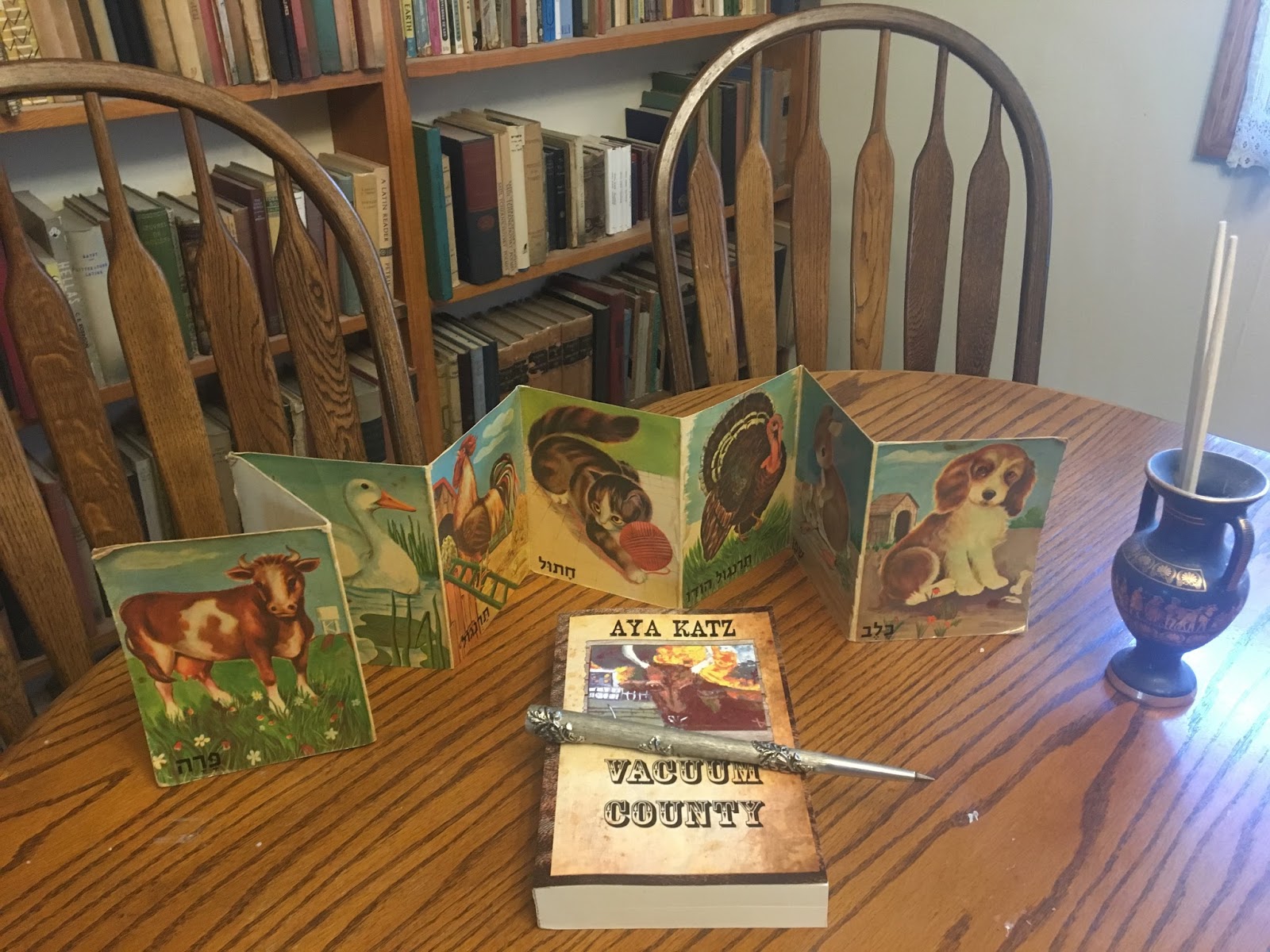
One of the early influences that may have led me to come up with Vacuum County, one that I've never thought of before, is this book from my childhood.


This is Vacuum County.

Buy it here!

And this is the book from my childhood.


Actually, this is the front of it.


It's one of those accordion books that have lots of pictures of animals. And I had it when I was a baby.


And so there would be a picture of a dog. And it would say כלב.


And there was a picture of a bunny. And it said שפן. Although a lot of people say you should say  ארנב instead of שפן. And there was a picture of turkey, and it said תרנגול הודו.


There was a picture of a cat, and it said  חתול. There was a picture of a rooster, and it said תרנגול.


And there was a picture of a duck and it said ברווז. And there was a picture of a horse, and it said סוס.


And then there was a picture of a cow, and it said פרה.


Well, my mother, when I was about eighteen months old, and this is not something that I personally remember, but it's something that my mother told me about, she was trying to see whether I could read or not at eighteen months.  So she pointed right here, and she said: "Aya, what does this say?" And I said: "פרח   ".פרח means flower.  And I thought that she was pointing to the flowers that are right here in the grass by the cow.


Okay. It just so happens that the word for פרח (flower) and the word פרה, which means cow, well, they have the first two letters in common. And the last letter, the  ה in פרה would be a ח in פרח. So my mother said: "Oh, wow, that's so close! You're almost reading."

Of course, I just thought that she was pointing at that flower. And then, of course, she realized that I was looking at the flower and not the word.

Anyway, this illustrates that cows have always played a part in my literacy, and that literacy has always played a part in my life, and that misunderstanding small things about words can have big consequences. So all of that may have been a subconscious influence on Vacuum County. 

Monday, May 8, 2017

2017 Appearance, Review and Bio


I will be a featured speaker, along with Will Coley and Bill Redpath at the 2017 Missouri Libertarian State Convention on July 22, 2017 in Jefferson City. My topic will be "Show Me What You want to Tax and I Will Show You What You Will Destroy."

I am very excited about this opportunity, Meanwhile, though we did not get a public celebration of the 200th anniversary of the  founding of Galveston this April, a new review of Theodosia and the Pirates: The War Against Spain has come out this year by a Top 100 Amazon Reviewer.


There is also an new biographical entry in the LPedia about me as a libertarian author.


For me, 2017 will be a year not for writing new books, but for speaking out about the books I have already written. The new audio version of Vacuum County as read by Kelly Clear should be out in late August. And perhaps for the first time, my writings will have a clear genre designation in which they legitimately belong: libertarian.


Monday, April 17, 2017

Memory Aids: Prose Poetry and Song

I am very excited about what Kelly Clear is adding to the experience of reading Vacuum County.  I am not a big fan of Audible books myself, because I like to look at the words in a book as I read it. You might say I am more of a visual learner. But there are some things that need to be heard to be understood and remembered. Poems are meant to be said out loud. Songs should be sung.


I was sharing this video of the song "Down by the Crick" from Chapter 3 in Vacuum County with a friend who had read the book many years ago. "That's nice," she said. "But I don't remember that there was a song in the book." Well there were the words to the song. And David was described singing it. But it depends on how you read books whether you are likely to remember that.

If you're reading visually, it's easy to miss that something is a song. I mean, it's obviously not prose. And it says in the story that David plays the guitar and sings it. But if you only kind of sped past that part in your reading and only tend to remember "what happened" in the chapter, then you are unlikely to remember the song at all.

Most people use episodic memory  for specific vivid events and rely on semantic memory to sort out the overall narratives of their lives, but they don't remember anything that they read in a novel word for word. By the same token, few people have episodic memory for dialogue in real life.  Much of the information that we acquire through experience is stored as semantic memory, without the moment by moment experiences that gave us the information. In the same way, if we read a book, and it made any kind of impression, we might later be able to describe what happened in the book as a general synopsis of the action, or we might be able to say what we may have learned from the book, but nobody expects us to remember all the words in the book in the right order. If we could do that, there would be no point in copyright laws. Everybody would have a copy of each book he has read stored in his head and would be able to read it off for other people at a moment's notice.

But when you hear a song played or a poem recited, this creates an episodic memory of it word for word, and not just a summary of what the song was about. Read it out loud several times or hear it played and re-played, and you'll remember it forever. That is the genius of poetry and song. 

When new readers experience Vacuum County through the medium of the Audible book produced by Kelly  Clear, they are  going to remember certain passages as if they had lived through the experiences themselves. The songs sung by David will come to life!

File:Frans Hals - Luitspelende nar.jpg


Image: By Frans Hals (1582/1583–1666) - André Hatala [e.a.] (1997) De eeuw van Rembrandt, Bruxelles: Crédit communal de Belgique, ISBN 2-908388-32-4., Public Domain, https://commons.wikimedia.org/w/index.php?curid=2774146

Monday, February 20, 2017

The Possibilities at Audible for Vacuum County

I was thinking of F.L. Light and how much better his Audible books were faring than his print books, when help came from an unexpected quarter. Kelly Clear, a vocalist who has been singing some of the Debt Collector songs, sent me a very nice reading from Vacuum County. It just happened over this weekend, and voila! here is a short demo.


Vacuum County is my most critically acclaimed novel. However, it is not my best seller. Over the years I have made a few videos about it. There is, of course, this trailer that emphasizes the Phoenician connection.


There is also this short discussion about the Biblical inspiration for the book.


And here is the video in which I discuss how realizing that Cabeza de Vaca had to be Nabal's ancestor led me back to my book report on  Hannibal of Carthage by Mary Dolan. .


And there is also the video in which I discuss the connection to the Branch Davidians in Mt. Carmel, Texas.


There is also one video filmed outdoors in the outer pen in which I am proofing Vacuum County and reading it out loud. but we are interrupted when Leo, who was just a puppy at the time, was whining for attention, and I had to get Bow to agree that I would go help Leo. We also still had chickens at the time. You can hear the rooster crow. But it does not make much of a reading.

I by far prefer Kelly Clear's readings to my own, and I look forward to working with him on a long term project on Audible to produce a full audio version of  Vacuum County. 


Order Vacuum County

If you want to order Vacuum County, I have provided the link above. Because if you just Google it, here is what you are likely to find:


Tuesday, March 4, 2014

Of Cows, Vaccines and Small Pox

Today we hear a lot of controversial statements about vaccines. Some people are dead set against them and think they are causing developmental delays in children. Others are gung-ho in favor of them, so much so that they want to sweep the inherent risks under the rug. And me? I want to know about the etymology.

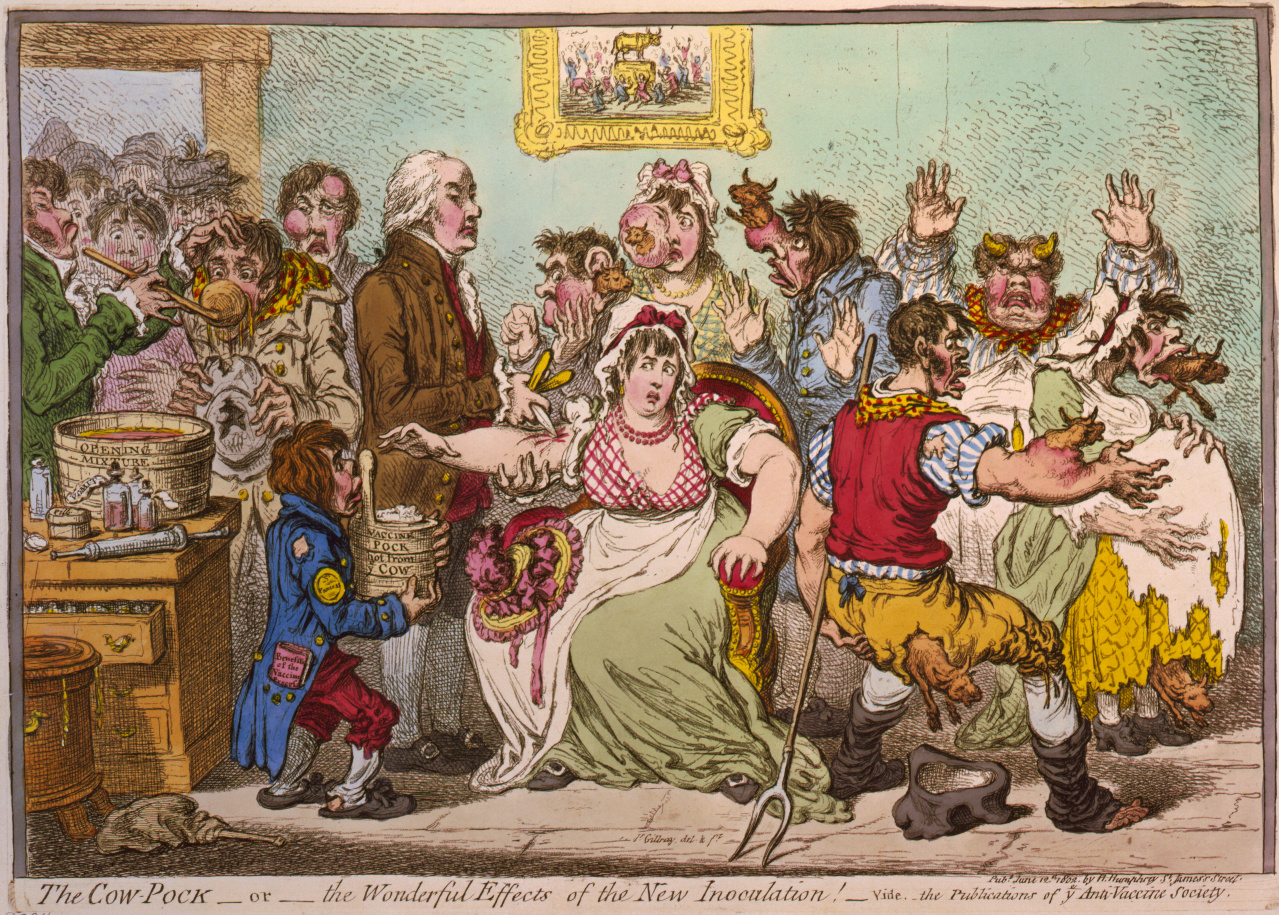
From the Wikipedia: An 1802 caricature by James Gillray depicting the early controversy surrounding Jenner's vaccination theory
I am a linguist, not a doctor. And I know from long experience that any latinate word starting with vacc- has got something to do with cows. I am so intrigued by this fact that I made it a major plot point in my critically acclaimed novel Vacuum County. (Critically acclaimed in this context means that none of the reviewers hated it.)

Order here

In Theodosia and the Pirates, I touched briefly on an important turning point in the history of inoculation. What was that turning point? The place in life where it was an option, but it was not yet required. It could save lives, and people knew that, but it was also risky. This was just before vaccination came out in all its glory.

In 1798, Edward Jenner developed the first successful vaccine -- it was an inoculation against small pox. Jenner had noticed that milkmaids who had caught cow pox from their proximity to their cows did not come down with small pox. Variolae Vaccinae   means small pox of the cow, and that is what the word vaccine derives from. The term vaccination to mean cow pox inoculation was coined in 1800 by Richard Dunning, a friend of Jenner's. 


However, before vaccination came into vogue, inoculation against small pox was already practiced. While many lives were undoubtedly saved due to inoculation, there was also a sizable percentage of people inoculated who died of it. Among them was the great theologian Jonathan Edwards, the great grandfather of our heroine, Theodosia Burr Alston. He died of an inoculation he received in 1758.  

How did this death affect the history of the United States? It left Aaron Burr four times an orphan. First he lost his parents to small pox. Then he lost his grandparents to a small pox inoculation. And finally, he lost his faith. For he concluded that you were damned if you do and damned if you don't.


There is an inherent risk in everything we do. It is risky not to vaccinate, because people do succumb to disease. But it is also risky to put all your trust in the medical establishment of the day, because they can't guarantee us a happy outcome. While vaccines may be safer today than they were in the past, there is always some risk. The idea of eliminating all risk is impossible.Sometimes people die because they were not vaccinated. Sometimes they die because they were.  That is why people need to weigh the options for themselves and decide which risk they are most willing to live with. The right answer for one person may not be the right answer for another.

 Even a theologian like Jonathan Edwards can be brought low by inoculation, and the implications of such a death affect entire families, and the legacy they leave to their nation. Fire and brimstone is what he preached. But sometimes you're damned if you do and damned if you don't.