Showing posts with label slavery. Show all posts

Tuesday, May 12, 2015

Lord Kitchener, Inventor of the Concentration Camp

World War II is the war that made us focus on the evils of the concentration camp. But there were concentration camps long before then. The English term "concentration camp" was coined by Lord Kitchener during the Second Boer War.

Horatio Herbert Kitchener
1850-1916
The Second Boer War  took place from October 11, 1899 to May 31, 1902 between the South African Republic, also known as Transvaal Republic, and the United Kingdom. During the war, as part of their scorched earth policy, the British placed South African civilians, most of them women and children, in concentration camps. They established separate camps for white Boers and black Africans, but conditions in both types of camps were equally appalling. Over 26.000 women and children died in the concentration camps, many of them from starvation.

Lizzi van Zyl suffering of malnutrition in a British Concentration Camp

It is quite possible that the idea for the Nazi concentration camps came from observing  the British example, though it is not really the case that the British intentionally set out to exterminate a whole race of people. Instead, the concentration camps were badly administered, and there was not enough to eat.

Today, people avoid using this term for camps that they want to have others think well of. They talk about "central relocation centers" or some other euphemism, due to the pejorization of the terminology from the previous century. But at the time, when the term "concentration camp" was newly coined by Lord Kitchener, it was meant to seem like a humanitarian effort to accommodate dislocated enemy civilians, rather than just letting them perish or selling them into slavery.

Boer Women and Children Entering a Concentration Camp
In ancient times, when civilian populations were being subdued during a war, most of the men were killed and the women and children were sold into slavery. As a result, the survivors were seen as valuable commodities to be exploited, and slaves were usually well fed. But as soon as enemy civilian populations stopped being something valuable that you could use or sell off for gain, that's when they became a complete liability. Even when nobody was intending to kill them off, they were locked away and not enough food was requisitioned to feed them, since there was no benefit to their captors from doing so.

People in a concentration camp are not free, but they are also not slaves. They might actually fare better if they were slaves. Their situation is unbearable precisely to the extent that no one sees them as being of any use.


Monday, March 23, 2015

Can Jean Laffite Ever Be Forgiven for his Part in the Slave Trade?

I was talking to a friend about what can be done to enshrine Jean Laffite as the American hero that he truly was. Some ideas that we bounced around is to get a scholarship or stipend endowed for graduate students in history, stipulating that their research topic be the accomplishments of Jean Laffite. Another much more modest idea was that an annual prize be awarded to high school students for the best essay about Jean Laffite.

My friend said that sadly it would be very hard to bring any of this about, because the very fact that Jean Laffite was involved in selling slaves precludes anyone from looking at him in a favorable light today.

George Washington had slaves. Thomas Jefferson had slaves. Even Jonathan Edwards, who did not own slaves, rented them by the hour when he needed his garden plowed. It was just the way things were.

Jean Laffite was not a slaver. He was a privateer. He looted enemy ships and sold the goods at auction. The fact that some of those goods happened to be human beings shipped as cargo is unfortunate, but not damning. He was a patriot, but not a saint.

The Laffites may not have been politically correct by today's standards, but I'll tell you what they were not: they were not racist. And the idea that racism was the only thing behind slavery in early  America is one of those misconceptions that needs to be put to rest.

There were not just black slaves. There were also white slaves. There were not only white slaveholders. There were also black slaveholders.

Pierre Laffite came as close to marrying Marie Villard as the law at the time allowed. She was a free black woman, and he bought her a house in her own name, a house where she was the mistress of all she surveyed. He also bought her a black cook to serve her.

These are the complicated realities of the time. I dealt with this issue directly in Theodosia and the Pirates: The Battle Against Britain. 


Slavery is a complicated issue in early American history. It deserves to be studied in a detailed and nuanced manner, without prejudice for or against any particular outlook. But right now it is being misrepresented to the public as only black and white, with no shades of grey.

In the process, everything good that Jean Laffite stood for is being ignored, just because he catered to all the market needs of the people of New Orleans and sold slaves at auction to both black and white buyers.

Sunday, March 8, 2015

Taiwan To Import Domestic Workers from Vietnam -- $7000 per Person

It is important when discussing the issue of slavery in modern times that we not focus on a particular ethnicity or nationality, such as people from Haiti, or on a particular use to which modern slaves are put, such as sex workers. If we do that, we sensationalize the problem and also reduce its significance. There is a market for people. All kinds of people, who can perform all kinds of jobs. At the same time as modern day first world countries are limiting the domestic market by setting minimum wages, working conditions and basic health care packages for their own citizens, there is a hunger in each of these countries for people to work at less than minimum wage performing jobs that need to be done, but nobody has enough money to pay for them in a market that is constricted by artificial demands set by law.

One of the biggest problems that first world countries are facing now and in the foreseeable future is that we have a glut of elderly people in need of domestic caretakers. High tech countries have low birth rates, and while this may seemingly make the standard of living of the average person higher than in those countries with a high birth rate, because people with fewer children are not burdened with many dependents, in the long run this leaves many elderly people with no one able to care for them in their dotage.

Not all elderly are wealthy, and despite all the social safety networks in place, many need help that they are not able to get without resorting to hiring an imported domestic worker who will accept reduced wages and working conditions. In Taiwan and in Israel, it is not unusual for elderly people to be cared for by workers imported from poorer countries for the specific purpose of becoming temporary "domestic caretakers". Notice that I am using the modern euphemism for what used to be unabashedly called "a servant." Servants and slaves have not gone away, but we distance ourselves from the concepts, by giving them new names.

Vietnamese workers in Taipei
http://www.taipeitimes.com/images/2015/03/08/P01-150308-a4.jpg

The difference between an ordinary servant and a slave is whether the service is voluntary. But how voluntary it is can be better gauged by how many runaways you have than whether there is an employment contract in hand. In Taiwan, according to the article linked below, there is a runaway problem with people imported from Vietnam,

http://www.taipeitimes.com/News/front/archives/2015/03/08/2003613033

Due to the loss of workers form Indonesia, Taiwan is considering lifting a ban on Vietnamese domestic workers, a ban that was initiated due to the high rate of "absconding" that was associated with Vietnamese workers, Why was there such a high rate of absconding?

Without reforms to guarantee vacation rights and adequate wages, absconding would likely remain common among migrant workers, Wu said, adding that brokerage fees for Vietnamese workers in Taiwan cost up to US$7,000 per person — the most expensive among all migrant worker-providing countries.
If we read between the lines and break through the doublespeak, here is the picture I get: People from Vietnam were being sold into the labor market in Taiwan at $7,000.00 a person. The "brokerage fee" went to someone in Vietnam, not to the worker himself. This is very similar to the indentured servitude model that we used to have here in the United States since Colonial times. Workers who  abscond are runaways. Today, the slave masters in Hanoy are offering to punish runaways more severely, and this makes the purchasers in Taiwan feel that perhaps the laborers they are planning on purchasing in the future will be more reliable.

People in Taiwan could try to solve this problem by passing more laws to protect indentured servants. Or they could do away with the thing that created this market for imported workers in the first place: the guarantees mandated by law for a minimum wage and benefits for domestic workers who are truly domestic.

A woman I saw on the streets of Taichung in 1998


There are poor people in Taiwan. I have seen them with my own eyes. But they never get these caretaking jobs, because the jobs go to people who have fewer guaranteed rights as to exactly what working conditions and salary and benefits they will have.


Saturday, February 21, 2015

Upward Mobility

A society with no upward mobility is said to be stagnant. When people are born into social castes and have no opportunity to improve their lot in life, the entire society suffers. Since ancient times, the ability for those at the very bottom of the social pyramid to move up has been one of the ways in which we gauge the health of the entire body politic.

Even societies where there are slaves demonstrate the value of upward mobility in their rate of manumission. For instance, in ancient Rome there was such a high rate of slaves being freed by masters that in 357 B.C. the State decided to capitalize on this and levied a five percent tax on manumission.

http://ancienthistory.about.com/od/romeslavery/qt/082707ManumiTax.htm

It is estimated that 1350 slaves were set free each year in Rome after the tax law was passed. It stands to reason that before passage of the tax, even more slaves were set free each  year, since every tax tends to diminish the activity on which it is based.

In early Colonial America, the tradition of manumission was also followed, and after being freed, some slaves became extremely successful, owning land, attaining to great wealth and even owning slaves themselves. For instance, Anthony Johnson was born in Angola in 1600 and was captured by an enemy tribe and sold into slavery to Arab traders. Johnson arrived as a black slave in Virginia in  1621 and was sold to a tobacco planter named Bennet. In 1635 Johnson and his wife Mary were set free. In 1647 Johnson already owned some property; records show he bought a calf. In 1651 Johnson acquired 250 acres. He now owned four white and one black indentured servants.

https://en.wikipedia.org/wiki/Anthony_Johnson_(colonist)

This is an example of extreme social mobility. Johnson did not merely go up one rung on the social ladder, from slave to free, but also several rungs, so that he himself was now on a social par with those who used to own him. This kind of rags to riches success story, of course, is not something that can happen to everyone in a given society, but that it can happen is very important to the social fabric, because it allows for hope of reward for dedication, ingenuity and hard work. It also shows every member of the society that nobody is guaranteed any position by birth, but that the roles to be played are fluid. Just as one person may rise, another may fall.

To the extent that the opportunity for social advancement is not available to all in any given society, it is much more likely that stagnation will set in, and that the motivation to try to achieve a better life for oneself will be lessened.

In the United States after the civil war, there were no more slaves, so the lowest rung on the social ladder now became the domestic servant. According to Nobel prize winning economist George Stigler, there was a premium on domestic service between 1900 and 1940, in that because it was seen as distasteful work, employers were willing to pay more for it than for other kinds of service.

This table is from piketty.pse.ens.fr/files/Stigler1946.pdf 


People in domestic service were often foreign immigrants or poor blacks. One of the benefits of domestic service was that those who served eventually learned a lot about the culture of their employers and were then able to use the information acquired in order to better their social situation.


This quote is from Stigler 1946.2


So while the position of domestic servant was distasteful in many ways, it was a tool that ambitious outsiders used in their pursuit of upward mobility.

This table is from http://piketty.pse.ens.fr/files/Stigler1946.pdf


While some might assume that the freest society is one in which there is no social stratification, a lessening in stratification also leads to fewer opportunities for upward social mobility. For instance, in Table II above we can see that during the great depression which led to World War II, both in Germany and in the United States, and to a much  lesser extent in Great Britain, there was a drop in the employment of domestic servants.

Stigler makes an interesting conjecture about the sort of income distribution that allows for domestic service: "..the equality of the distribution of income, rather than the amount, may be a factor of considerable importance. A society with relatively many families at both ends of the income scale would provide both a large supply of servants and a large demand."  (Stigler 1946.7). What this means is that it does not matter how many dollars of income are involved, but the relative distribution of this income into high and low groups.  Unless there is a wide variety of incomes, there will be less social mobility. The more even the income distribution, the less social mobility will be available to anyone, and the more stagnant the society will become.

After World War II, domestic service in the United States went down and stayed down, with only the very wealthy having servants. The result is that very few people one meets today have ever been a servant or employed a servant. Servants are something we usually only encounter in fiction. Our society is much more egalitarian, and by extension there are also fewer opportunities for meaningful upward mobility.

Saturday, January 17, 2015

Slavery: Abolished and Still Ongoing

Making something people tend to do all on their own illegal usually makes it worse. If you make liquor illegal, then you bring on gangsterism. If you make drugs illegal, you create international drug cartels. If you make slavery illegal, then you drive it underground where no one can see and where the rules of common decency may not apply.

Slaves in America used to cost the equivalent of tens of thousands of dollars in today's money and were regarded as a valuable investment. Owners took care not to break them, in the same way that today we try not to wreck our cars, burn down our homes,  or crack the screens on our tablets and iphones.  Today, in Port au Prince, according to Benjamin Skinner in an interview with Terrence McNally, you can buy a slave for fifty dollars -- the price of less than a full week's groceries where I live. This makes the person bought entirely disposable.  A slave in Haiti today is worth less than an iphone. Siri, your electronic personal assistant,  is worth more than a girl bought and sold on the streets of the city where Jean Laffite grew up. This is not progress.

Here is the full interview:
http://www.alternet.org/civil-liberties/there-are-more-slaves-today-any-time-human-history


According to McNally, real slavery never ended, just the legalities have changed.

What exactly is slavery, then? Is it legal ownership of another human being? If this were so, than abolishing the legality would abolish the phenomenon by definition. But most of us understand in our gut that slavery is something that precedes any legal system -- that it is an ongoing relationship that gets regulated after it arises, just like marriage or the parent-child pairing. You cannot abolish it by passing a law, because the relationship precedes any legal definition. Slavery is not a legal fiction. Slavery is real.

Yet, in the interview I link above, Skinner says: "...we assume that once you abolish something, it no longer exists." Who but an idiot would assume that? This is exactly what is wrong with the progressive agenda, and this misunderstanding of how reality works predates the twentieth century. It was the nineteenth century abolitionists who are famous for this kind of magical thinking.

You might as well say: "Let's abolish human nature, and then all our vices will go away." Cultural attitudes shift. The words we use lose their meaning and new words come to take their place. But the basic facts of human nature do not change. The image below is of  a master (right) and his slave (left) from 350-340 BC in Sicily.
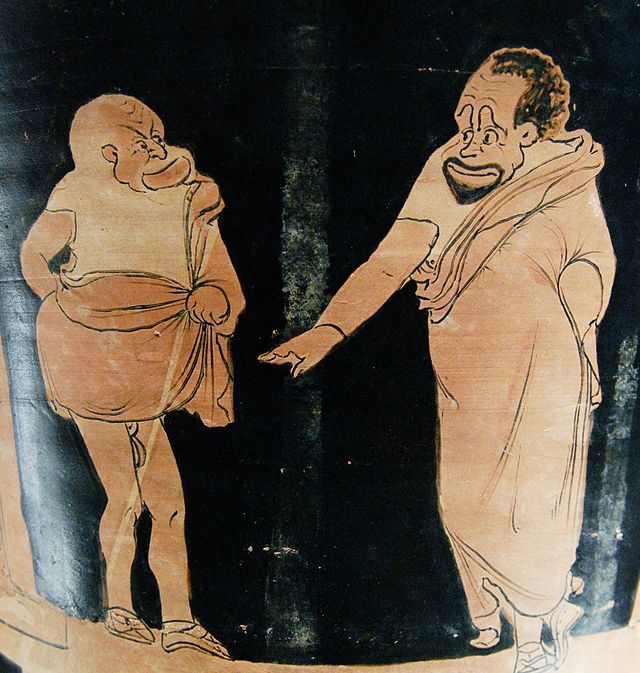

: "Phlyax scene Louvre CA7249"
 by English: Lentini-Manfria Group - Jastrow, own work, 2008-03-07.
 Licensed under CC BY 3.0 viaWikimedia Commons - https://commons.wikimedia.org/wiki/File:Phlyax_scene_Louvre_CA7249.jpg#mediaviewer/File:Phlyax_scene_Louvre_CA7249.jpg
Slavery is something that humans practiced since the earliest recorded history. It was present during pre-Biblical times; it was practiced in ancient Greece, and it continued throughout the Middle Ages and through the Enlightenment and on into modern times. The words and terms and concepts used to describe it have changed, but the thing itself has not.

One of the reasons we think we have made so much progress and have overcome our basic nature is that we tend to wear out the words we use to describe servitude and slavery, and when we use different words, we think we have solved the problem.

Over twenty years ago, I published a linguistics article entitled "Semantic Shift and the Concept of Servitude." In it I examined slavery, servitude and employment from both a linguistic and a legal point of view.

What is interesting is that sometimes the very same word that is used to describe abject slavery also serves  to describe public service of the most prestigious sort. Take this Biblical  quote:

כב  וּמִבְּנֵי, יִשְׂרָאֵל, לֹא-נָתַן שְׁלֹמֹה, עָבֶד:  כִּי-הֵם אַנְשֵׁי הַמִּלְחָמָה, וַעֲבָדָיו וְשָׂרָיו וְשָׁלִישָׁיו, וְשָׂרֵי רִכְבּוֹ, וּפָרָשָׁיו.  {ס}

22 But of the children of Israel did Solomon make no bondservants; but they were the men of war, and his servants, and his princes, and his captains, and rulers of his chariots and of his horsemen. 
In this excerpt from Kings I Chapter 9, verse 22, in the original Hebrew version, the word for what is translated in the English as bondservants and afterwards as just servants is the same: עבד.   (I have marked both instances  in bold above. They look different because one is singular and the other is plural with a possessive suffix, but it's the same lexeme.)

In today's English, servitude has been so degraded as an undesirable thing, that in the article below by a man who learned to be a better servant to his wife, he uses servanthood, rather than servitude.

http://www.confessionsofaparent.com/sex-starts-in-the-morning/

This man is ready to humble himself before his wife, but he stops short of using the ordinary word "servitude". He re-derives the word, rather than admit to what it is.

So what is it, really, that we mean by slavery? How is it different from another, less abject form of servitude to another human being? Slavery, first and foremost, is involuntary servitude. It means that you can't get out of it, even if you want to. It's not about the work you do -- it isn't necessarily drudgery and you aren't necessarily abused -- but you don't get to choose whether to accept employment or not. You can't leave when you don't like it, anymore, and you have no right to tender your resignation. If you want to quit, people with guns and whips will keep you from leaving.

Slavery is a very serious condition. Let's not be two-faced about it. It is not something we would want for ourselves or our children, not because it is abusive, but because it is an affront to our dignity, just like rape. And in fact, when this unwanted servitude happens in the sex industry, it is rape.

Which is not to say that I agree with Mr. Skinner in regard to what we should do about it. I believe we need fewer laws in order to help people enter into voluntary arrangements of working for and with one another. It is the law that tends to force people into involuntary service. The more we are provided for by the government (free health care), and the more we are required to pay for the right to exist (mandatory health insurance), the less free we are to turn down an offer of employment. So government intervention is the surest road to slavery for us all.

But that's not what's happening today in Haiti, is it? Haiti used to be a French colony full of slaves. It was called Saint Domingue, and those of us who have read the Journal of Jean Laffite know all about what Haiti was like before and after the slave rebellion that led to its independence.

You would think that a country that came into being as a result of a slave rebellion would remain vigilant against the re-emergence of slavery. You would think that the people would reject any such institution for themselves and utterly abhor such an arrangement for their children. But even though slavery is illegal in Haiti,  according to Skinner, it still happens very regularly there that children are sold into slavery. Sometimes it happens because parents believe their children will be better off as slaves than starving. In other words, slavery is a way for a child to earn a living, and another, better way is not always available.

According to UNICEF, there are 300,000 child slaves in Haiti.
That's not Haitian children sold to strangers outside the borders of Haiti. That's within Haiti's borders. Haitians themselves own 300,000 child slaves from among their people. In the interview, Terrence McNally was a little surprised that people in Haiti could afford that many slaves.

TM: So with all the poverty in Haiti, there are still people who can afford 300,000 slaves?
BS: Well if they're paying $50 ...
From this it follows that having slaves cost so little is part of the problem. When human life is held cheap, it is easy to sacrifice. So you would think that if a humanitarian wanted to help solve this problem and free the slaves, one option would  be to buy their freedom.

But Skinner is against this solution! Just like the abolitionist that I depicted in Theodosia and the Pirates: The War Against Spain. 


What is a better way: to pass a law that all the slaves are free, and assume that as soon as slavery is abolished legally, then there will be no slavery? Or to free the slaves one at a time, taking the trouble to teach them a trade, so that they can be self-supporting and choose their own way through life?

Here is what Skinner has to say about this:

I want to make clear, I never paid for human life; I never would pay for human life. I talked to too many individuals who run trafficking shelters and help slaves become survivors. They implored me, "Do not pay for human life. You will be giving rise to a trade in human misery, and as a journalist, you'll be projecting to the world that this is the way that you own the problem." If you were to buy all 300,000 child slaves in Haiti, next year, you'd have 600,000.
Here is the paradox: there are so many slaves in Haiti, because the slaves only cost fifty dollars a piece, so that the local people in Haiti can afford to buy them. But... if we were to offer to buy them in order to set them free, then there would be twice as many slaves, because the money value of each slave will have risen, tempting parents to sell more children into slavery. So we want to keep the value of slaves artificially low?!!!

Remember the original argument about why we try not to crack the screen of our iphone? Because it would be so expensive to replace. If slaves are cheap, then slaves are plentiful, then slaves are expendable --- then slaves will be mistreated.

So what does Skinner suggest we do instead?

Barack Obama is still setting his foreign policy agenda. He needs to hear from all of us that the true abolition of slavery needs to be a part of his legacy.
Remember what we learned at the beginning of the interview, that just because something has been abolished does not mean that it no longer exists?

One hundred forty-three years after passage of the 13th Amendment to the U.S. Constitution and 60 years after Article 4 of the U.N.'s Universal Declaration of Human Rights banned slavery and the slave trade worldwide, there are more slaves than at any time in human history -- 27 million.
If the bloody revolution in Haiti during the life of Jean Laffite, the Civil War in the United States and the UN Declaration of Human Rights have done nothing to stop the relentless march of slavery, because there is a market for human slaves, and parents are willing to sell their own children into slavery, how is putting this on a current presidential agenda going to help? What does this man really want us to do?  I think he wants another war!  As the Battle Hymn of the Republic goes, and children still sing it in the schools: "Let us die to make men free!"

 Benjamin Skinner, when asked how he first got interested in slavery, had this to say:

The fuel began before I was born. The abolitionism in my blood began at least as early as the 18th century, when my Quaker ancestors stood on soapboxes in Connecticut and railed against slavery. I had other relatives that weren’t Quaker, but had the same beliefs. My great-great-great-grandfather fought with the Connecticut artillery, believing that slavery was an abomination that could only be overturned through bloodshed.
Abolitionists, wherever they are found, want bloodshed, and they make very little secret of it. They know that abolishing slavery just creates more slavery, and still they want war!

Slavery goes away when people find something better than slavery. When they stop selling their children and buying other people's children. When they find that it's not necessary to live that way. Or when the slaves themselves arise and refuse to be abused any longer. Slavery does not end when someone passes a law, and it is not worth dying for the theoretical freedom of someone that you are not later willing to support and house and feed and educate and love.

By all means, if you want to free slaves, then go and buy those slaves, and adopt them and make them a part of your life, and nurture them until they are able to stand on their own two feet. But remember, when you save a life, you are responsible for it. What we don't need is do-gooders who will send other people to die for them, to do their dirty work, and who are not willing to pay for the long term consequences of their convictions.
Friday, October 3, 2014

Jean Laffite on the Insurrection in Haiti

Add caption Toussaint L'Ouverture from the Wikipedia

What did Jean Laffite think about the insurrection that led to the formation of Haiti? Here is an excerpt from the Journal of Jean Laffite that deals with this issue.


He writes: "Toussaint L'Ouverture annd Henri Christophe were the two educated blacks who directed and agitated the insurrection for the absolute independence of the black negroes of the eastern part of Santo Domingo, choosing an Indian name, 'Haiti' which is the current name of the Republic."


"The two principal black leaders had an excellent education and had without a doubt the right to liberty and independence because France was strangled on all sides by the British dragon and the despotic crown of Spain."


"Mr. Bonaparte thought that these slaves of Santo Domingo had the the right to establish a small autonomous republic, but he resented greatly that a nation, no matter which, would give contraband munitions of war and firearms into the hands of  illiterates for independence in an effort to cause insurrection [reurrections?-sic]."

There is a legitimate cause to criticize this attitude as attributed by Jean Laffite to Napoleon, as there is no reason to assume that only literate men have the right to freedom. However, what Jean Laffite probably meant was that he was in favor of freeing the slaves, but he was against the general carnage that ensued when the literate and civilized leaders lost control of their followers.

Here is an excerpt from Theodosia and the Pirates: The Battle Against Britain that deals with this question:

From "Theodosia and the Pirates: The Battle Against Britain"
It is perhaps in the 19th century when the idea of education as a cure-all was introduced. It is the same idea that is attributed to Robespierre by today's progressives on Facebook memes, But it is not education that is lacking when people turn to general carnage as a way to air their grievances: it is common decency. Indigenous tribes, ordinary people with limited means and many other illiterates have common decency and behave well toward others even when they are unhappy about something. It is slavery that robs people of the experience of bearing arms and knowing how to restrain themselves in their use. Freemen are so accustomed to being armed that the common decency that comes with this responsibility is second nature. One of the dangers that accompanies the loss of second amendment rights in the United States today is that too few people have been trained in gun safety or the moral imperatives of proper firearm use.

The Biblical adage "a servant when he reigneth" is what applies here. Freedom is something you have to grow into. It is dangerous to give it to a whole mass of people all at once, however well-educated they are, when they have not yet learned self-restraint. Neither poverty nor illiteracy is the problem. It just takes time and proper upbringing to master self-control.