I write, because I must. It's an inner compulsion. My writing flows out with passion. And while I later go back and check for factual errors. structural issues, problems with syntax and stray typos, I don't generally change anything just to please a particular audience. I do, however, always hope that what I have written will eventually have an impact.
This attitude and its conflict with other ways of thinking about writing and the marketplace is discussed in my last and final CS blog post from 2015.
Often after seeing reviews of my books, I am left with the impression that even if reading the book had been an enjoyable experience, ultimately no impact has been made. Lives have not been changed. Minds have not been touched. The worldview they came in with is intact. And that's okay, but I always hope.
Today, Facebook told me that the fans of Our Lady of Kaifeng had not heard from me in a while. Not knowing what to post, I scoured the internet for new mentions. I did not find any new reviews, but I found something even better. Our Lady of Kaifeng: Courtyard of the Happy way was mentioned when discussing the meaning of the word autoist.
The impact I am having is not literary or political -- but I am making a contribution to the English language!
Why is the word "autoist" necessary to describe someone who does things only for the love of the thing? Because "hedonist" isn't right, and "selfish" or "egoist" have all those negative connotations, and because while "autistic" is actually closer than you think, it, too, is heavy with misconceptions.
So there you have it: the opposite of an altruist is an autoist, not an egoist. And altruist, in case you are wondering, is just "social metaphysician" with a positive connotation. So the opposite of an egoist is a social metaphysician. But if you want to avoid words with negative connotations for the concepts you are discussing, just use autoist and altruist. They are pretty much self-explanatory, if you understand the etymology.
My new year's resolution when it comes to publishing is to improve my reviews-to-books-published ratio. This means writing and publishing fewer books and expending more time and energy in getting people to review the books that are already out there,
I am actually thrilled with the reviews I did get this year, so I compiled them into a video and am sharing it here.
"You must be really disciplined," one friend told me, "to keep writing so many books year after year." No, actually it's a lack of self-discipline that makes something like that happen. It's unbridled passion that compels a person to start writing one book in the middle of writing another one. The two Theodosia and the Pirates books happened to me when I had not even finished writing the second half of Our Lady of Kaifeng. How embarrassing!
As an author, you want to have many more readers than books to your credit, and I think that requires discipline. So in the future I will write less and work harder to recruit readers for the books I have already written.
Why just a few moments ago, I put this New Year's resolution to work when the dogs made a commotion and Bow alerted me to the fact that a car had pulled into my driveway. It was two older Jehovah's witnesses, a man and a woman, and they were lugging Bibles and pamphlets as they walked up to the door.
"Merry Christmas," I greeted the white haired man and woman opening wide the door, before they even had a chance to knock. "I see you have a lot of information to share with me," I said, eyeing their literature. "But I have a lot of information to share with you, too. I have written these books, and I want to give them to you as a Christmas present."
The man glanced down at the volumes I was proffering. The picture of Theodosia and Jean on board ship did not seem to appeal to him on the cover of the top book. "I don't think I want them right now," he said with a look of displeasure, as if I were offering him something not quite kosher.
"Oh." There was a very brief silence when I considered telling him that I did not want his literature, either, But I decided that would not be polite. So then I just said: "Well, then you have a merry Christmas, anyway." And they said merry Christmas, too, in a half-hearted way, and turned and walked back to their car, dejected.
In terms of handling solicitors, I think that went rather well. But as a seller of books, I have a long, long way to go. Like any other gospel, you just can't give it away!
The real problem is that we are all so divided. Nobody dares stand up to our oppressors, because we cannot seem to agree that it would be a good thing to do. If we ever did act as one, then there would be no limit to what we could accomplish. That's why it is very important to keep talking to our neighbors, even when we belong to opposing political camps.
There is a meme going around: "I hope we can still be friends after the election, even if we are in different internment camps." And yes, there are people who see an internment camp in their future.
What would it take to fight the relentless march of government over our lives? The courage to do what you feel is right and the conviction that all your neighbors will do the same.
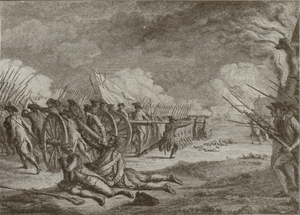
In the United States, April 19 used to be a day to celebrate the Battles of Lexington and Concord. More recently it has become a day to mourn lost liberty.
19th-century depiction of Battle of Lexington Source: Wikipedia
Today is the 23rd anniversary of the Mt, Carmel Massacre.
How many people need die to preserve liberty generation after generation? That really depends on how many people still remember what liberty is. If we all remember, then no blood need be shed. Even if only most of us remember, liberty can be defended without a single shot being fired. Sometimes all that takes is a symbolic reminder.
At Weihsien, not a single shot had to be fired, because the prisoners believed in the symbol of the American flag on the plane that brought seven men to the camp. It was not those men who freed the internees in the Courtyard of the Happy Way. It was what they stood for.
Excerpt from Our Lady of Kaifeng: Courtyard of the Happy Way Purchase on Amazon
If we all stand together, not a single one of us has to die fighting for freedom. But that is more easily said than done.
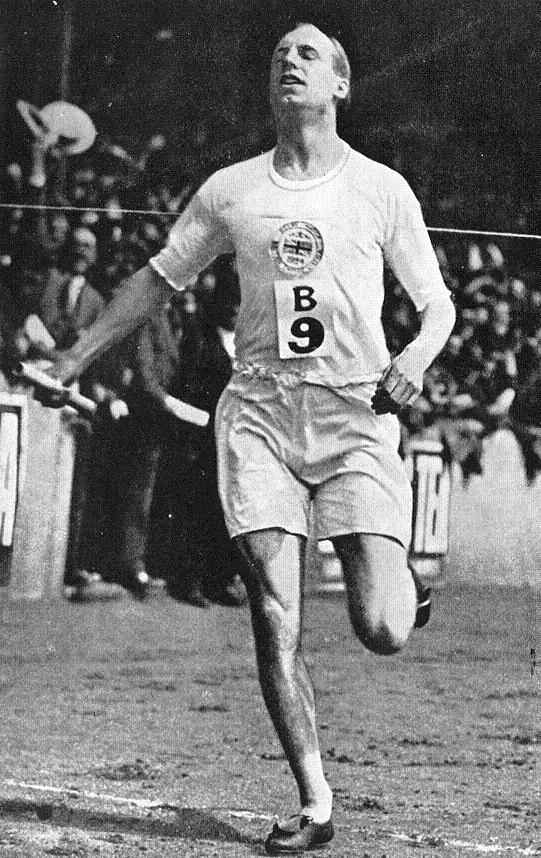
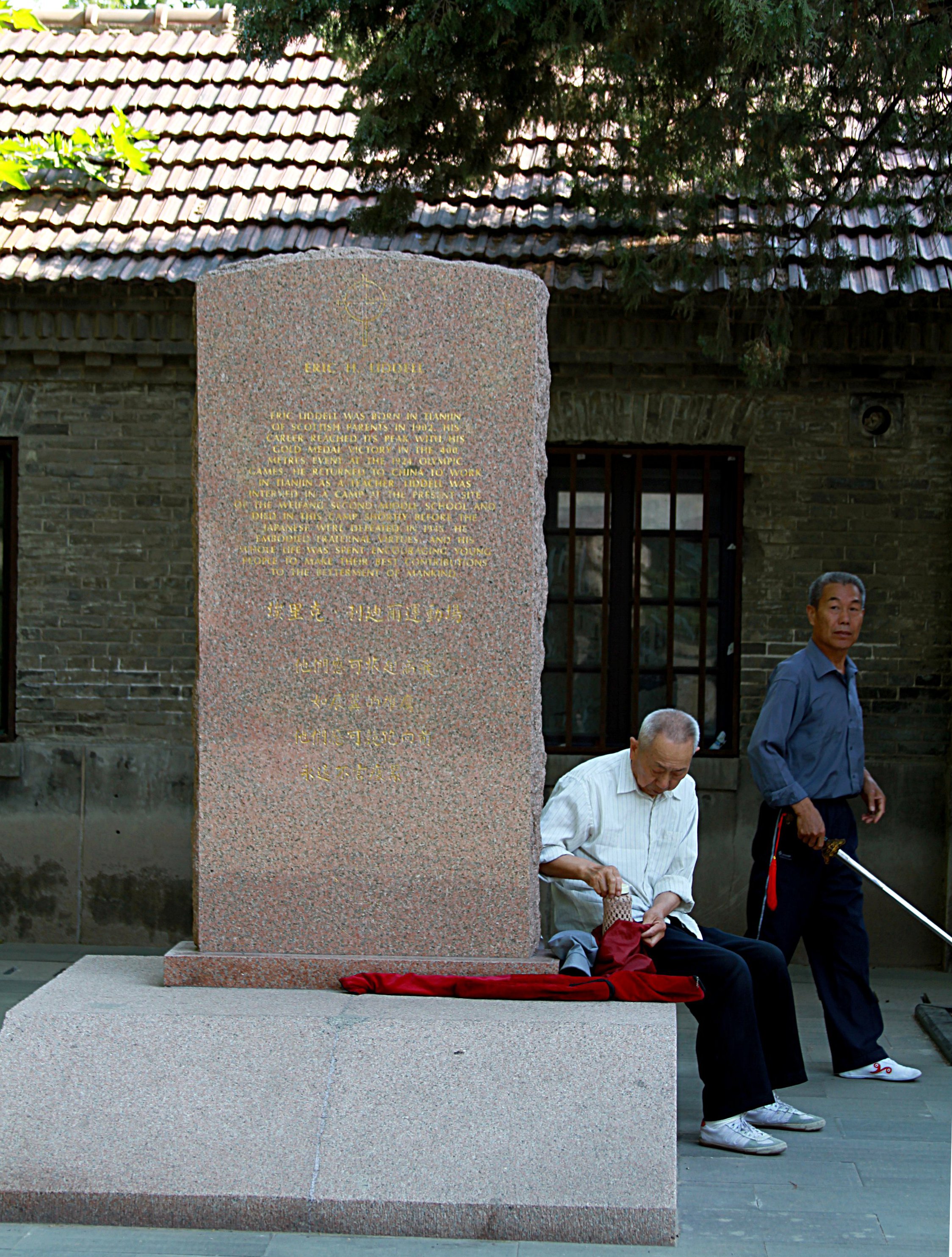
Eric Liddell is famous as the Olympic gold medalist who refused to run on the Sabbath, due to his Christian convictions. He is heroic in the sense that he stood up for his beliefs, when there was a great deal of pressure on him to do otherwise. That kind of stubbornness is always to be applauded.
But did you know that later on, he acted in a different way? Twenty years after winning the Olympic Gold Medal, Liddell found himself in an internment camp for enemy aliens in China.
And when Liddell had the choice of holding running meets for the children under his charge in that camp on a Sunday or not at all, he chose to award prizes for running on a Sunday.
What brought about that change? And what exactly is the Biblical basis for prohibiting running on a Sunday?
Old Testament Provisions Concerning the Sabbath
Here below is the text from the ten commandments, concerning the Sabbath:.
Remember the Day Off to keep it holy. Six days shall you work and do all your tasks. And on the seventh day, it is a Day Off to Jehovah your god. Do not do any work, you, and your son and your daughter, your slave and slave girl, and your animal and your alien resident who lives in your city gate. Because six days Jehovah made the sky and the earth and the sea and all that is in them and he rested on the seventh day. That's why he made the Day Off and blessed it.
The translation above is my own. I translated the word "Sabbath" as "Day Off", because that is essentially what it is, and once we take the veneer of sophistication that comes with the borrowing from Hebrew into English, then we can see exactly what is really going on here. This is a provision for a weekend, back in ancient times. It is there to make sure that people who are forced to work for other people have a day off.
The Sabbath is not for the benefit of the free man (or woman) who is commanded to keep it. It is for the son and daughter, who have to obey their parents and do everything they say. It is for the slave man and the slave woman, who otherwise might not have any time off at all. It is for the guest workers who live in the city, but get no vote, because they are aliens. It is for all the working animals, the beasts of burden, the oxen who have to help plow the field, to make sure that they, too, get a day off. The one commanded to keep the Sabbath is the owner and employer of all those who are to be let off work. They are not commanded to keep the Sabbath. He is!
Yes, this is couched in religious terms, but there is a very simple reason for the Sabbath. It's to give people -- even animals -- who have no control over their own time a break from working for somebody else. It is to make sure that forced labor does not go on forever without a day of rest. This does not mean that those granted the day of rest have to sit perfectly still while on that break. For some, it would be torture to do so.
When is the Sabbath?
Under the Hebrew calendar, the Sabbath is the seventh day, and the first day of the week is Sunday. So the Sabbath is Saturday, and that's what Saturday is called in Hebrew -- שבת. Seventh Day Adventists follow the Hebrew calendar, and they have Saturday as their Sabbath, too. But most Christians celebrate Sunday as the Sabbath, because they start counting the days of the week on Monday.
For all intents and purposes, it does not matter which day you use, as long as one in seven is your Day Off.
What is Work?
The Sabbath is a time to cease from work. But what exactly is work? Is breathing work? Is walking work? Is changing a baby's diaper work? Is preparing a meal for you and your family to eat work?
We all think we know what work is. It's a very simple concept, after all. But the definition of work changes depending on whether we are talking in terms of physics, employment law, taxation regulations or some other specialized field. Is anything we do when we are not at rest work? Or does it have to be paid for by others? What if you are a landlord? If your income is not considered "earned income" as defined by the tax code, does that mean you are not working to earn it? Or what if you are an amateur runner in the Olympics and have no professional standing? If you don't get paid, is that not work? Does it have to be something you dislike in order to be real work? If you are doing it just for fun, is it not work then? What if instead of being paid to do it, you have to pay somebody else for the privilege? When people take a music lesson, is that work? If they practice the piano, is it work? If they sing in the Church choir, is it work? What if you are the pastor and get paid to preach on Sunday? Is that work?
The bottom line is that for purposes of working on the Sabbath, "work" means being employed by somebody else with strict orders about what you must do and when you must do it.
Whom Does This Commandment Protect?
A mother's work is never done. No matter how religiously observant, no mother has ever said: "I won't feed my baby today, because it's my Day Off." No owner of a small farm ever said: "I won't milk the cow or feed the animals. because it's my Day Off." No one who is in business for himself has ever said: "I won't deal with this urgent order, because it is my Day Off." It would be as self-destructive as deciding not to breathe because it's the Sabbath.
The prohibition is only against the employer, owner, or master forcing a dependent to work non-stop, seven days a week. The reason behind the Sabbath prohibition was to spare the forced worker. It was not to keep the self-employed person from feeding himself or the joyous amateur from being happy on his day off.
But over time, tradition obscures the reasons for almost every religious or government-decreed commandment. So by the time they were in the diaspora, many observant Jews interpreted the Sabbath prohibition to be something that applied to them, but not to foreigners. They felt they could not prepare a meal for themselves on the Sabbath, but they could employ a "Shabbes goy" (a gentile of the Sabbath) to do work for them, on the holy Day Off. This went exactly contrary to the words of the commandment about the alien in your gate. Except that by now, they were the aliens in somebody else's gate. But these people were still the employer and the outsider was still their employee.
The United States government has also issued many rules to keep people from working every day of the week. These rules are supposed to spare helpless, dependent servants and employees from being exploited seven days a week, but do not apply to owners of businesses. If you have ever owned a business, you know that like a mother's work, it's never done. You work every day, all day long, till the task is accomplished. Yet when employers petition for an employer identification number, so they can withhold wages and give them to the IRS, the government's website keeps them from filing an application after work hours. This is not to spare the would-be employer, of course. It's to keep the clerks who work nine-to-five hours at the employer's expense from having too much work to do after the long weekend.
http://www.mygovcost.org/2016/03/31/how-bureaucrats-think/ What Does the New Testament Say About the Sabbath?
The original prohibition against working on the Sabbath was written at a time when every task in any household was performed by a person or an animal, not a machine. Your drawer-of-water was a person, not an electric pump. Your tiller, operated by a man, was powered by an ox or a horse. Boiling water meant cutting wood and starting a fire. You could not just turn a switch. Driving a car - or chariot -- involved using horses, not just horsepower.
But when those tasks became automated, and therefore did not involve anybody sentient working at all, the ritualized observers of the letter but not the spirit of the law continued to believe that driving a car is work, and that's why religious zealots in Jerusalem today will stone you for driving a car on Saturday. Apparently throwing stones on Saturday is not considered work.
Even by the time of Jesus of Nazareth, there were a lot of people who had turned the law into a ritual that went contrary to the original meaning. What did Jesus have to say about this?
"The Sabbath was made for man, not man for the Sabbath."
So is it okay that Eric Liddell changed his mind about running on the Sabbath when he was interned at Weihsien? I think it's more than okay. It's a step in the right direction.
Have you ever noticed that the food in the cafeterias of our public schools is not all that different from prison food? Nominally nutritious, it does not taste very good. The same is also true for food in other institutional settings, where people have very little choice. This is why food in hospitals is not very tasty, though it can be quite expensive, and why the food in concentration camps is also pretty bad. And don't even get me started on what they feed chimpanzees in zoos and sanctuaries!
A Bowl of Oatmeal Can Be Had At Home
Now, before you stop me and say: "Well, of course, the food in concentration camps isn't very good! It's not supposed to be!" -- Let me tell you, not every concentration camp is intended by the people who run it to be a death camp. Some Camp Commandants really do want to provide their inmates with humane and even happy circumstances. But there is something about the concentration camp setting that makes it impossible, even when the inmates themselves are preparing the food they will eat. And while we might be tempted to say that this is just the nature of cafeterias, that is demonstrably not true.
Contrast your average institutional cafeteria -- school, hospital, geriatric nursing home -- with your favorite cafeteria-style restaurant. Why is it that the food is bad in the former and good in the latter? It's not so much the price, but the fact that diners have a choice. We vote with our money, rather than in some other way, and every vote is a veto. The votes are not averaged out. There is no majority rule. We do not collectively decide which restaurant we are all going to patronize. Each of us takes our small wad of cash and decides for himself. And that makes a huge difference!
Each of us gets to decide whether we eat out or not, when we eat out, how often we eat out, and where we choose to eat. The money that we use on our dining choices does not merely pay for the food and the service -- it also serves as quality control. Take away the right to say no, to decide not to eat there, and while there still will be food on the table at first, it will not be as good -- nor will the service be adequate.
The problem with public as opposed to private cafeterias is not redistribution of resources. It is that marketplace voting is no longer operating as quality control. At Weihsien, people could still vote who the head cook would be, but they made that decision collectively. Individuals had lost their veto. They could no longer decide to take their business elsewhere, because to allow them to do so might cause somebody who is not as smart or farsighted to go without food altogether. Even when the choices are more varied than that, the fewer choices people have, the less likely their choices are to function as quality control.
Of course, it's not always clear what has happened. For instance, in the average American school cafeteria, people can still bring food from home and turn down the cafeteria food. But did you know that once most of the children are eating cafeteria food, some entirely subsidized by the government while others still paying a fee for their share, the votes of the children who do not like the cafeteria food count for considerably less than in an open market? It is this kind of creeping change that has reduced the quality of the food in the American supermarket, as well. When free market-style choice is coupled with forced choices that are legally introduced into the system, we don't always see clearly how we have been robbed of our veto. Many food choices that we might like to make today, such as buying unpasteurized milk, have been driven underground, where people must pay cash. Yet the people on public assistance with food stamps are becoming a bigger and bigger market share in the supermarket. When producers of valuable food are forced to sell it not on the open market, and a large percentage of consumers are forced to buy only in the supermarket, the food in the supermarket no longer represents our free choice. In those areas where a majority of shoppers are not there by choice, the quality of the food in the store is considerably reduced. Even liberals have noticed that food in poor neighborhood supermarkets is not as good. But do they understand why? It is because the free market has been disrupted there.
When people have no choice, they cannot exercise a veto on bad food. And that's why a lot of food available in the store today isn't as good as it used to be. This is not a failure of the free market, but rather evidence that the market is not free.
It's that season. Everything is in flower. The birds are chirping, and two of the major religions have a holiday that falls very close to the vernal equinox. So is it all about flowers and springtime? You would think so, if you saw the Easter decorations or went to an Easter egg hunt.
My Hyacinths in bloom
But though it's true that Easter is named for a pagan holiday about springtime, rebirth and fertility, two of the world's major religions celebrate acts of rebellion against oppressive authority -- successful and unsuccessful rebellions-- at this time.
The single daffodil that bloomed by my lagoon this year
In Our Lady of Kaifeng: Courtyard of the Happy Way, though the story is set in China during World War II in a concentration camp run by the Japanese, some of the characters are influenced by the Judeo-Christian symbolism of the Passover and Easter scenarios. Marah Fallowfield, for instance, sees the Camp Commandant as a sort of Pharaoh whom she asks to let her people go. She also warns him of the consequences, should he fail to do so. But Commandant Izu is working from another playbook, and he eventually has Marah crucified. What is ironic about the good faith, literal belief of these innocent characters is that the vast majority of people who celebrate these springtime holidays do not see them as celebrations of rebellion at all. Most devout Christians and Jews understand all their holidays as ritualized submission to authority! That right there is the real conflict in my new novel.
Historically, there is a process whereby people forget. Successful religions are founded by rebellious visionaries, but they are kept alive only if those in power find them useful.
For instance, while Passover is about slaves rebelling against their masters in Egypt, the big focus for most believers is on the supernatural miracles and the absolute necessity of total submission to the priesthood and the payment of taxes in gold to a particular god and not some other god. Though the new testament is about a man who called himself a "messiah" -- which is another name for the King of Israel -- and who was crucified for failing to pledge allegiance to the puppet king installed by the Romans -- most Christians put the emphasis on the need for ultimate submission to their God in the form of Church membership, including paying a tithe. So while the holiday celebrates rebellion from rulers who tax people, those who take it seriously do not think they should follow the example and also rebel. They believe they should submit.
In the same way, when Americans celebrate the 4th of July, which is the time when they declared their independence from the British, but had not yet won it in an armed rebellion, most see the patriotic holiday not as a time to renew the fight for liberty, but to show submission to the Federal government -- which is much more oppressive than the British were in 1775-6.
Springtime seems to be a natural time to celebrate liberation. Coming up soon is April the 19th, an American holiday about a struggle for liberation from great Britain in 1775, but oppression of Americans by the ATF in 1993. There's just something about spring in the air that makes people long for freedom -- and other people eager to crush that longing in the bud.
A wasp on my peach blossoms
Some of the most successful films at the box office these days are about teenagers rebelling against oppressive governments -- The Hunger Games and The Divergent Series -- but there seems to be a real disconnect when it comes to understanding what real oppression would look like. It would look more like the British in 1775 or the Romans in the time of Christ or today's Bureau of Land Management hounding ranchers, and a lot less like some sort of post-apocalyptic wasteland in which people have to fight each other to the death on a daily basis. Even in the Courtyard of the Happy Way. most of the daily life was undramatic and ordinary, and people just tried to keep their nose clean and do their jobs. Oppressors want you to be happy. When people chant slogans learned straight from the Nazi death camps, such as: "When we're no longer able to change a situation, we are challenged to change ourselves." -- they are unwittingly giving in to oppression. By all means, we should change ourselves for the better, but only if it helps to change the situation. If the situation is intolerable, we do not adapt to accept it as normal.
Years ago, I read a children's book by Judy Blume, calledBlubber. It was a book about bullying. And I was disappointed in it, because it did not vindicate the obese little girl who was bullied. It merely showed the people doing the bullying that what they did was not "nice".
The copy of the book that I read had this cover.
My disappointment need not reflect on the value of the book to other people. I was just hoping for a different book, one that looked at things from the point of view of the person being bullied, who had some secret virtue that no one was aware of, and I wanted the turning point to be when that virtue was revealed. But Judy Blume never showed how the bullied girl felt about anything. Instead, she described in detail the revulsion that even "nice" girls in the class had for not only the person of the obese girl, but also her character: she was phlegmatic, she had no sense of humor about her problems and she did not stand up for herself, making her an easy target. I learned a lot about normal people and how they think when reading this book, but I was disappointed that there was no turn-around, no empathy and no appreciation of a different point of view. In the end, the nice girls decided not to bully, because they did not like how they felt about themselves when they were being vindictive, but not because they had learned to admire and respect the victim of their bullying. Deep down inside, the main character still felt the victim deserved to be bullied, but she now felt it was beneath her to engage in bullying. To my way of thinking, this book represents the "Kindness Movement."
A person who has been bullied isn't looking for kindness. What is needed are honest, smart people -- people who are perceptive enough to see what it is that each of us has to offer. Victims don't want charity. They crave fairness. Bending over backwards to be kind, ordinary people miss the virtue behind the presumed sin.
In Our Lady of Kaifeng: Courtyard of the Happy Way, Bertha Higginbotham is a character who resembles the victim in Blubber. She comes into the camp morbidly obese, and even after losing a lot of weight on the Weihsien diet, she is still quite heavy, when everyone else is emaciated. Jealous of her good health, people accuse her of stealing sugar, on the mere circumstantial evidence of her weight. That would be like accusing your co-worker who earns the exact same salary as you do of theft, merely based on the fact that he has savings, while you do not. People do this every day, and nobody thinks anything of it. Who will stand up for the thrifty? In my book, it was Father Horvath.
When politicians suggest that we tax the rich, they are not going after corrupt people who have stolen from others. They advocate taxing anyone with savings, and they rely on the hatred of the masses for the financial Bertha Higginbothams of this world, who may seem unattractive, but who have hidden virtues.
A man by the name of LaVoy Finicum was shot dead by the Federal authorities, while he had his hands up. The Bundy Militia has stood down from their takeover of the Malheur Wildlife Refuge near Burns, Oregon. And life goes on.
One side will quote you Bible verses as if they were the constitution, and sections from the constitution as if they were Bible verses. The other side is laughing and saying: well, how did you think it was going to end? Did you really think you could go up against the big, bad Federal government with a few guns and some Bible verses and the constitution and win?
Even my most libertarian friends have said to me: that is just like asking for war. Yes. that's what it is. And so was the American Revolution. The only difference is: then, those fighting for freedom had the support of those who were not. Today, asking for war is not really practical, because no one will stand up and be counted with you, and they will just say you deserved what you got when it happens.
So here's what I really think: no matter who you are, right wing or left, Bible-thumper or unbeliever, strict constructionist of the constitution or a follower of unfettered democracy: It's all about the beef. It's about your food supply. It's about the price of meat in the supermarket. It's about that steak dinner you like to eat, or the hamburgers you buy at the fast food place. And even if you are a sworn vegan, it's going to affect you where it really hurts: in your pocket book and your belly. There will be economic repercussions for all of us when those ranchers give up and close off their businesses, and go on unemployment and welfare, with their hat in their hands, like everybody else. It's not just on our heads -- we will feel it in our stomachs.
Should the Federal government own that land? No, they shouldn't. The constitution does not allow that. But who pays attention to the constitution? That document has been pretty much ignored since before the Civil War. It was a good idea, but the people will not fight for it, so it's very, very dead.
However, city people need to realize that when they allow the authorities to destroy the independent farmer and rancher, they have only themselves to blame when there is nothing but factory produced food on the grocery store shelves. Do you want free range chickens and grass fed beef? Where do you think they come from? Not a collective farm run by hippies, I assure you. And not from the government.
This is just like what happened all those many years in the concentration camp near Weihsien in Shandong Province. When the prisoners did not stand up for the Chinese farmers who were shot for selling them eggs, they lost their egg supply. It's that simple.
You don't need to like the farmer or rancher who raises your food. You do not need to believe in what he believes or go to the same church or use the same jargon. But when he goes down, you need to get ready for very hard times at the dinner table.
In other words, the "needs" of society to have a stable stock market have been placed above the rights of individual stockholders to sell or buy as they please. That in a nutshell is the entire dilemma of looking at everything from a social perspective. How can society be more important than the people of which it is composed?
I made a second book trailer for Our Lady of Kaifeng: Courtyard of the Happy Way that addresses this issue.
This trailer is about the personal and spiritual issues addressed in the novel, but if you are an economist or a political science major, don't let this put you off. The issues are all the same, whether the relationship in question is one between two people or among all the people in a country or region. What is paramount, the individual or his relationships?
Over and over again, we are told that relationships are more important than individuals. For instance, yesterday, I saw a TED video that claimed people are happiest if they have stable relationships, not when their personal achievements are at their best. In other words, if you spend your entire life loafing on the couch, but your sweetheart is right there with you, that is better than being a successful athlete, businessman, hunter-gatherer, explorer, artist, writer, scientist, farmer, rancher, privateer, craftsman, silversmith or shopkeeper.
Why do you suppose those people are trying so hard to sell us on being low-achievers with good social connections? Could it be because that is what socialism is all about? People who work in factories as automatons and people who work in offices as bureaucrats have this in common: that they try to solace themselves for their less than creative day-to-day life by having good personal relationships outside work.
But, of course, these relationships cannot be based on admiration, respect or hero worship, so then the connection itself is elevated to a place of worship over and above the individuals. People sacrifice their own desires in order to keep the relationship aloft. They put in circuit breakers to prevent themselves and their partners from getting out of the relationship -- for the sake of the relationship and against the best interests of those involved.
I once had a friend in England who was a big fan of 1984 and Animal Farm. I convinced him he should read Atlas Shrugged. But all he liked out of that huge book was the story of the Twentieth Century Motor Company. He thought the whole rest of the book should have been trimmed off as excess. He especially did not see what the point was of recounting Dagny Taggart's love life. To him, that was entirely spurious.
Unless we understand that the minimal relationship -- one consisting of only two people -- is a model for all our more complex relationships, we won't be able to fix the problem of putting society before the individual. That's why the relationships in Rand's books are important. That's also why unrequited love needs to be the model for all love. Love precedes the relationship. It does not derive from it. The person comes first. The relationship is built on individual feelings, not the other way around. Society could not exist if it were not for the people. No god could survive without worshipers. If we all die of starvation, where does that leave society?
In our current culture, we have two main views on happiness, which are diametrically opposed;
1. You must stay in the present moment, forgetting all about the past and the future, in order to enjoy true happiness. A representative article belonging to this school can be found here, in a review of a book by Alan Watts:
2. A meaningful life, one based on working in the present to secure future rewards, not necessarily for oneself, but for others or for abstract ideals such as knowledge, love or civilization, is more sustaining than the momentary happiness that comes from focusing on the present.
Both views are widely accepted, so much so that I see the same people posting memes sometimes in favor of the one view and sometimes in favor of the other, seemingly unaware that they contradict each other. And for those of them who really live in the present moment, with no concern for consistency, maybe it really does work that way!
As a believer in the "pursuit of happiness" rather than its immediate possession, I may seem to fall into the second school, that of Victor Frankl, the holocaust survivor, but I really don't buy into his embracing suffering for its own sake. For instance, if you believe in the future, why would you sacrifice your young pregnant wife to your elderly parents? Even without the holocaust, the parents eventually would have died. Living for the future means saving the young, so they can transmit your culture and your genes on into a possibly limitless future. None of my grandparents stayed behind to take care of their parents. All of them made sure that their children survived, which is why I and my daughter even exist. This to me seems to be the productive way of living for the future.
But on the other hand, it is very difficult to simply give way to sensual pleasure -- eating, procreation, taking care of young -- without thinking what those things mean for the future. The emptiness of drug induced pleasure comes precisely from the fact that this natural signal that one is on the right path to a sustainable future has been hijacked out of its biological context. A drug high, unlike a natural high, is lulling one into a sense of happiness in the present moment without any positive implications for the future.
In nature, every sensual pleasure is a stimulus created to guide the living being onto a productive path.
Often religious highs are made to mimic drug highs and to create in the mind an elation that is at variance with natural stimulus. So a person meditating or praying can cause the depression and pain of being in a hopeless situation in the present to dissipate and be replaced by a pleasure that comes not so much from anticipating a future reward, but from experiencing that reward in the present moment. That is the true danger of religion as an opiate for the masses -- not the promise of reward after death, but the granting of a reward now that prevents people from taking positive action to change the present.
In Our Lady of Kaifeng: Courtyard of the Happy Way the Camp Commandant wanted everyone in the camp to be happy, so that they could not only survive their internment but also thrive under his direction. In order to make this dream of his come true, he gave people flower seeds and encouraged them to put on plays and concerts, to sweeten their captivity.
Marah Fallowfield, on the other hand, did not want everyone to be lulled into a present happiness. She wanted them to fully experience their momentary suffering, so that they would rise up and rebel. She found happiness from being truly present to the evils of the moment, while plotting a brighter future.
Sometimes we are deluded when we plan for a future that never comes. Sometimes we are deluded by momentary pleasure that is ultimately meaningless. But actual happiness does not come from pretty flowers or pleasant odors or soft caresses. It comes from a past, present and future that are integrated together as a whole. Happiness does not require us to bypass death. Death is inevitable. Happiness means making sure that what we value outlives us, whether that is our children, our handiwork or our ideas.
I recently finished writing Our Lady of Kaifeng: Courtyard of the Happy Way. It is now undergoing the usual editing process, and it will not be available for sale until next year.
The issues in this novel are intertwined between personal and global concerns. But one question that we try to resolve is: what makes someplace a concentration camp? Is it it just that you're not allowed to leave? What other characteristics do concentration camps tend to have?
"Just before winter sets in, the butterflies are most active."
"Can anyone deny the beauty of a butterfly? Or of the flowers on which it depends?"
Those are the words of Commandant Izu, a character in my work in progress, Our Lady of Kaifeng: Courtyard of the Happy Way.
Does observing the beauty of the seasons help diminish suffering in the present? Do governments nudge those under their power by giving them things or taking things away? Should we be thankful for what we have, and if we are very full of gratitude for the little we have, will this ensure that we are compliant and do not rebel?
Of course, inflation is a massive government engineered nudge to force people to spend, rather than save money. But is that merely a psychological manipulation? Can a single, isolated consumer resist the need to spend more on staple goods once the currency is inflated? Does scarcity cause prices to go up? Can rationing keep prices down? Is the price of food higher because of inflation, or do we cause inflation ourselves when we spend more and more on the same foods? If we tried hard enough, could we just refuse to spend the money?
If the intended effect of food rationing is a fixed price on goods, can this intended effect ever be achieved, given that for every forbidden fruit, there exists a black market, where it can be purchased, if the price is right?







[1]%20-%20http://lewishamlegacy.wdfiles.com/local--files/eric-liddell/EricLiddell.jpg,%20Public%20Domain,%20https://commons.wikimedia.org/w/index.php?curid=11833878)
