Showing posts with label The War Against Spain. Show all posts

Saturday, December 24, 2016

The Ratio of Reviews to Books

My new year's resolution when it comes to publishing is to improve my reviews-to-books-published ratio. This means writing and publishing fewer books and expending more time and energy in getting people to review the books that are already out there,

I am actually thrilled with the reviews I did get this year, so I compiled them into a video and am sharing it here.


"You must be really disciplined," one friend told me, "to keep writing so many books year after year." No, actually it's a lack of self-discipline that makes something like that happen. It's unbridled passion that compels a person to start writing one book in the middle of writing another one. The two Theodosia and the Pirates books happened to me when I had not even finished writing the second half of Our Lady of Kaifeng. How embarrassing!

As an author,  you want to have many more readers than books to your credit, and I think that requires discipline. So in the future I will write less and work harder to recruit readers for the books I have already written.

Why just a few moments ago, I put this New Year's resolution to work when the dogs made a commotion and Bow alerted me to the fact that a car had pulled into my driveway. It was two older Jehovah's witnesses, a man and a woman, and they were lugging Bibles and pamphlets as they walked up to the door.

Lickety-split I went and fetched my own books. Three of them were easiest to get hold of: Our Lady of Kaifeng: Courtyard of the Happy Way, Theodosia and the Pirates: The Battle Against Britain, and Theodosia and the Pirates: The War Against Spain. I've written other books, of course. Those were just the ones that came readily to hand.

"Merry Christmas," I greeted the white haired man and woman opening wide the door, before they even had a chance to knock. "I see you have a lot of information to share with me," I said, eyeing their literature. "But I have a lot of information to share with you, too. I have written these books, and I want to give them to you as a Christmas present."

The man glanced down at the volumes I was proffering. The picture of Theodosia and Jean on board ship did not seem to appeal to him on the cover of the top book. "I don't think I want them right now," he said with a look of displeasure, as if I were offering him something not quite kosher.

"Oh." There was a very brief silence when I considered telling him that I did not want his literature, either, But I decided that would not be polite. So then I just said: "Well, then you have a merry Christmas, anyway." And they said merry Christmas, too, in a half-hearted way, and turned and walked back to their car, dejected.

In terms of handling solicitors, I think that went rather well. But as a seller of books, I have a long, long way to go. Like any other gospel, you just can't give it away!

The books I offered the Jehovah's Witnesses

Tuesday, September 30, 2014

Recent Reviews of "The War Against Spain"

Because "Theodosia and the Pirates: The War Against Spain" is the continuation of the story begun in "Theodosia and the Pirates: The Battle Against Britain", I often refer to it simply as "The War Against Spain." In some ways, it is a separate novel, but in others it is just the last third of the story. It is less of a canonical romance, as those are usually about the beginning of a relationship, but it's still a love story. It is  very much grounded in history, even though there are elements that are not based on strict historical fact.

As with every other book, different people react to it in different ways. Today, I will just share a few of the recent critical reactions to the book.

From Eye on Life Magazine, we have Jerilee Wei's review:

Alternative History in Fiction

From the Amazon review section, Pam Keyes' review:

A Gulf Coast Romance with a Twist

From the LeslieBard blog, Leslie Fish's review:

Book Review: "Theodosia and the Pirates: The War Against Spain", by Aya Katz


And from her My Stories and Musings, Julia Hanna's chapter by chapter reading guide:


Each person approaches the story from a very different perspective, so it helps to compare and contrast the reviews in order to be able to see the full picture. After reading the book and the reviews, ask yourself which description is more nearly like what you got out of the book. Or, alternatively, if your view is not represented here, write one of your own.


Thursday, September 4, 2014

Patriotic Dissent

Can you be critical of the actions of your government without being seen as unpatriotic? Can you be reverent of the founding documents of your country, but disparaging of the founders, some of whom helped to draft those documents? Can you love America while criticizing important Americans? Or even Americans in general?

 I once heard someone say that she really admired the Quran, but she hated Moslems. It sounded so funny to me at the time. I chided her on this, asking how that was possible, and she said that Moslems universally misinterpret their holy book. I have since heard someone say the same thing about the Bible and Christians.

Any really broad use of a term invites misunderstanding, which is why I changed the blurb of Theodosia and the Pirates: The War Against Spain from what it used to be to this:

http://www.amazon.com/dp/1618790099/ref=cm_sw_r_fa_dp_RYBbub1JWTMS5
What was the blurb like before? It was more or less the words to the War Against Spain book trailer:


When understood in context, these words are very patriotic and show reverence to America's ideals, as put forth in the constitution. But when read out of context, they can be seen as unpatriotic.

That is actually what Theodosia and the Pirates: The War Against Spain is all about. How can you remain loyal to the ideals of your country when your countrymen violate them with impunity? Do you have to go underground with your patriotism?  If you can't practice freedom openly, do you have to furtively support those ideals? Is your country the land, the people, the government or the ideals?

It is young Jules who expresses some of these questions toward the end of the book.


We don't have to put anyone's head on a plate to set the record straight. Nor is it unpatriotic to point out when any governmental action or citizen's attitude is in conflict with the founding documents.


But since people who have not read the book may not know this is what it is about, it is best to be a bit more expository in the descriptive blurb. They can wait until after they have read the book to ponder what it would mean to be "more American than the Americans."

Friday, August 1, 2014

Should Smaller Countries Rely on the Beneficence of the United States?

If there is any lesson to be learned from the way Jean Laffite was treated by representatives of the United States goverment at Galveston, it is this: A very small country cannot expect to survive long if it chooses to become a satellite of the United States.

There are many reasons for this, not the least of which is the fact that in the tit-for-tat of diplomatic negotiation, the United States tends to make concessions to countries whose behavior and goals it sees as problematic and even threatening, while taking for granted that well-behaved satellites will stay in line.

My father, back when he still hoped that Israel would stop relying on US assistance,  explained it like this:

An excerpt from ISRAEL: WHENCE AND WHITHER
the entire article can be read in facsimile here:http://www.pinterest.com/ayakatz/israel-whither-and-whence/

When Uri goes to school, the teacher, Bracha, tells him that discipline, quiet and order are the keys to success. If Uri asked for my advice, I would tell him to ignore the teacher and do whatever he feels like. I know what the teacher learned in her pedagogical seminar: take the wildest boy, give him a position of authority, give him responsibility, imbue him with importance,  and he will help you to rule over the class. You will be able to handle the obedient children either way. Uri knows all that. He does not need my advice.
I'm not saying that it has to be this way. It is possible to manage a class, a family, a country or the world another way, too. The teacher, the head of the family, the government of the country,  the international authority can do so. But it's not up to Uri. He can only study the responses of Mrs. Bracha and learn that it is not the one who obeys her who is rewarded. In the area of international relations, it is not in Israel's hands. Israel can only determine that it is not in its best interest to obey international powers, even if their intention is for the good. The international powers have interests that are in conflict with those of Israel; at times the great powers do not even understand what is their own best interest. For its own sake, and at times even for the sake of the great power whose commands it disobeys, Israel must break out on its own.
 This same advice holds in every relationship, even the intimate ones. Those who are most secure in our love and most sure of our allegiance to them are the ones who tend to take advantage of us. Often family members show greater deference and concern toward strangers they are wary of than to those whom they trust and rely on. In a romantic relationship, the person who is most committed is the one with the least leverage. In business negotiation and at the diplomatic conference table,  it is the least well-behaved participant who has more of a chance to get what he wants.

http://www.amazon.com/Theodosia-Pirates-The-Against-Spain/dp/1618790099

In Theodosia and the Pirates: The War Against Spain, we learn this lesson over and over again. From the opening pages, where Theodosia's love for Jean leaves her unable to demand anything for herself, not even that he break his ties with the treacherous General James Wilkinson, to the many different moments when Jean offers his allegiance and his services to the United States only to be told that they would rather do business with Spain or Britain, to the final negotiations by Pierre for a safe conduct pass, which is only granted when Pierre hints that Jean could just hand over Galveston to Spain, we see how it all works. The one who loves the most is rarely found on top, and the United States gives in to empires it is afraid of and not to the friends that are helping it to resist them.

Could it be otherwise? Could unconditional love ever be rewarded? Could a pater familias, a governor or a ruler ever punish the disobedient and reward the good? Could justice be swift and unerring, and could there ever be someone we can count on not to betray our trust once we give it?

We do see that in the actions of Jean Laffite as he governs his own family, his captains and his  own little country. But Jean Laffite was not a world power, and he was fighting too many enemies on too many fronts, while not having enough allies he could count on. If the United States had feared Jean Laffite more, it would have respected him better. Because they knew they could always count on his loyalty, they were able to completely disarm him. In the long run, this was not in the best interest of the United States.

Thursday, June 5, 2014

When did Privateers Fall Into Disrepute?


Today's blogpost  is a transcript of a conversation  I had in the outer pen this afternoon, as depicted in this video.


When did privateering go into disrepute? I would say that it happened sometime after the War of 1812. And I would say that it wasn't a coincidence that it happened then, and that it was part of a concerted effort to change the way Americans looked at those who provided them with protection and military service.

Prior to the War of 1812, it was understood that while there was going to be a standing navy, there would not  be a standing army. And the Navy itself was  to be much smaller than the navy of a large empire, such as Great Britain. The idea was that the services provided by the American Navy could be supplemented by private enterprise, by private ship owners, private captains and private warriors who would perform the same services as the military of the competitors of the United States without affecting the taxpayer, without affecting the civil rights -- the civil liberties -- that were protected in the bill of rights. And that was why prior to War of 1812...

 -- Can I borrow this book, Bow? I want to show the people the book, okay? --

This is my second book in the Theodosia series. Bow was reading it, but he took very good care of it while he was reading it. And this is where you see the transformation happen. All of a sudden, privateers are not the good guys, anymore. And it's not just Jean Laffite, although he certainly was a victim in this change in the way the wind was blowing. But there were other privateers, American privateers, who were suffering the same fate. All of a sudden it was decided that only the government was going to be waging war, only the government would be involved in major defense or offense efforts, and that anyone who wanted to compete with the government was not welcome anymore -- even if that person, like Jean Laffite, saved the United States in the past.

[Bow starts to protest.]

--Okay. You can have the book back. You're welcome.

Saturday, May 24, 2014

How Open Should We Be With Our Children?

How open should we be with our children? Should we share everything we know about life? Or should we leave some of it for the children to discover for themselves? Reading this post by Julie Deneen made me think about that question again.

http://juliedeneen.com/2014/05/21/abstinence-teaching-sexual-responsibility/

While this is not the central theme of Theodosia and the Pirates: The War Against Spain, it is one of the topics that I cover. How does one raise an independent and spirited young woman in the 19th century if one is a filibuster or a privateer? What should we tell our sons and daughters about love, sex, and personal responsibility? If we tell them too much, will it harm them? If we share too little, will they fall into avoidable traps?

Detail Representing Denise Laffite from a painting by Colleen Dick
Theodosia Burr Alston had a very devoted, liberal, open-minded father. He was not perfect, but he was honest with her to an unusual degree. After her mother's death, he did not remarry. He was a freethinker, and he brought up his daughter to question everything and accept nothing on faith.

http://www.historiaobscura.com/aaron-burr-as-a-father/

It is good to be honest with our children. But did Burr damage Theodosia in any way by letting her know that he had mistresses and that he frequented brothels? Would it have been easier for her to separate and individuate, if he had not freely shared with her so much about his life? As the teenagers nowadays like to say: TMI! She must, at times, have been deeply embarrassed by some of his letters from Europe.

Jean Laffite was also a father. But I think he was more the traditional type: providing well for his children, showing them affection when he met with them, but being gone for long periods of time and not discussing anything unseemly with them.

http://www.historiaobscura.com/jean-laffite-as-a-father/

So which is better: total honesty or a little bit of repression and subterfuge, avoiding full disclosure?

In my experience, people whose parents share a lot with them are actually more likely to be a little gun-shy and wary. Knowledge does not necessarily lead to experimentation. It can lead to being more picky and careful. It can also lead to delayed maturation, because without the drive to rebel against your parents, there is less of a desire to experiment and find out for yourself.

In my experience, more traditional-minded parents drive their children into early experimentation, which is why all the born-again Christians I know are actually not all that repressed in their behavior, and they only give lip service to the chastity they supposedly believe in. Unexpected motherhood comes often to the faithful.

But here's the irony: the unintentional results of the search for pleasure can be blessings in disguise. The safety and security that come from a lack of desire to experiment can actually be stultifying. So repressing your children and driving them to mature early may not be such a bad course of conduct, counter-intuitive as it sounds. You do not want them to never leave the nest and never have a life of their own, do you?

Both mothers and fathers can be guilty of too close a relationship with their children which hinders their emotional growth. While I did not depict this in my novel, historical accounts indicate that Jules Laffite, Jean's youngest surviving child, was so close to his mother, Emma Mortimore Laffite, that he did not marry until after she died.

Maybe, as with many other aspects of life, this calls for a happy medium. I don't think we should lie to our children, but we probably shouldn't share everything with them, either. And even if your instincts are to be open and honest, remember:  a little repression might just be the right thing, if you ever want to see grandchildren in your own lifetime!

Thursday, February 27, 2014

Family Values and Piracy

The second half of Theodosia and the Pirates -- The War Against Spain --  is not so much a romance, but a story about family life against a backdrop of world conquest, colonization of a new island, the meting out of justice and receiving injustice in return, exile, diminished circumstances, and a new life as a respectable, productive middle class family. This is not primarily a book about sea battles and burning buildings on the shore, although there is some of that, too. It is more about family values than it is about the fires of first love, although there is a bit of that as well.

Next month I will be revealing our new cover with a stunning illustration by Colleen Dick and everything will be gearing up for the release of the new book. But for now, let me say that I don't think people have given much thought to what it is like to be a good parent and a pirate at the same time. No, it's not  a joke. I'm perfectly serious.

Jean Laffite was a privateer, a liberator, a protector, a husband and a father. He had three children by his first wife and two by his last wife. And there may have been some other children born on the wrong side of the blanket, but I'm not writing about that.

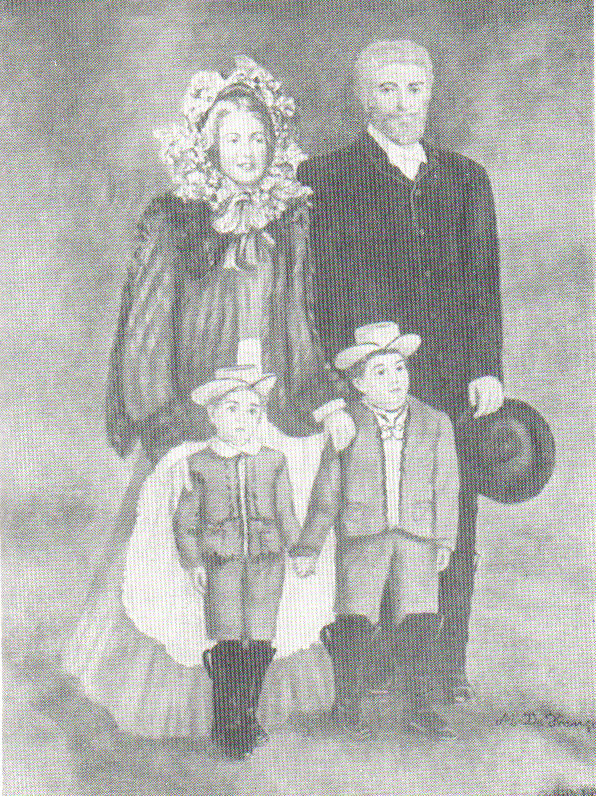
Jean Laffite and his second wife Emma Mortimore and their two sons, Jules and Glenn
painting by Manoel J. de Franca

Imagine being asked by your little boy why it is all right to pillage and loot. What would you answer? Would you say that you only go against evil empires, like Britain and Spain? Would you say that what you do is good, because the enemy is bad? Would you tell him that you treat women and children and the downtrodden with ultimate courtesy, but that the people you hurt deserve it? And if you said that, how much of it would you yourself believe?

Today on my Facebook feed, there was a discussion of Vikings. Apparently, the History Channel is running a series about Vikings. I have not seen it. I don't have cable. But people seem to be fascinated by the violence and the family dynamics of what they term "mafia-like" arrangements, and some of them are talking about having Viking ancestors, but at the same time saying that they were just farmers.

I don't want to make any statements about the life and morals of Vikings one way or another. But I do think that there's something that most of my acquaintances are overlooking about their own mode of making a living: almost all of them are a little like Vikings, except that there is a veneer of respectability that hides this fact.

"First do no harm." That is the mantra that most people adopt. But how many of us live by it? How many could explain to our children what we do for a living and why it is okay?

Take one of the most respected profession in the world: teachers. I have been a teacher myself, and I taught on the university level in Taiwan. But who or what paid for my fees? Even though I was working at private universities, did you know that the government of Taiwan had to authorize the universities to hire me as an assistant professor? There was so much red tape! And in the end I was issued a government document allowing me to teach . Behind all this was a complicated system that certified students, teachers and the validity of knowledge. And all at the point of a gun!

 I'm not being critical of Taiwan, when I point this out. All the countries I've ever lived in and all the countries I have visited have had some such a system, if not on the university level, then certainly for elementary education. If your work is regulated by the government and funded by taxes or coerced payments, you, my friend, are a pirate!

If you are a teacher, chances are you are profiting from some combination of government coercion and expropriation. If you are an elementary or high school teacher in a United States public school system, then you are probably paid with tax dollars, even those taken from people who have no children. If you teach at a private school, you probably still received some kind of certification that said you were allowed to teach and somebody else could not. The mandatory education laws indirectly send money into the coffers of private institutions as well as public one.

I have been a lawyer. That, too, involved government certification by the State of Texas where I practiced. I was part of a state-run monopoly on the practice of law. Are you a doctor? A registered nurse? A social worker? An insurance agent? A farmer? There are government subsidies, government monopolies and government coercion involved in all those professions. People can't help being dragged into these things, because it's everywhere.  If you are a retailer, chances are you are actively collecting sales taxes from your customers, because if you refuse, you will be shut down. We are all of us victims of piracy, but we are also willing participants. Where did your money come from? Are you sure it is clean? Would you walk the plank rather than join a government program that allows you to earn a living?

People revile welfare recipients, but they look the other way when the local grocer pockets the welfare recipient's money. It's almost impossible, in every line of business, not to somehow have gotten one's gain from someone else's illicit plunder. And even if you are clean yourself, the people you do business with are not, so that in some way we are all part of it.

"But I offer valuable services!" we may protest. "I work hard!" Doesn't everybody? "But the services I offer are needed. I help people!" Doesn't everyone?

Privateers help people, too, but they do so without leeching off the people they help. The good thing about privateers is that they do not plunder the people they are protecting. Unlike the local police officer and the military who serve us while living off our earnings without our consent, a privateer protects us from others by robbing others. Is it fair to those others? They probably don't think so. But at least it is honest.

And yet how do you explain that to a little boy? How do you teach him to respect others, not to steal or bully or abuse, when what you are doing yourself looks an awful lot like armed robbery? That's a big part of what "Theodosia and the Pirates: The War Against Spain" is all about.

So when you think of Vikings or your Viking ancestors, think of that!