Showing posts with label the Louisiana Purchase. Show all posts

Saturday, September 10, 2016

We Annexed Texas the Right Way

Davy Crockett
Yesterday was a Friday, and at The Libertarian Republic I posted a list of the top five libertarian war heroes. Even though the list format tends to promote facile generalizations, I am happy with the article I wrote, and so I want to share it here.

http://thelibertarianrepublic.com/top-5-libertarian-war-heroes/

Even though the biographies of the five men are short and superficial, using the list format enabled me to make the following point about the Neutrality Act and about how the annexation of Texas was done the right  way:

The United States was founded on the principle that residents of a geographic area should be allowed to decide for themselves how they want to be governed. It was also founded with the help of volunteers from elsewhere, like the Marquis de Lafayette, who fought in the American Revolution, just because he liked the ideas the Americans espoused. At the very start of the Republic, it was understood that any individual American could decide for himself what foreign wars he wanted to fight in and what Empire or regime he wanted to help topple, without asking for permission from the government of the United States. That's why American privateers fought on behalf of the French against Britain at a time when the United States was at peace with Britain. But wanting to put an end to this, in the Jay Treaty negotiations, Britain lobbied for the passage of the Neutrality Act, thereby putting an end to the legal pursuit of foreign policy by individual Americans for fun and profit. But this did not mean that Americans stopped trying. Aaron Burr was one example of somebody who wanted to help Hispanic colonists to liberate themselves from Spain. Long after Jefferson had ruined Burr, there were Mexican revolutionaries still writing the former Vice President letters asking for his help in their liberation from Spain. Jean Laffite, the smuggler and privateer, founded Galveston as a stronghold against Spain. But... just as they had done when he contributed to the defeat of the British in the Battle of New Orleans, the American government drove him away from Galveston so that they could give Texas to Spain on a silver platter under the terms of the Adams-Onis treaty. The United States did not drive Laffite out because they wanted Galveston for themselves. In fact, if it had been up to the American government, Texas would never have belonged to the U.S. But men like Davy Crockett and Sam Houston, when they got fed up with the corruption in Washington D.C. and opposed President Jackson's Indian Removal Act, went to help the Mexicans in Texas liberate themselves from what was now Mexico. They formed their own government, and the Republic of Texas eventually chose willingly to be annexed by the United States.
That's the story. And by looking at the biographies of the five men on my list in close succession, I think that you can see it is a single story with a unified plot line.  The theme of the story is individuals fighting against foreign governments, whether their own government allows it or not.

The Louisiana Purchase had been unconstitutional, precisely because entry into the Union was supposed to be voluntary. You were not supposed to be able to buy new territories and new constituents at the expense of the taxpayers. Jefferson was afraid that Burr was out to steal the territories that he bought, by turning the residents in those territories against the idea of eventually being annexed into the United States. This was completely untrue. Burr was going after fresh new territory south of the border. He was doing it at his own expense, without getting the United States into debt and without conscripting a single soldier.

But let's face it: Talking to the people living in American-held territories and suggesting that they might not want to be annexed would not have been treason. So even if Burr had been plotting what Jefferson thought he was plotting, it would not have been wrong.

Lots of people today do not know that Texas independence from Mexico was achieved through the rebellion of the people who lived in Texas against Mexico, including most Hispanic residents. It was not some Anglo-led plot to hurt Hispanics. It was the exact opposite of the policy being pursued by Andrew Jackson against the Cherokee nation. The government of the new Republic of Texas was inclusive.

If Davy Crockett and Sam Houston had obeyed the Neutrality Act, Texas would never have joined the Union at no cost to the taxpayers of the United States. The Neutrality Act should be repealed, so that Americans can continue to help others abroad when they choose, without involving the rest of us against our will.

But the other side of all this is that the idea of secession is something Jefferson was afraid of as early as his second term. A lot of Southerners don't know this. Once you start behaving like a Statist, buying and selling territories and the people in them, it makes you paranoid. Andrew Jackson's martial law during the Battle of New Orleans was something that happened because he did not really trust the people of Louisiana not to betray the United States to the British. He completely misunderstood them, lumping all "foreigners" together. He could not see how the French speaking population of the territory that had newly been annexed actually hated the British. But when you try to impose yourself on others, you also tend to think the worst of them.

The Neutrality Act did more harm than just destroying the individual careers of specific privateers. It put us on the slippery slope to the loss of all our civil liberties, because there in black and white in the body of the Statute the right of people to decide for themselves what government to support and which one to fight against was abridged. It undercuts the very reason for the American Revolution. It meant that we all came under the thumb of  foreign empires, if once our government negotiated a treaty with them. Thank goodness that real patriots like Sam Houston  never paid any attention to this law.


Friday, July 15, 2016

Competing Title Agencies

Darryl Perry had an unpleasant encounter with someone over personal sovereignty and title agencies. The argument was simplistic. Perry maintained that we should each be sovereign over ourselves and our property. and he was challenged to explain how he had title to his property in the first place, if not by virtue of the government now in place. You can watch the conversation in the video embedded below.


Perry  spoke about having private, competing agencies that would issue deeds. He was asked what happens when the competing agencies disagreed about arcane issues of chain of title or property boundaries. Perry, who adheres to the NAP (Non-aggression Principle), did not have a good answer, so he hung up, leaving the interviewer to feel that he had won the debate.

As funny as that clip may seem, I'm actually more on Perry's side than not. There are now  and always have been  and always will be competing title agencies -- they are called sovereign nations -- and when they cannot resolve title disputes through diplomacy, they go to war.


The following is the text of the video embedded above. If you have trouble hearing me talk in the video, you can follow along below:

The eastern boundary of my land runs through these woods. And it's not a deed, or an abstract of title, that keeps other people from invading my property. Land title has always been subject to competing title agencies. The agencies have had such names as Britain, France and Spain. Also Cherokee Nation or the United States. So, in terms of how we get our title, it's always purchased directly through blood spilt in battle or indirectly through diplomacy. Land in Missouri was acquired through the Louisiana Purchase, but let's face it, how did France get it? 
This is my abstract of title that I have. I am not going to tell you the legal description of my land, but I'm going to go far, far back in time -- back to the beginning. Back to ... It says here  in the first patent of the United States of America to this larger plot of land from which my land derives: "In testimony thereof, I, James Buchanan, President of the United States of America, have caused these letters to be made patent, and the seal of the General Land Office to be hereunto affixed, given under my hand at the City of Washington, the Friday of March [sic: should be first day of March] ,,,I don't know what date... 1859 and of the Independence of the United States the 83rd. By the President, James Buchanan, by T. J. Albright, Secretary, and recorded by J.N. Granger, Recorder of the General Land Office."
Now, I built this fence. But it's not the fence that keeps other people out.
 I'm going to tell you a story about something that happened on this land a long time ago. And it's something that didn't happen to me. And it didn't happen to Bow. But it did happen to our predecessors in title. That means the people who owned the land before we did. One day, even though they had this wonderful abstract of title that guaranteed that they owned the property, a bad man came from the other side of the woods -- and there wasn't even a fence at the time --  and he entered the house. The woman was alone. He threatened her. He notified her husband that he was going to kill her if a ransom was not paid. Well, the husband went to the bank, got a banker with him, came to the house, was shot in the head, but survived, and the woman had already been shot about twelve times and was killed. 
So what's the point of this story? The point is that it's not because we have title to the land that people don't trespass. It's not an abstract of title that guarantees us our property. It's the fact that we have good neighbors.
Now some people might object that title companies are the ones who maintain the chain of title and courts of law determine the outcome to boundary disputes, but these things are actually a very minor factor in the lives of most people. Adverse possession takes care of most inaccuracies in boundary mapping. Even if you have had your fence on the neighbors' property by mistake or they on yours,  after a certain number of years of everybody believing that the fence marks that boundary, the fence actually becomes the legal boundary. That's because title like many other social concepts is really all in the minds of people. If the neighbors all agree that you have title, then you have title. And nobody walks down the street coveting somebody else's house, thinking to himself: I wonder if they really have title. We know that the neighbor's property isn't ours, and we don't go around laying claims to it. That is how title is maintained.

Except for one thing: The local county government demands a ransom from us at the end of the year in the form of a property tax. If we don't pay it, then they will eventually come and by force of arms take our property away from us. Then they will change the deed records in their favor. Darryl Perry does not like that the government does this, and I must say that I sympathize with him.

Naturally the government tells us that if we did not pay this fee, one of our neighbors would try to steal our land, and no one would defend us. But I think that it's actually the neighbors who would come and stand up for our rights and fight right alongside us to defend our land, in the same way that we would do to defend theirs. And I think that's what Darryl Perry should have said in the interview.

Governments get their legitimacy from the consent of the governed. They are here to serve us. We are not here to serve them. That's what people sometimes forget, because after a while, the size of the government comes to eclipse any legitimizing force that each individual's consent originally granted it.  If somebody comes to claim our land, ultimately we will have to fight for it. This is true whether it's a foreign invader or a bad neighbor. And we need the help of our good neighbors to keep the bad ones at bay. That's all you really need to know about title to land.
  

Thursday, December 4, 2014

Consequences of the Louisiana Purchase

I have finished reading Matthew Warshauer's book and have posted a review on Amazon.

Andrew Jackson and the Politics of Martial Law Review

In looking back on what I learned from reading about the refund debates, the biggest thing that stands out was what a mistake the Louisiana Purchase was and what a very big price we paid for it in both the loss of life in a war fought to keep it, the loss of our civil liberties under martial law imposed during the Battle of New Orleans and in the financial shenanigans that bankrupted our economy right after the War of 1812.

Please understand, I am not saying that the states which were once part of the Louisiana Purchase should not be part of the union. On the contrary, I think that they inevitably would have been, had we followed a constitutional course of action, But you cannot "purchase" land for mere money, and a country committed to civil liberties cannot possibly maintain ideological purity when it buys not only the land but the people who live on it.


The corrupting influence of the Louisiana Purchase can be seen in Andrew Jackson's belief that the people of Louisiana were not faithful to the United States, and hence there was a necessity to impose martial law on an unwilling population. He made it seem that if not for his heavy handed, dictatorial treatment of everyone in the city, the non-English speaking population would have embraced the British invaders.

It wasn't true. The people of Louisiana did not want the the British to win. Those of French descent particularly hated Britain and everything it stood for. The Battle of New Orleans was won through the voluntary donations and exertions of the French speaking Baratarian volunteers, Jean Laffite chief among them.

But sometimes the hidden sense of guilt that we have for being a conqueror can make us paranoid, because deep down inside we feel that if anyone had done to us what we did to our subject population, we ourselves would rebel. That's what happened to Andrew Jackson, and for a few months he ran roughshod over an entire population, just in case there might be some spies or turncoats or terrorists or saboteurs among them. And twenty-nine years later he returned to Congress and asked for an endorsement of those actions. And he got it! This precedent was in turn used to subdue civilian populations during the Civil War and during World War II and after 9/11 and ever since.

But there's also an economic price for the Louisiana Purchase that we are paying to this very day. The original notes for the purchase were made out to France, but Napoleon turned around and sold them to a British Bank, and when the payments came due, we paid almost all our gold and silver reserves to Britain, precipitating the Panic of 1819.

Today, people who are against a strong monetary system point at the business cycle's ups and downs and say that being off a hard specie standard is what keeps us from having crises like the one in 1819. But it was not the free market that caused the Panic of 1819. It was the Louisiana Purchase all over again.

So how should we go about getting new territories? The colonization of Texas by independent Americans is one example. Filibustering is the American way. It allows independent individuals to pursue their own interests, while keep the government out of it. This way any war that occurs is a private war, waged only by those who stand to gain from it.

The Neutrality Act should never have been passed. Americans should have been free to settle anywhere and fight for independence from European empires. Then, years later, when everyone who lived in the territory actually wanted to join the United States, they could petition to join the union.

This is how a government by the consent of the governed operates. It does not  put the union above the people. It waits to be asked nicely to join. And if we had lived by this creed of consent of the governed,  we would have been left free both in the economic sphere and in the matter of civil liberties  That's why I think repealing the Neutrality Act is the first step in regaining our freedom.


Sunday, July 13, 2014

The Benefits of Acquired Immunity

We've all heard the adage "Whatever does not kill you makes you stronger" or "the meek shall inherit the earth". I think these sayings don't really apply to every situation, and many people misinterpret what they mean. It is not true that anything that does not kill us will make us stronger. Many people have emerged maimed and scarred for life out of situations that did not kill them. It is also not generally true that meek or the poor have the opportunity as individuals to rule the world. But it is true that because of their exposure to situations that more powerful or wealthy people are able to avoid, the children of the poor tend to be stronger and healthier and more resilient than those of the rich. Nothing illustrates this more clearly than how the course of disease decided battles during the first half of the nineteenth century.

Yellow fever is a case in point. The following article by Pam Keyes describes how Napoleon's loss of Haiti and his decision to give up Louisiana were almost entirely decided by the immunity to yellow fever of the Haitian blacks and the complete vulnerability to the disease of the French troops sent to put down the rebellion:

http://www.historiaobscura.com/yellow-fever-napoleons-most-formidable-opponent/

Yellow fever was also instrumental in the fall from grace of Edward Livingston. He was holding two offices in New York City, one local and one Federal, when he took sick while attending to his duties as mayor. While he was ill, a subordinate embezzled money from the funds of the Office of the United States Attorney to which President Jefferson had appointed him. Livingston was forced to resign, turn over his entire fortune to the Federal government and try to start a new life in New Orleans. Jefferson never forgave him. However, having survived yellow fever, Livingston was extremely resilient, lived through the War of 1812 as a prominent citizen in New Orleans, and was able to attain to the high federal office of Secretary of State under President Andrew Jackson.

http://www.historiaobscura.com/edward-livingston-a-famous-man-that-few-have-heard-of/

Malaria was another disease that played havoc with unexposed populations, while sparing the adult slaves who could not avoid exposure.

http://www.historiaobscura.com/malaria-in-colonial-america/

In South Carolina during the War of 1812, malaria not only took the life of Governor Joseph Alston's only son, Aaron Burr Alston (Gampy), it also made it impossible for him to maintain discipline in the state militia.

http://www.historiaobscura.com/governor-joseph-alstons-record-in-the-war-of-1812/

Because the rich planters had avoided exposure to malaria by fleeing the area during the hot season, they were spared the high infant mortality that black slaves were exposed to, but they ended up with children who had not acquired immunity to the disease, and as adults were useless for military service in the field. If instead they had allowed their children to be exposed to the disease, then infant mortality would have been higher, but surviving children, and hence military-aged adults, would have been immune.

Immunity to malaria is acquired differently from the way immunity to yellow fever works. In the case of yellow fever, those surviving the disease acquire immunity by antigens in their bloodstream. Infants and persons under the age of five suffer a much milder disease, so that exposure at an early age is beneficial, and infants of mothers who have had yellow fever have what is known as passive resistance.

Immunity to malaria, on the other hand, involves genetic changes through natural selection. Malaria is said to have placed the greatest selective pressure on the human genome -- more than any other disease --  in recent years. Genetic immunity is acquired, among other paths,  through the sickle cell trait, which can lead to sickle cell anemia in those who are homozygous -- having two copies of the allele -- but does not lead to anemia in those who are heterozygous or have just one copy. In other words, the trait is recessive and is helpful enough for survival that it remains in exposed populations despite the risk of anemia to some descendants.


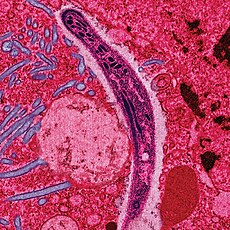
A Plasmodium, the living entity that malaria consists of

Whether a population acquires immunity to a disease through antigens or through mutation, the greatest danger to the safety, health and well being of the public can come not from exposure to the disease, but from its complete and total eradication and then an accidental or deliberate reintroduction.

Take the case of the recent cholera epidemic in Haiti. Cholera had been completely eradicated among the Haitians for about a century. As a result, no living person in Haiti had any immunity to cholera. Then in 2010 there was an earthquake. The UN sent in a peace-keeping force that included Nepalese who carried cholera. In short order, one in sixteen Haitians came down with the disease and eight thousand have died of it.

http://www.npr.org/blogs/health/2013/01/12/169075448/after-bringing-cholera-to-haiti-u-n-plans-to-get-rid-of-it

One of the benefits of being a first world country may be low exposure to many epidemics. Some people think we should try to eradicate all disease. In doing so, we would be freeing ourselves from the last source of natural selection for our species, as we have eliminated all other predators long since. But one of the dangers of artificial eradication is complete lack of immunity and total helplessness in the face of the accidental or intentional reintroduction of the pathogen.

Today, we have new people, some of them mere children, coming in to the United States through our southern borders, Many of them may have been exposed to diseases that we have eradicated a long time ago. They may be healthy and immune, but our lack of exposure can make us vulnerable. The balanced approach to disease control is to acquire immunity naturally, rather than trusting that we will never be exposed again.