Showing posts with label Theodosia Burr Alston. Show all posts

Saturday, October 3, 2015

Ships Names: "The Patriot" and "La Diligente"

Theodosia Burr Alston was last seen on board The Patriot  on December 31, 1812. That was also the last time The Patriot itself was ever seen. At least, it was never spoken of under that name again. But did you know there is a long history of ships named The Patriot? It is a very common name for a ship.

Ships named the Patriot


The above link is to a database of reference to ship names. There have been many such ships over the years, including during the 20th century. But it is interesting to note that even during the War of 1812 there were ships named Patriot on both sides of the ocean.


Once a ship was captured, its name was often changed, and it was put to good use by new owners. Could the ship named The Patriot on which Theodosia was sailing have been captured? Might its name have been changed? In Theodosia and the Pirates: The Battle Against Britain that is exactly what happened:  The Patriot was renamed La Diligente.


Saturday, September 26, 2015

Theodosia Burr Alston's Disappearance was Used in Anti-Privateer Propaganda

There are many stories about what may have happened to Theodosia Burr Alston after she boarded The Patriot on December 31, 1812. Most of those stories involve pirates: pirates forcing her to walk the plank, pirates turning her into their love slave, pirates slitting her throat because they are after her jewels. Every such story was used to hurt Theodosia's father Aaron Burr, both personally and politically,  and in the process to bolster the Neutrality Act under which he was persecuted for his expedition against Spanish held Mexico.

It is one of the practices of the political propagandist to recruit as victims of the policies they are against people near and dear to their political enemies. So it should come as no surprise that some of the people accused of killing Theodosia were not pirates at all, but rather law abiding privateers. One of these was Captain Jean DesFarges, who while working for Jean Laffite, was accused of piracy for taking as a prize a Spanish ship named the Filomena . This occurred about seven years after Theodosia's disappearance. The purpose of the prosecution and later hanging of DesFarges and his crew was to discredit Jean Laffite and his privateering establishment in Galveston. As part of the general smear campaign,  a baseless story was published to the effect that DesFarges had confessed to murdering Theodosia.

The following newspaper account, countering the "pirate" story, from The Famer's Repository, Charleston, W. Vrginia, August 30, 1820 was provided to me by Pam Keyes;

The New Orleans Advetiser of August 21 contradicts the story in the New York prints of June 1820, of certain pirates, executed at New Orleans, having confessed they composed part of the crew of the pilot boat Patriot who murdered Mrs. Alston. The Advertiser discredits the whole account: and upon the testimony of the Rev. Mr. Larned, who attended them in prison from the day of condemnation to the moment of their being swung from the gallows, "It did not appear that they had ever stained their hands with blood."

Nevertheless, the legend of Theodosia having been done away with by pirates lives on. And very few people understand that DesFarges and his crew were not pirates. Likewise, Jean Laffite is known as a pirate, and Aaron Burr, while acquitted of treason, is known as a traitor.  This is how political operatives kill two birds with one stone.

Saturday, April 4, 2015

Do You Have to Be at Home to Homeschool?

I was reading a blog the other day in which a mother who devoted her entire day to homeschooling her two boys felt overwhelmed, and she did not seem to be able to accomplish anything else in her life.

I thought back to the time when I was home schooled by my own father, from age thirteen to age sixteen. My father did not stay home to homeschool me. He continued to work. My mother was the one who stayed at home and prepared the meals and made sure that the household ran smoothly. But my mother was not my teacher. She did  not supervise my lessons or grade them or do anything that pertained to my school work. She did prepare my lunch, and she took care of my much younger brother all day. But my father was the headmaster of our school, and he taught all the classes, except for English. Because he was not a native speaker of English, he delegated that task to an English teacher who came by once a week.

                                                     Me in my home school T-shirt
                                                     Our school was named after the Israeli poet

Once a week, on Sunday, my father would have a long teaching session with me. Sometimes he was quite frustrated with my lack of talent in mathematics. Sometimes I was quite frustrated by his uncompromising teaching method that did not adapt to my limitations. But even though I did not accomplish everything he had hoped for me, the homeschooling was not a complete failure, as I was able to gain knowledge of history and languages and literature that is far greater than most American students get in high school. At sixteen, I began college.

Whatever regrets my father may have had about the homeschooling experiment, his entire self-worth was not tied into it, as he never gave up his life's work to engage in it, and he continued working on many other projects, both at his place of employment and at home, while he was also running our little home school. He was not so overwhelmed that everything else fell by the wayside. And as a result, I also did not see him as exclusively my teacher or caretaker. In fact, even when he was my only teacher, he was never my babysitter.

I got to know my father as a person, and I did not judge him solely on his success or failure as a teacher -- or as a parent. I was very much aware of his other accomplishments

                                          My father and I at the airport with one of his planes
                                          Aza, our dog, is careful as she approaches.

The same thing, I believe, was true of the relationship of Theodosia Burr with her father.


http://www.historiaobscura.com/aaron-burr-as-a-father/

Burr directed Theodosia's studies while serving in the Senate and was always correcting her compositions, even from a distance. However, his duties as a father did not keep him from following other pursuits and having a career of his own.  He was not so overwhelmed by directing his daughter's studies that he could accomplish nothing else.

One of the problems with today's conception of homeschooling is that it attempts to replace the public schools, and the public schools keep students occupied all day long, because one of their main functions is to babysit children, replacing the stay at home mother or nanny, more so than the tutor or the father who directs a child's studies while doing something else, too.

Parents do not have to be nannies in order to be good parents. Those who instruct their children do not have to stay home, and even if they do stay home, they can follow other pursuits. A teacher, to be a good teacher, does not have to keep a child occupied all day long. Even a mother who stays home is entitled to some time to herself. But in order to let the mother have that time, you also need to loosen the reins on the children. They need to have some free time, too.

Sunday, July 13, 2014

The Benefits of Acquired Immunity

We've all heard the adage "Whatever does not kill you makes you stronger" or "the meek shall inherit the earth". I think these sayings don't really apply to every situation, and many people misinterpret what they mean. It is not true that anything that does not kill us will make us stronger. Many people have emerged maimed and scarred for life out of situations that did not kill them. It is also not generally true that meek or the poor have the opportunity as individuals to rule the world. But it is true that because of their exposure to situations that more powerful or wealthy people are able to avoid, the children of the poor tend to be stronger and healthier and more resilient than those of the rich. Nothing illustrates this more clearly than how the course of disease decided battles during the first half of the nineteenth century.

Yellow fever is a case in point. The following article by Pam Keyes describes how Napoleon's loss of Haiti and his decision to give up Louisiana were almost entirely decided by the immunity to yellow fever of the Haitian blacks and the complete vulnerability to the disease of the French troops sent to put down the rebellion:

http://www.historiaobscura.com/yellow-fever-napoleons-most-formidable-opponent/

Yellow fever was also instrumental in the fall from grace of Edward Livingston. He was holding two offices in New York City, one local and one Federal, when he took sick while attending to his duties as mayor. While he was ill, a subordinate embezzled money from the funds of the Office of the United States Attorney to which President Jefferson had appointed him. Livingston was forced to resign, turn over his entire fortune to the Federal government and try to start a new life in New Orleans. Jefferson never forgave him. However, having survived yellow fever, Livingston was extremely resilient, lived through the War of 1812 as a prominent citizen in New Orleans, and was able to attain to the high federal office of Secretary of State under President Andrew Jackson.

http://www.historiaobscura.com/edward-livingston-a-famous-man-that-few-have-heard-of/

Malaria was another disease that played havoc with unexposed populations, while sparing the adult slaves who could not avoid exposure.

http://www.historiaobscura.com/malaria-in-colonial-america/

In South Carolina during the War of 1812, malaria not only took the life of Governor Joseph Alston's only son, Aaron Burr Alston (Gampy), it also made it impossible for him to maintain discipline in the state militia.

http://www.historiaobscura.com/governor-joseph-alstons-record-in-the-war-of-1812/

Because the rich planters had avoided exposure to malaria by fleeing the area during the hot season, they were spared the high infant mortality that black slaves were exposed to, but they ended up with children who had not acquired immunity to the disease, and as adults were useless for military service in the field. If instead they had allowed their children to be exposed to the disease, then infant mortality would have been higher, but surviving children, and hence military-aged adults, would have been immune.

Immunity to malaria is acquired differently from the way immunity to yellow fever works. In the case of yellow fever, those surviving the disease acquire immunity by antigens in their bloodstream. Infants and persons under the age of five suffer a much milder disease, so that exposure at an early age is beneficial, and infants of mothers who have had yellow fever have what is known as passive resistance.

Immunity to malaria, on the other hand, involves genetic changes through natural selection. Malaria is said to have placed the greatest selective pressure on the human genome -- more than any other disease --  in recent years. Genetic immunity is acquired, among other paths,  through the sickle cell trait, which can lead to sickle cell anemia in those who are homozygous -- having two copies of the allele -- but does not lead to anemia in those who are heterozygous or have just one copy. In other words, the trait is recessive and is helpful enough for survival that it remains in exposed populations despite the risk of anemia to some descendants.


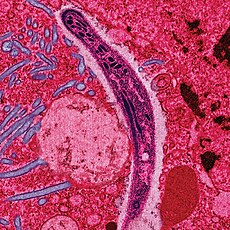
A Plasmodium, the living entity that malaria consists of

Whether a population acquires immunity to a disease through antigens or through mutation, the greatest danger to the safety, health and well being of the public can come not from exposure to the disease, but from its complete and total eradication and then an accidental or deliberate reintroduction.

Take the case of the recent cholera epidemic in Haiti. Cholera had been completely eradicated among the Haitians for about a century. As a result, no living person in Haiti had any immunity to cholera. Then in 2010 there was an earthquake. The UN sent in a peace-keeping force that included Nepalese who carried cholera. In short order, one in sixteen Haitians came down with the disease and eight thousand have died of it.

http://www.npr.org/blogs/health/2013/01/12/169075448/after-bringing-cholera-to-haiti-u-n-plans-to-get-rid-of-it

One of the benefits of being a first world country may be low exposure to many epidemics. Some people think we should try to eradicate all disease. In doing so, we would be freeing ourselves from the last source of natural selection for our species, as we have eliminated all other predators long since. But one of the dangers of artificial eradication is complete lack of immunity and total helplessness in the face of the accidental or intentional reintroduction of the pathogen.

Today, we have new people, some of them mere children, coming in to the United States through our southern borders, Many of them may have been exposed to diseases that we have eradicated a long time ago. They may be healthy and immune, but our lack of exposure can make us vulnerable. The balanced approach to disease control is to acquire immunity naturally, rather than trusting that we will never be exposed again.

Saturday, May 31, 2014

Unrequited Love of Country

As the publication date for Theodosia and the Pirates: The War Against Spain approaches, I am having to find new ways to describe the book. Publicists and readers alike want to know: what is your book about? Why did you write it? What's in it for me?

There are many, many different ways to answer that question. Today, I want to give an answer that focuses on patriotism. And not just any kind of patriotism, but passionate,  unrequited love of country.


When I set out to write Theodosia and the Pirates, I was a little tired of unrequited love. I had just finished writing the first half of Our Lady of Kaifeng, which is a story about a woman who travels halfway across the world in the hopes of having a conversation with someone she loves, but who does not love her.


It was quite a release to be able to write a joyous story of love that is reciprocated, and in part, that is what Theodosia and the Pirates represents for me. But as I was writing it, I became aware of a theme of rejection that ran just under the surface. And this rejection was not about the love between a man and a woman. It was about being rejected by your own country, or by a country you love and long to help.

How does this theme manifest itself? Here are a few instances:


  • Zora Nadrimal, Jean Laffite's grandmother, was a loyal Spaniard. And yet she and her husband were arrested and tortured by the Inquisition, and she was forced to flee the country after her husband's death, never to return. Spanish was still her native language. She raised her daughter speaking Spanish. She spoke Spanish to her grandchildren and educated them in the culture of Spain. But how did she really feel about her native country? What about her behavior inspires Jean to take up his "War Against Spain", an endless vendetta against the country that rejected his grandparents?
  • Theodosia Burr Alston was a loyal, patriotic American. Yet her father was accused of being a traitor, and even after he was acquitted of the charges, his name was dragged in the mud. If you open a history book today, Aaron Burr is known for two things: killing Alexander Hamilton in a duel, and plotting to "separate the Western territories" from the United States. Burr went into exile for a time after his acquittal, but he returned to the United States and lived in poverty and obscurity for the rest of his life. How did Theodosia Burr really feel about the country that could do this to her father, after he had been a revolutionary war hero, had served as Vice President, and had always championed the freedoms of all Americans?
  • Jean Laffite, despite being a hunted man, gave the Americans information about their enemies the British that was designed to help them avoid being conquered. What did they do in response? They sent a raiding party against him. He ordered his men not to fight back against the looters, and even after his ships were stolen and storehouses looted, he contributed to the American cause by donating gunpowder and flint, artillery and trained cannoneers, and he fought for the US cause right alongside the men who looted him: Patterson and Ross. Yet when the conflict was over, he was never compensated for what was taken from him, and he was forced to find another place to continue his privateering business. Not content with driving him out of Barataria, the Americans required him to leave Galveston, too. And even when he was enlisted in the Columbian Navy, the  Americans were still out to get him. What would you feel toward a country that did that to you? Paradoxically, Jean Laffite felt only love for the United States of America, despite the actions of its government. 

Some people feel that everything in life is based on turn taking and reciprocity. It's all you scratch my back and I'll scratch yours. But real love, whether it is for a person or a country, is not like that. True love transcends the need for reciprocation.

That's the big theme in Theodosia and the Pirates. It was present in the first book from the beginning, but it is given a final expression in The War Against Spain. Sometimes love of country is so strong, that it transcends borders and rulers. It is like a weed that flowers despite everything that is done to eradicate it. In this sense, the book is a tribute to the triumph of love over hatred.


Saturday, February 15, 2014

The Nature of Love

Yesterday was Valentine's Day, and I posted a dry article about types of love. Today, I would like to share a discussion about the nature of love from Theodosia and the Pirates. I read from this part of the book to Bow a long time ago, and all the comments I got were about chimpanzees. So I am going to embed the video here for people who are actually capable of attending to the content. Bow, I think, was more interested in the novel than those who watched the video!


You can follow along as I read with these excerpt snapshots from the novel:


After you have listened to the reading and/or read the snapshot excerpts, think about the following questions:


  1. Do you approve of teenaged marriages, like those of Jean Laffite with his first wife Christina Levine or of Theodosia Burr with her husband Joseph Alston? Why or why not?
  2. Who was right about the proper age for men to marry -- Aristotle or Benjamin Franklin?
  3. What sort of love do you think Theodosia and Jean had in this section of the book? Attachment and Bonding or Limerent? Or was it some other sort?

Thursday, February 6, 2014

Connections between Theodosia Burr Alston and Jean Laffite


The first time I met Theodosia, I was reading Gore Vidal's Burr. And she had a bit scene. She was not an important character at all. It was during the period when Jefferson and Burr were tied. Theodosia was about to go off on her honeymoon. She was about to be married, and she said to her father that he should grab the presidency while he still could, and he should not keep his promise to Jefferson. And he made some kind of joke about her honeymoon or her wedding night. It was a very kind of light banter. That scene made a really big impression on me, so that years later, I decided to read up on Theodosia herself.

And having read her entire life story, the tragedy of her death or disappearance -- whatever it was that happened to her after she boarded that ship The Patriot -- I decided that someday I was going to rescue her. I was going to give her a happily ever after, because I thought she deserved it.

Now, the first time I met Jean Laffite, I was reading the Journal of Jean Laffite. And the reason I was reading it was that I was looking for someone to rescue Theodosia. And at the time my interest in Jean Laffite was contrived. The idea of bringing them together was contrived. But as I got to know Jean Laffite better from his own words and his own description of the world he lived in, and  not just the great deeds that he did, I saw that there was a connection. And the connection involved Texas, the plans to conquer it. It involved being a filibuster. It involved being very patriotic and supporting Jefferson, and there was one person who appeared in both stories. It took me a while to figure this out. Because every biography that I had ever read of Theodosia mentioned a compliment paid to her by Edward Livingston.

It was something to do with being careful because her beauty might ignite the sparks -- or cause sparks -- and ignite a French frigate that he was escorting her on. Now I didn't understand what the significance of this compliment was, because, frankly, I didn't know who Edward Livingston was. I'd never heard of him, until he appeared again in the Journal of Jean Laffite. And Jean refers to him as his lawyer, Ed Livingston. It took me a while to figure out that was the same Ed -- the same guy.

In Theodosia's biographies, mentioning Edward Livingston was like name dropping. It would be equivalent to someone saying that someone from my period had been paid a compliment by Henry Kissinger or Alexander Haig. Now years in the future, nobody is going to remember who Henry Kissinger was. He just wasn't important enough to appear in long term history. But for the short term he was an important guy. Same thing for Al Haig. Edward Livingston was extremely important during the period when Theodosia and Jean Laffite were alive, but nobody really remembers him now. Lots of things are named after him, but if you ask a school child who Edward Livingston was, you're going to draw a blank. And most grown ups don't know, either. As I said, he was mentioned in the biographies as a kind of name dropping to show how important Theodosia was and how she was admired by the important people of the day. Although it does fall flat on the ears of someone who has no idea who this guy is.

But when Jean Laffite mentions Edward Livingston, he's not name dropping. Edward Livingston was actually somebody who was involved in his business and his life, and he really didn't feel that Edward Livingston was more important than himself, or that Edward Livingston's contributions were more important than those of Jean Laffite.

So, one of the things that I learned after I got to know Jean Laffite better was how very much in the same world he and Theodosia were living. Did they ever meet? I don't know. But it's entirely possible that they did. Whether before or after she disappeared, I don't know.


This book is a romance, and it's fictional. But if you really want to understand what happened in those days, what the power struggles were that people were facing, and possibly the effect of the politics of the day on what is happening to us right now, you should read it. It isn't just fantasy.  It's about connections that you haven't made yet -- that I hadn't made yet, until I met Theodosia and Jean..

Wednesday, February 5, 2014

Criticism of Theodosia and the Pirates

As you probably know if you've ever read a synopsis of Theodosia and the Pirates, it's a speculative historical romance based on the idea that when she was lost at sea, Theodosia Burr Alston may have met Jean Laffite and fallen in love with him, and the two of them may then have gone off to save the United States from the evil British together.

Realistic? Maybe not. But romantic, exciting and patriotic, definitely. And yet there were those who found this notion offensive.


None of the Jean Laffite aficionados was offended by this plot device, but Theodosia apologists were. Is there a double standard in play here? And why do people like having pirates as bad guys in historical novels set in the War of 1812, when it is the British who behaved badly toward the American public?