Showing posts with label Libertarian Party. Show all posts

Monday, February 19, 2018

Libertarian Ideas Are About Repealing Government Mandates

Libertarian positions on any issue are about repealing government mandates. They are not about telling other people what they should or should not do.

The essence of the libertarian doctrine


Here are a few libertarian positions:


  • Taxation should be repealed.
  • Mandatory Education should be repealed.
  • Mandatory Health Insurance should be repealed.
  • Mandatory service -- military or otherwise -- should be repealed.
  • Government funding of any product or service should be repealed.
  • Government prohibition on the possession of any product or object or animal or thing should be repealed.
  • Government interference in freedom of contract should be repealed.
  • Any law telling people what to do in their private lives with other consenting adults should be repealed.

Here are some examples of non-libertarian positions:

  • Telling people that they should educate their children.
  • Telling people what they may or may not say, write or publish.
  • Telling people what religion they may belong to. 
  • Telling people how to prepare food.
  • Telling people what substances they may imbibe, inhale or eat.
  • Telling people how to use their money.
  • Telling people what sorts of agreements they can make with other people.
  • Telling people that if they are not educated enough or wealthy enough they should not have children.
  • Telling people what they may not do for a living. 
This should not be all that hard to understand. And yet I constantly hear people who hold office in the Libertarian Party saying things about what people should do. Just stop it! You are not helping the cause.

Here is a recent discussion about some of these issues that I had with Julia Hanna.


Monday, October 2, 2017

Neither Populism Nor Elitism

The people who disagree with my proposal to change the Libertarian Party Bylaws have trouble classifying me and my motives. Half the time they accuse me of being a populist. The other half of the time, the accusation is that I am an elitist. I am neither. I wish everybody could have a veto on everything that affects himself and no say at all on anything that affects only others. In the free market, each person does get a vote on precisely those things that pertain to himself. I wish we had a free market for government, too. But barring that, I want to make sure that representation, when representation is meted out, does not all go to the majority. Why? Because the closest thing to freedom, under any form of government, is checks and balances to make sure that one group of people cannot victimize another group of people just because they outnumber them. Which is why I keep bringing up the Constitution of the United States as an example of limited government. I don't do this because I think the constitution is divinely inspired or the most perfect document imaginable. I do it because it is an example we all know about, and it seemed to work for a short while, before it was so altered that it stopped working.

Populism is letting everyone vote on everything, and allowing the majority to decide all things for everybody else. Elitism would be allowing a small number of select people to have the only votes and to decide everything for everybody else. What I want to do with my proposal is to allow the majority to elect the presidential nominee, but then let the next highest minority choose the vice presidential nominee.

My proposal is not more populist than the current provisions in the Bylaws, because it takes power away from the majority to decide everything. But it is also not more elitist than the current provision in the Bylaws, because the minority who gets to elect the vice presidential nominee is not defined in advance. It is not an elite group of people who know they are the elite. It is not going to be the same group of people each time. It is not based on financial status or skin color or gender or even belonging to a particular faction of the party. It is just the next most numerous group who happen to agree on their choice of a presidential nominee after the winning group. In all likelihood, just like the winning group, the second group will consist of a diverse part of the Libertarian Party membership who just happened to support the VP nominee as a better presidential nominee than the one chosen by the majority. Every time we go in to vote as delegates, we will not even know in advance which group we belong in: majority or minority.And that is the beauty of the proposition. The Silver Rule we all should follow is: When you are in the majority, treat the minority the way you would have them treat you if you were in the minority and they were in the majority. Isn't that a great rule? Wouldn't you like to see it implemented in our party's bylaws?

People have asked me: Why can't we just have a second election where the vice presidential nominee is chosen? Because the same majority that chose the presidential nominee will be able to choose the vice presidential nominee, if majority rule is what we are going by. So it really does not matter if they run as a ticket or are chosen separately: if the same people are choosing them, the same choice will be made as if they had been running as a ticket, so long as this is what that faction wants to do. Only if a Presidential nominee supported by the majority does not choose a running mate will the practice of having two separate votes for POTUS and VP nominee make any difference at all.

When I patiently explain this to opponents of my proposition, some retort that it would be like handing out trophies to losing contestants out of a desire to spare their hurt feelings. They speak about it as if a political race were like a physical race to determine who can run the fastest, or a beauty contest to see who is the fairest of them all. And by fairest, I don't mean who has lily white skin like snow white. What then is "fair"?

People argue that fairness in such a competition is to award the prize to the fastest runner or the most beautiful contestant. Handing out a trophy to a loser would be unfair and smacks of political correctness or worse, SJW shenanigans. Letting the VP be a person not supported by the majority would be like handing out prizes for participation, they say. But in an actual race to see who can run the fastest, the second and third best do get trophies routinely, and even Miss Universe has a first runner up who will replace her in the unlikely event that she is disqualified or otherwise unable to serve. Even when casting parts in a play,  a producer will select an  understudy, who is usually someone deemed less desirable than the person cast, but still good enough to step into the part in the case of an emergency. Choosing the second-best person as spare in the event of a disaster is actually a very normal practice in real world selection processes not involving politics. The Vice President of the United Stares was originally intended to be the second runner up or understudy to the President. It's only through a convoluted series of historical events that that was ever changed.

But besides all of that, there is this: Our choice of Libertarian Party nominees for President and Vice President is not a reward to the candidates for a job well done in running such a nice campaign prior to the national convention. Those people are chosen to represent us. And they will -- whoever they are -- in all likelihood represent precisely the interests, not of everybody, but of those delegates who selected them.

That's why voting for the "best man" is almost beside the point in politics. "Best" is only meaningful in relation to what it is you hope to achieve. As libertarians, what we should all hope to achieve is minimal involvement by government in our lives. But for some reason, individual libertarians tend to have pet areas of non-intervention by government, while looking the other way when it comes to other forms of intervention. If we want to have an honest libertarian campaign, we need people on the ticket who represent a wide spectrum of areas in which we do not want the government to intervene in people's lives, ranging from economic issues, to religion, to personal choices of lifestyle to freedom of speech and association. This is important to each of us, and it is important to the Libertarian Party as a whole.

I am not a "typical" libertarian, nor a typical "conservative" nor a typical "radical"
When I joined the LP and supported AP my biggest immediate concern was US Fish & Wildlife confiscating chimpanzees
I am a minority of one -- and so are you!
When the Founders decided that we should have checks and balances built in to the government they were organizing, they could have just divided the Federal government into three branches and then let all the people vote en masse for each office holder in each of the branches. But they understood that if the same majority got to elect all the office holders, then it would not matter that there were different individuals in each of those offices -- they would all still serve only those special interests who had been able to cobble together a majority, leaving the minority unrepresented.  That's why they chose for Congress to have two houses, the lower one to represent the people and the upper one to represent each State. That is also why there is an electoral college, and the people do not elect the President and Vice President directly. It is why Federal Judges are appointed and not elected at all. It is why the Justices of the Supreme Court are appointed for life. All of this is done in order to divide the power of those who rule over us, so that no one will be able to run roughshod over anyone else, just because they happen to command a majority at the moment. And this is why one man, one vote was never a slogan of the Founders. By the time we got to one man one vote as the ideal, our Republic was already well on its way to becoming a democracy. And a democracy is the least libertarian of all forms of government for one simple reason: in a democracy the "people" never vote not to hurt others and not to take their stuff. They vote to only hurt the minority and only take the stuff belonging to the minority. And even though it always turns out the people they voted for do hurt them and do take their stuff, the "people" always persist in trying to vote in new representatives who will only hurt others and only take away other people's stuff. To put an end to this cycle, we need to get away from the illusions and delusions of majority rule. We need to get to a point where everyone realizes that if they vote to take away stuff, it will be their own stuff that is taken. And if they vote to hurt people, they are the ones who will get hurt.

Yes, the Libertarian Party is a private club. Yes, we can make up whatever rules we damn well please. The rules do not have to be fair at all, and anyone who does not like the rules can leave. But if our aim is to take over the government so we can leave everyone alone, shouldn't we start by showing a little more wisdom in how we run our own house? Shouldn't we serve as a shining example to everyone else that our party is not like the others?

RELATED


Thursday, September 14, 2017

Proposed Libertarian Party Bylaws Change

This is the Proposed Change
Things marked in Blue are added to the original. Thing struck out in red are removed from the original Bylaws.

This is my proposed change to the Bylaws of Libertarian Party of the United States. Here is my rationale for the proposed change:

In order to allow maximal representation to the delegates at the convention, including those whose first choice of presidential nominee is not selected by a majority of their peers, and to prevent a vice-presidential candidate who is not considered by the delegates to be fit to be the president from serving in the capacity of vice-presidential nominee, it is best to select the candidate for presidential nominee who received the second highest number of votes in the final ballot for presidential nominee to serve as our vice-presidential nominee. This will also save a lot of time in superfluous nominating speeches, as no vice-presidential nominee will require an additional nominating speech besides that already given before the election for presidential nominee takes place.
For an in-depth discussion of the proposed change, including answers to questions posed by those arguing against the change, see the video embedded below. 


RELATED POSTS


Monday, May 8, 2017

2017 Appearance, Review and Bio


I will be a featured speaker, along with Will Coley and Bill Redpath at the 2017 Missouri Libertarian State Convention on July 22, 2017 in Jefferson City. My topic will be "Show Me What You want to Tax and I Will Show You What You Will Destroy."

I am very excited about this opportunity, Meanwhile, though we did not get a public celebration of the 200th anniversary of the  founding of Galveston this April, a new review of Theodosia and the Pirates: The War Against Spain has come out this year by a Top 100 Amazon Reviewer.


There is also an new biographical entry in the LPedia about me as a libertarian author.


For me, 2017 will be a year not for writing new books, but for speaking out about the books I have already written. The new audio version of Vacuum County as read by Kelly Clear should be out in late August. And perhaps for the first time, my writings will have a clear genre designation in which they legitimately belong: libertarian.


Monday, November 7, 2016

Compromises and their Price

Most people work at jobs that they don't really like, but find tolerable enough to sustain them. They marry individuals that they don't quite respect, but who are at least kind enough and supportive enough to get them through the day. They vote for political candidates they are deeply suspicious of, but at the same time, these are the best candidates available to vote for, from their own personal perspective.

We can't expect to change the world in one fell swoop, so we are conditioned to get along with others and work together for small improvements in our lives. Arguably, there's nothing wrong with that -- except when we turn around and see the changes wrought in the landscape of our society by all these small, seemingly innocent compromises.

I recently watched the Tim Burton movie, Big Eyes, about the artist Margaret Keane and her domineering conman of a husband, who catapulted her art into fame, before she exposed him for the fraud that he was.


In my daughter's bedroom there is a print of a  painting of a cat that looks as if it might have been painted by Margaret Keane. If it is not actually painted by her, then it must have been a conscious, intentional imitation. It looks just like her art.  I got this painting from my parents. It used to hang in their house. It is a relic from the sixties and early seventies.


When my daughter was very little, she really liked this cat painting and even identified with it deeply, thinking that if she were a cat, she would look like that. Then, later, it scared her, because of those big spooky eyes, and she took it down off the wall and hid it. Then, later still, she put it back up.

Margaret Keane's art is confusing like that. It moves us, then it scares us, and then after a while we come back to it. Or maybe we decide it is kitsch, and later still we realize that there is a history there, and no matter what base instinct within us it appeals to, it is still definitely art.

But did you know the history of the paintings? Did you know that her husband took credit for them? Or that in all probability we, the public,  would never have seen any of her paintings, if not for the false origin story he spun out of thin air, to make the emotional appeal seem to have a bigger, almost political meaning? I did not know until after I had seen the movie Big Eyes. And all this made me think of the Election of 2016, where nothing is quite as it seems. Read my LibertyBuzz article, to see how it all ties together.

http://libertybuzz.us/story/libertarians-imposters-among-us/2016/11/07/1213/


Wednesday, July 27, 2016

Austin Petersen on Balancing Force and Freedom


I thoroughly enjoyed the conversational style and the deep content of Austin Petersen's live stream last night, so I am going to share it here. Austin Petersen is a Minarchist, not an Anarchist. He admits that he identified much more with Darryl Perry than with Gary Johnson at the Libertarian Convention this year. But... he can't quite bring himself to subscribe to the NAP. Because, what if grandma catches a burglar on her own? Should she have to keep him imprisoned in her basement forever without anyone else's assistance?

This is a discussion not about what we are going to do in 2016. Right now Gary Johnson is the Libertarian Party Presidential candidate, and we are all supporting him. There is no one better on the ballot. But in four years' time, the issue will come up again.

Gary Johnson is a Pragmatist, not an ideologue. John McAfee got the celebritarian vote. Adam Kokesh is a sincere Anarchist. Petersen would prefer not to run against Kokesh in 2020, because he does not want to tear the Libertarian Party apart.

Petersen would accept an Anarcho-Capitalist over a Statist "any day", he said.


Kokesh and Petersen have debated before. You can see the full debate in the video above. The point at which they seemed to disagree was when Petersen suggested that even a voluntary collective that makes rules such as "don't hurt anyone or take their stuff" would eventually be a government. Petersen believes that you can never entirely eliminate coercion, but he would like to minimize it. It's the enforcement mechanism to voluntary agreements that is the sticking point.

Petersen defined government as a collection of people who create a monopoly on the use of force. He seems to think that such a monopoly is necessary to some extent. He believes in freedom for everyone, he realizes that we can only enforce it at home. Abroad, he favors non-intervention.

Not everyone can consent to be governed, Children, the disabled and some Democrats are examples of such people. To which Kokesh replies:
So if you can't consent, someone else is going to govern you... So if you don't meet Austin's standard of intelligence, whether its because you're a Liberal or a Statist or a child or a disabled person then you are not entitled to those rights. If you cannot consent to be governed, we're going to govern you, anyway.
Kokesh's point  was that rights should apply equally to all people, even the mentally disabled, In this respect, Kokesh seems more of a purist and Petersen a pragmatist. However, compared to someone like Gary Johnson, Petersen is numbered among the ideologues, and Johnson is the Pragmatist.

What if Petersen and Kokesh run in 2020 for the Libertarian presidential nomination and cancel each other out -- leaving an establishment candidate like Johnson to win? Petersen is not sure that running against Kokesh is the right thing to do.

This all comes down to the NAP -- the Non-Aggression Principle. Petersen is afraid that the moment we contract out our rights to a defense agency, then that agency will be a de facto government, no matter what we choose to call it. This is true if that agency acquires an exclusive monopoly on law enforcement and judicial practices. But what if we didn't grant anyone a monopoly on justice?

The local, neighborhood policeman is our friend, as long as he has no special rights to enforce laws that the rest of us do not have. It's when police officers can carry guns and we cannot, can wear body armor and we cannot, can arrest us, but we cannot arrest them, that the police officer becomes the enemy.

I think that Austin Petersen should run on a platform of the right of all citizens to use force to uphold the law. If someone is violating our rights, we get to use deadly force to defend ourselves. We can also ask our neighborhood policeman to help us, if we can't manage the task all on our own and pay him for his help, but the policeman will not have more rights than we do. It will be just as it is today with our volunteer firefighters. It is okay to call the fire fighters for extra help in a pinch. But there is no law that says we are not allowed to put out the fire on our own, too.  Then Adam Kokesh will not be able to object that this privileges some people over others. And Petersen will still be better at representing the Libertarian position, because he understands how to talk to ordinary people and not just ideologues.

Does grandma have to imprison the burglar she caught in the basement forever? Certainly not. She can hire a warden if she wants to and pay him. The neighbors can all pitch in, too, if they feel it's a good idea. But nobody will be held at gunpoint to pay for the local prison.

Anarchists and Minarchists should all agree on this. And then Petersen will explain it to the general public without using scary words like Anarchy. It's all common sense, really.

Problem solved!

Tuesday, June 7, 2016

Politics: A Game of Prisoner's Dilemma

In the classic scenario of Prisoner's Dilemma, two prisoners who are co-conspirators are kept in separate cells. Each of them is promised leniency if he agrees to testify against the other. If the other testifies against the one who stays silent, then the prisoner loyal to his friend will get the harsher sentence.  If both of them refuse to testify, both will be set free. So it is a matter of trust -- can I trust you? Will you betray me? In this way, the authorities pit people against one another. Those who trust unwisely will get a harsh sentence. Those who trust and can be trusted will be set free. But those who betray trust will do better than those who are too trusting. So the lowest common denominator prevails. If one person breaks, all is lost.

Photo Credit: Anna Shoemaker of Elleimaging.com
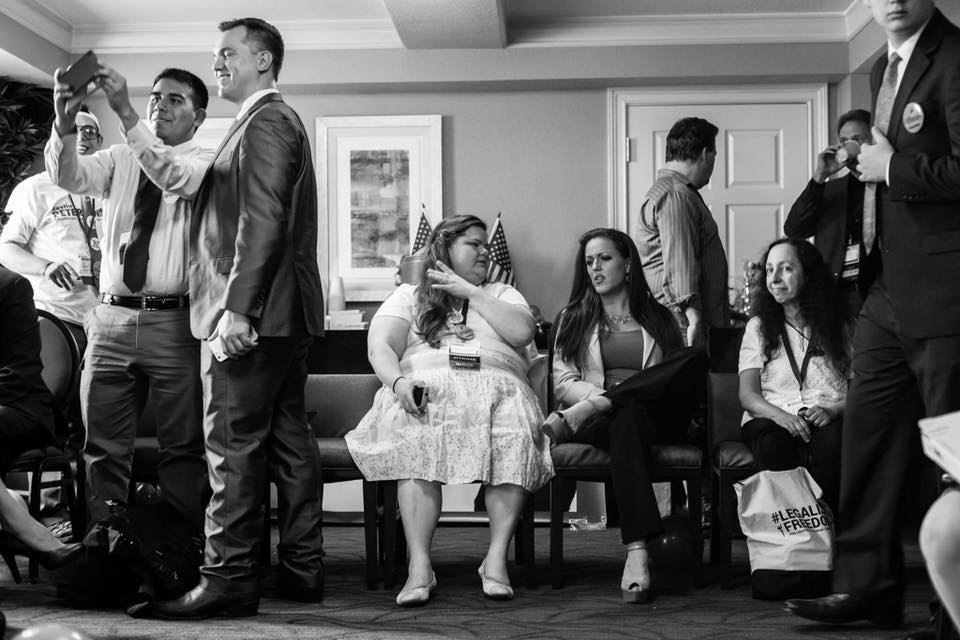
Austin Petersen, Lauren Turner, Resa Willis, Aya Katz
In a democracy, the same game of prisoner's dilemma is played out over and over again. People are told not to vote their conscience, not to consider what would happen if the candidate of their choice won -- but to avoid the result of having the worst possible candidate come to rule over them. They are told to betray their principles in order to avoid a harsher punishment. And so over and over again the electorate betrays itself as the voters attempt to outsmart each other.

When we go to the polls to vote, most of the important decisions have already been made for us. It's too late to make any difference. The choices on the ballot were selected for us by people behind closed doors. Or rather, they were chosen for us by the political parties, at their conventions. So if we want to have a voice in the choice that everyone else gets, the place to be is at the national convention of the party of our choice. That's why I went to Orlando for the Libertarian National Convention at the end of May.

A Scene from John McAfee's party
Inside the Rosen Centre Hotel, a group of diverse libertarian delegates met to choose a presidential and vice presidential nominee, as well as to fill national party offices, such as chairman, vice chair and secretary.

Some of the presidential candidates at the Libertarian National Convention were running to win, Others were running in order to get across some kind of veiled message. Judd Weiss, John McAfee's running mate, told us these images were his "artistic vision", after he conceded and announced he was not running for VP after all.


Do people behave better when they are trying to form a coalition with somebody else? Or does coalition formation always result in something much worse than what each faction wants?


Sometimes the idiosyncrasies of various participants can come out in the wash of a general coalition. But at other times the idiosyncrasies are magnified. Take John McAfee, for example. He threw the festive pre-debate party depicted in the video below, which featured strobe lights, psychedelic music and women on stilts.


These same women on stilts were present at the convention floor while McAfee gave his nomination speech. What did these women symbolize? And why, after we all lost, did McAfee scold the delegates for being all white males, when this was patently untrue?

Running to win or running to make a point, each candidate had a motive. This interview contrasts John McAfee with Austin Petersen.


In the interview above, McAfee says right from the start that he has no intention of winning the presidential race. Austin Petersen, when he gets a chance to speak, talks about polling and about support from outside the Libertarian party. Petersen, if granted the Libertarian Party nomination, would have run a campaign intent on winning the White House. But in order to win, he needed the nomination of his party. When CNN interviewed Austin Petersen, we his loyal supporters, were right there in the room while he explained his plan to form a cross-party coalition.

"I think I am the only candidate who can bring together a coalition of not just Libertarians, but of the NeverTrump conservatives and the NeverHillary social Democrats."
Meanwhile, Governor Gary Johnson was the favorite of the party establishment and of moderates who did not really espouse libertarian ideals, but were firm on a couple of popular issues: legalizing marijuana and establishing gay marriage on the Federal level through protected class membership.

I have already written about all my experiences at the convention here:

http://libertybuzz.us/story/experiences-libertarian-national-convention/2016/06/07/527/

I don't want to dwell on why it was that so many Gary Johnson votes appeared at the last moment, clinching his nomination. But in this blog post, I want to examine what it means to us as libertarians -- or simply as voters -- that coalitions seem always to go to the less principled member of the party. Rather than examining the motives of Gary Johnson and his followers, I want to dwell on what happened with our would-be allies who shared more of our core beliefs. Together, all those who did not vote for Johnson on the first ballot had a majority of the vote. All of us preferred someone else to Gary Johnson. Why could we not band together behind a candidate who shared our core values? Why did John McAfee not bow out when he saw that he could not win? Is it because he never intended any of us to win?

In the game of prisoner's dilemma that we call democracy, the failure to support a fellow prisoner is the cause of continued imprisonment for all. How can we ever break out of this game, unless we violate the NAP? Didn't the Founding Fathers do that?

There is one other way besides perfect faith among inmates to get out of prison. We don't have to play by the rules of the Prisoner's Dilemma scenario. We can just break out!  But that is hard to do without killing the guards. Must it come to that? What was McAfee hoping for when he broke faith with our cause?

Thursday, April 28, 2016

Endorsement of Austin Petersen


[This a Vlog Post in which the text is from the embedded video.]

I'm Aya Katz, and I support Austin Petersen for President of the United States. I first heard of him when he was talking about letters of marque and how we could cut down on our military budget by issuing them. Well, I... one of my favorite heroes is Jean Laffite who saved the United States during the Battle of New Orleans. And he did so by having a letter of marque not from the United States, but from the independent Republic of Cartagena. So what we need to do is to repeal the Neutrality Act so that Americans can get letters of marque from other countries in order to fight on our behalf without involving the United States in a declaration of war.

I also believe in cutting off all foreign aid to any country, and I do this with all the best intentions in my heart. Because I know that it would be so much better not to send money to Israel to bribe it not to fight its enemies, while at the same time sending money to the enemies so that they can build weapons.

And I am against U.S. Fish  Wildlife who want to confiscate the chimpanzees that belong to American citizens while sending taxpayer money to Africa.

So this is the reason I support Austin Petersen, and I hope to go to Orlando to help him get the nomination of the Libertarian Party.

Thank you.