Showing posts with label James Monroe. Show all posts

Friday, August 7, 2015

Patterson and Ross Awarded Laffite-owned Property They Seized

This week on Historia Obscura there is a very significant article by Pam Keyes.


http://www.historiaobscura.com/john-dicks-letter-to-monroe-honoring-the-baratarians/

The article gives the background for a letter written by John Dick, the US District Attorney for Louisiana,  to James Monroe, the Secretary of State, on behalf of the Baratarian privateers. President James Madison had just signed a blanket pardon to the Baratarians for their evasion of the Customs Taxes of the day prior to the Battle of New Orleans. Dick was glad he did not have to prosecute any of the Baratarians, because of their indispensable service to the United States that helped defeat the British.

But despite the presidential pardon, Pam Keyes notes in her article that property belonging to the Baratarians, and the Laffites in particular, which had been seized in the Patterson-Ross raid prior to the Battle of New Orleans, was awarded by Congress to the raiders, Patterson and Ross,  to have and to hold and to spend as they pleased.

A couple of weeks before Dick wrote his letter, and after the Baratarian indictments were dropped, Ross left New Orleans in March 1815 for Washington, D.C. to petition Congress with the help of a Congressional friend for the monies from the Barataria raid. The bill for the relief of Ross and Patterson was read for the first time in Congress on April 1816, a month before the sickly Ross died at a relative’s home in Pennsylvania. Jean Laffite went to Washington, too, but not until December 1815, when he wrote a letter to President Madison on Dec. 27 seeking recovery of the raid monies. Madison’s response is unknown, but at that time, he was not in Washington. On Feb. 22, 1817, President Madison signed into law an amended bill supported by Congress that directed the secretary of the treasury to pay Ross and Patterson $50,000 from the proceeds of the Barataria raid.
 We have to ask ourselves who were the pirates in this transaction, and who was the aggrieved property holder.

Monday, April 7, 2014

President Monroe on Withholding from the Wants of Others

When we consider how very badly things turned out for most Americans in terms of economics in 1819, it might be a good idea to go back to President Monroe's first address to Congress and see the rosy forecast he gave and the ways in which he predicted there would be revenue to pay off the national debt.

In calling your attention to the internal concerns of our country the view which they exhibit is peculiarly gratifying. The payments which have been made into the Treasury show the very productive state of the public revenue. After satisfying the appropriations made by law for the support of the civil government and of the military and naval establishments, embracing suitable provision for fortifications and for the gradual increase of the Navy, paying the interest of the public debt, and extinguishing more than $18 million of the principal, within the present year, it is estimated that a balance of more than $6 million will remain in the Treasury on the first day of January applicable to the current service of the ensuing year.
The payments into the Treasury during the year 1818 on account of imposts and tonnage, resulting principally from duties which have accrued in the present year, may be fairly estimated at $20 million; the internal revenues at $2.5 million; the public lands at $1.5 million; bank dividends and incidental receipts at $500,000; making in the whole $24.5 million.
The annual permanent expenditure for the support of the civil government and of the Army and Navy, as now established by law, amounts to $11.8 million, and for the sinking fund to $10 million, making in the whole $21.8 million, leaving an annual excess of revenue beyond the expenditure of $2.7 million, exclusive of the balance estimated to be in the Treasury on the first day of January, 1818.
In the present state of the Treasury the whole of the Louisiana debt may be redeemed in the year 1819, after which, if the public debt continues as it now is, above par, there will be annually about $5 million of the sinking fund unexpended until the year 1825, when the loan of 1812 and the stock created by funding Treasury notes will be redeemable.
It is also estimated that the Mississippi stock will be discharged during the year 1819 from the proceeds of the public lands assigned to that object, after which the receipts from those lands will annually add to the public revenue the sum of $1.5 million, making the permanent annual revenue amount to $26 million, and leaving an annual excess of revenue after the year 1819 beyond the permanent authorized expenditure of more than $4 million.
The Louisiana Purchase and  the debt that came with it were not President Monroe's fault. That he could not predict that cotton prices would go down as soon as Europe recovered from the wars it had been embroiled in, and the bad harvest of the year without a summer (1816), was also not his fault.  Many of the problems he faced as a president were inherited from his predecessors. But to allow the banks to renege and default on their obligations to depositors and to hold the Second Bank of the United States above the laws of the states for purposes of the application of ordinary contract law was in my opinion bad policy as well as unconstitutional.

In President Monroe's Address from December of 1819, he spoke of the drop in the price of both goods and labor:
The great reduction in the price of the principal articles of domestic growth which has occurred during the present year, and the consequent fall in the price of labor, apparently so favorable to the success of domestic manufactures, have not shielded them against other causes adverse to their prosperity. The pecuniary embarrassments which have so deeply affected the commercial interests of the nation have been no less adverse to our manufacturing establishments in several sections of the Union.
So it seems that the price of unskilled labor, of staple goods and of manufactured goods all went down at the same time. If this was the case, you would think that people who had money would in fact be doing very well. Those of us with a positive net worth are supposed to thrive under these conditions of reduced prices. Let's remember who those people are. They are not all rich. Some are widows and orphans and retired people who happen to have a nest egg and who hope to use that money to live on for the rest of their lives. Often they deposit such money in the bank. In a depression, they should do really well, because there is plenty of food and other goods to be had at a highly reduced price. This means retired people ought to be suddenly able to afford a higher standard of living than they otherwise could.

 But guess what? The people who had money in the bank were not able to use the money to buy more things, because the banks would not release the money! This is an aspect of what happened during the Panic of 1819 and of every subsequent panic, including the one in 1929, that people don't tell you about. Depressions are not bad because the price of everything goes down. Lower prices are a good thing for the average person. Depressions are bad because the banks get to keep ordinary people's money, with the government's blessing.

But was President Monroe worried about people not being able to get to their savings? No, he was worried about the effect on businesses when the banks could not loan them money to take advantage in the fall in price of goods.
The great reduction of the currency which the banks have been constrained to make in order to continue specie payments, and the vitiated character of it where such reductions have not been attempted, instead of placing within the reach of these establishments the pecuniary aid necessary to avail themselves of the advantages resulting from the reduction in the prices of the raw materials and of labor, have compelled the banks to withdraw from them a portion of the capital heretofore advanced to them. That aid which has been refused by the banks has not been obtained from other sources, owing to the loss of individual confidence from the frequent failures which have recently occurred in some of our principal commercial cities.
The economy, even in the days of President Monroe, was seen as healthy when it was growing and unhealthy when it was not growing. But a non-interventionist policy ought in fact not to have cared whether there was growth. Debt fosters growth. The fact the Federal government was chronically in debt made it long for constant growth in the economy, and this in turn fostered a policy toward population growth and against hunter-gatherers.

Today, the same policies are still being applied, even while liberal-minded people give lip service to their concern about how the native American populations were expropriated of their lands. But President Monroe, in his first address to Congress, had no compunction about spelling it out. Hunter-gatherers had to stop hunting, because our mission is to expand the population to the max.
In this progress, which the rights of nature demand and nothing can prevent, marking a growth rapid and gigantic, it is our duty to make new efforts for the preservation, improvement, and civilization of the native inhabitants. The hunter state can exist only in the vast uncultivated desert. It yields to the more dense and compact form and greater force of civilized population; and of right it ought to yield, for the earth was given to mankind to support the greatest number of which it is capable, and no tribe or people have a right to withhold from the wants of others more than is necessary for their own support and comfort.
Wow! There in a nutshell is the idea that no one should be allowed to own land if that land could support more people if somebody else owned it! The "wants" of others trump your property rights!

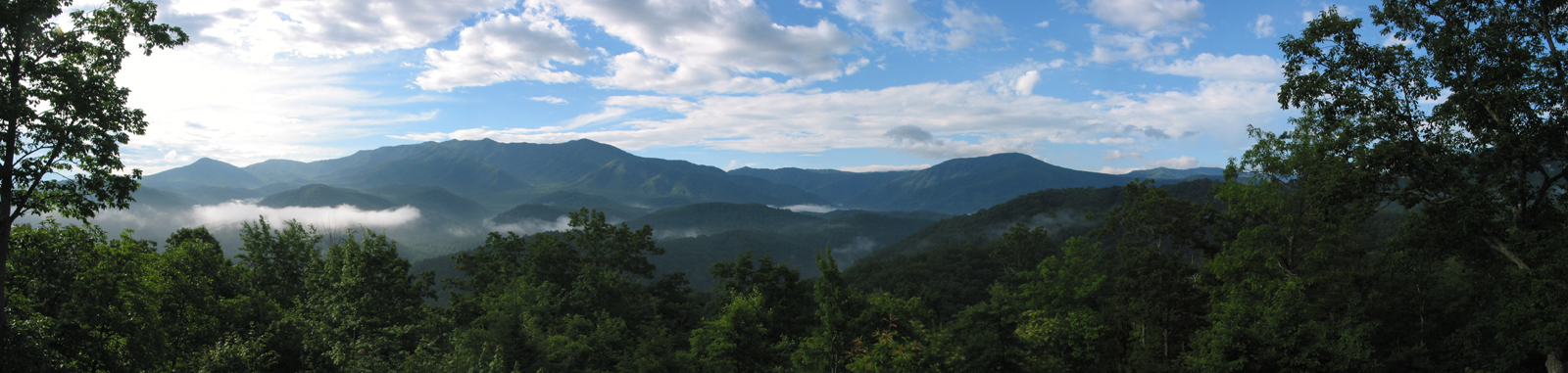
Photo compilation of Smoky Mountains by Reverie Hikes from Wikimedia Commons

"The earth was given to mankind to support the greatest number of which it is capable." James Monroe

The fiscal policy of wanting loans for large businesses but not having specie available to small depositors is the same as the land policy of  enabling the high yield of denser populations and overriding the rights of smaller, less productive landholders to decide what lifestyle they prefer.

Notice that this is not a racist policy. At no time did the race of the native inhabitants come into it. President Monroe applied the same essentially socialist policy to everybody. His goal was constant expansion in order to fuel a growing economy in order to produce ever greater revenues to pay off massive debts. We have been on the same trajectory ever since.

Sunday, April 6, 2014

When the Banks Renege -- The Panic of 1819

Jean Laffite always paid for his purchases in specie. He paid his debts in silver and gold. When he wanted to make change, he could cut up a coin or a bar into smaller pieces, because the value of the coin was in the metal it was made of, not the printing that was on it. Try making change by cutting up a dollar bill today. Not only will the little pieces not be worth a fraction of the whole, but also it's illegal to do so!

During the War of 1812, some merchants in New Orleans tried to blame the Laffites and their establishment at Barataria for a shortage of specie. It is typical of people who themselves deal in bank notes without cover that they try to blame others who are more fiscally responsible for their own problems.

The United States was not on a solid financial footing during the War of 1812, but after the war, things became much worse. In 1816 the Second Bank of the United States was established. And in 1819, we had our first major Panic, aptly named the Panic of 1819.

What were the causes of the Panic of 1819? Those in the know will name a few: a reduction in the price of staple goods like cotton due to a resurgence of production in Europe which hurt growers in  the U.S., the printing of bank notes without cover by various banks, and the eventual  tightening of the money supply when the United States needed to withdraw two million in specie from the Second Bank of the United States to make payments in October of 1818 on its notes for the Louisiana Purchase, promissory notes made out to France but now owned by an English bank.  After this withdrawal, there was not enough specie to cover the bank's obligations.

The problem for ordinary people was that while banks that were in debt were not forced to pay their creditors in specie, and the Bank of the United States, though a supposedly private entity, was exempt from the laws of the states and could not be foreclosed on, ordinary people still had to pay their own debts, or suffer the consequences.

When a tighter fiscal policy was enforced at Second Bank of the United States, the saying went that the bank was saved, but the people were ruined.

Now, many populist agitators see this as an issue between the "wicked rich" and the "victimized poor", but this way of conceptualizing the problem hides the real issue: that not all poor people are treated the same. If we go by net worth alone, the Second Bank of the United States and all the other reneging smaller banks that relied on it, were actually poorer than an ordinary person who had a few coins in his pocket, because they had a negative net worth. The banks, including the very biggest one,  should by rights have been allowed to collapse and their corpses fed to their creditors.

President Monroe is thought to have been a fiscally conservative president, because he did not pass relief for the "poor". But how fiscally conservative is it to allow a bank to reneg on its obligation to depositors? The very poorest of the poor were the banks themselves. They should have been allowed to fail.

Would the United States not have fared better under pirates who dealt exclusively in silver and gold and made change in bits and pieces?


the value of money used to be in the metal and people made change by cutting it


Wednesday, April 2, 2014

President Monroe's First Address to Congress

James Monroe by Samuel Morse
from the wikipedia
Even before George Graham arrived in Galveston, President James Monroe had already decided that Jean Laffite should be asked to leave. As early as December of 1817, he said so in his first address to Congress. After describing the Amelia Island Incident, which culminated in the capture of that independent island by an American naval force, President Madison went on to say this:

A similar establishment was made at an earlier period by persons of the same description in the Gulf of Mexico at a place called Galvezton, within the limits of the United States, as we contend, under the cession of Louisiana. This enterprise has been marked in a more signal manner by all the objectionable circumstances which characterized the other, and more particularly by the equipment of privateers which have annoyed our commerce, and by smuggling. These establishments, if ever sanctioned by any authority whatever, which is not believed, have abused their trust and forfeited all claim to consideration. A just regard for the rights and interests of the United States required that they should be suppressed, and orders have been accordingly issued to that effect. The imperious considerations which produced this measure will be explained to the parties whom it may in any degree concern.
  To obtain correct information on every subject in which the United States are interested; to inspire just sentiments in all persons in authority, on either side, of our friendly disposition so far as it may comport with an impartial neutrality, and to secure proper respect to our commerce in every port and from every flag, it has been thought proper to send a ship of war with three distinguished citizens along the southern coast with these purpose. With the existing authorities, with those in the possession of and exercising the sovereignty, must the communication be held; from them alone can redress for past injuries committed by persons acting under them be obtained; by them alone can the commission of the like in future be prevented.
President Monroe's use of the term "impartial neutrality" belies his assertion that he has the right to "suppress" the establishment at Galveston, when Galveston is outside the territorial claims of the United States at that time. His questioning of whether these establishments were ever "sanctioned by any authority whatever" begs the question by what authority the government of any country, and especially an upstart like the United States,  is sanctioned.

To conquer a territory outside your own borders requires a declaration of war against those who hold it. To tell an established government that it must be suppressed is an act of war. You would think that if this is what James Monroe had in mind, he would be asking Congress for a declaration of war against the currently established government at Galveston. Instead, he informs Congress that he has sent a ship of war.

Jean Laffite had a policy engraved in stone not to make war on the United States, whom he regarded as his ally. But the United States more than once made war on him, without a declaration.

Tuesday, March 25, 2014

American Diplomacy in the Wake of War

Diplomacy is  just one of the tools of war. At the bargaining table, many a nation has won more territory than it could possibly have conquered in a pitched battle. At the bargaining table, many a victor's gains have been squandered. Sadly, the United States has a long history of dumping friends in order to make "peace" with bullies.

Neutrality would be a very fine thing, if it meant not getting involved in other people's disputes. But under the pretext of maintaining "neutrality" the United States has often broken with its natural allies in order to appease its more powerful enemies.

Can you imagine going to war with France to help Britain, when only a few years earlier France helped you win your independence from Britain? That's what the administration of John Adams did without a declaration of war.

Or how about the way the Soviet Union ended up our ally in World War II and FDR divided up the world between himself and Stalin at Yalta? Was that in the best interest of US citizens? How?

 Or the way in which Israel is constantly being pressured to give up territory for the sake of peace, while simultaneously being offered bribes in the form of American financial aid at taxpayer expense? Would a powerful Israel not be a good thing for the US? How does using taxpayer money to bribe Israel not to defend itself from forces unfriendly to the US help American citizens? Does it make the price of oil go down? I don't think so.

 Or exactly why was it that  we severed diplomatic relations with our friend Taiwan in order to make peace with Mainland China? Wouldn't "neutrality" have demanded that we treat both China and Taiwan just exactly the same? Why do we have to stop being friends with Taiwan in order to offer friendship to China? Would a real friend ever ask that of us?

All of these actions are part of a pattern that was established very early on in the history of the United States. There is nothing new under the sun, except that diplomacy as practiced by the US State Department does not tend to promote the natural interests of the United States and often penalizes United States citizens who are taxed to support policies inimical to their own interests.

The treatment of Jean Laffite by the United States, both at Barataria and at Galveston, is a case in point. Having driven Laffite out of his territory at Barataria when he helped defend New Orleans from the British invaders, when he moved to Galveston where he served as a buffer against Spain the United States went on to demand that he leave again, and not so that United States forces could take possession, either. It was so that Spain could retain its holdings in Texas, and so that the United States could maintain its fragile "friendship" with Spain. Is that neutrality? Siding with the local bully against the underdog who is friendly to you?

This is my take on it. But what did Jean Laffite think? A few well chosen snippets from his journal will give us an idea.

In this section of the Journal, Jean Laffite is talking about the events that precipitated his expulsion from Galveston. They involve the Spanish Ambassador de Onis putting pressure on President Monroe.
Ambassador de Onis protested more violently and thus forced President Monroe to send agents to Texas to verify the settlement of French refugees without the power of General Lallemand and to prevent him from settling in United States territory.
George Graham, who gave himself the honors, was chosen for the mission.  Mr. Graham was involved in banking matters in Washington, and he was always ready for placement when the occasion presented itself. Mr. Graham did not sympathize with Luis de Onis.
So then Mr. de Onis protested to Secretary John Quincy Adams on the subject of the French invasion of Texas. Mr de Onis and Mr. Adams were able to come to an agreement on their points.
John Quincy Adams, like his father John Adams, sympathized with the British against the French. He was perhaps more nearly neutral about Spanish interests, but Ambassador de Onis knew Adams the younger rather well, and he knew how to manipulate him to see things his own way.

Mr. Adams did not make much noise on the subject of my commune, but when he learned that my corsairs seized British ships, then along with the rest of his cabinet, he protested.

Like his father before him, John Quincy Adams, then secretary of state under President Monroe, sympathized with the British. It was a historic preference inherited from his father, the second president. The Federalist John Adams favored Britain, while Democratic-Republican Jefferson had been sympathetic to  France. Nobody seemed to be neutral, each faction having its own preferences in the European power struggle. In fact, throughout the career of Jean Laffite, it seems that the struggle between the Federalists and the Anti-Federalists, even when it seemingly culminated in the demise of the Federalist party, was still a factor.  There are echoes of this in the Journal of Jean Laffite.


Jean Laffite writes:

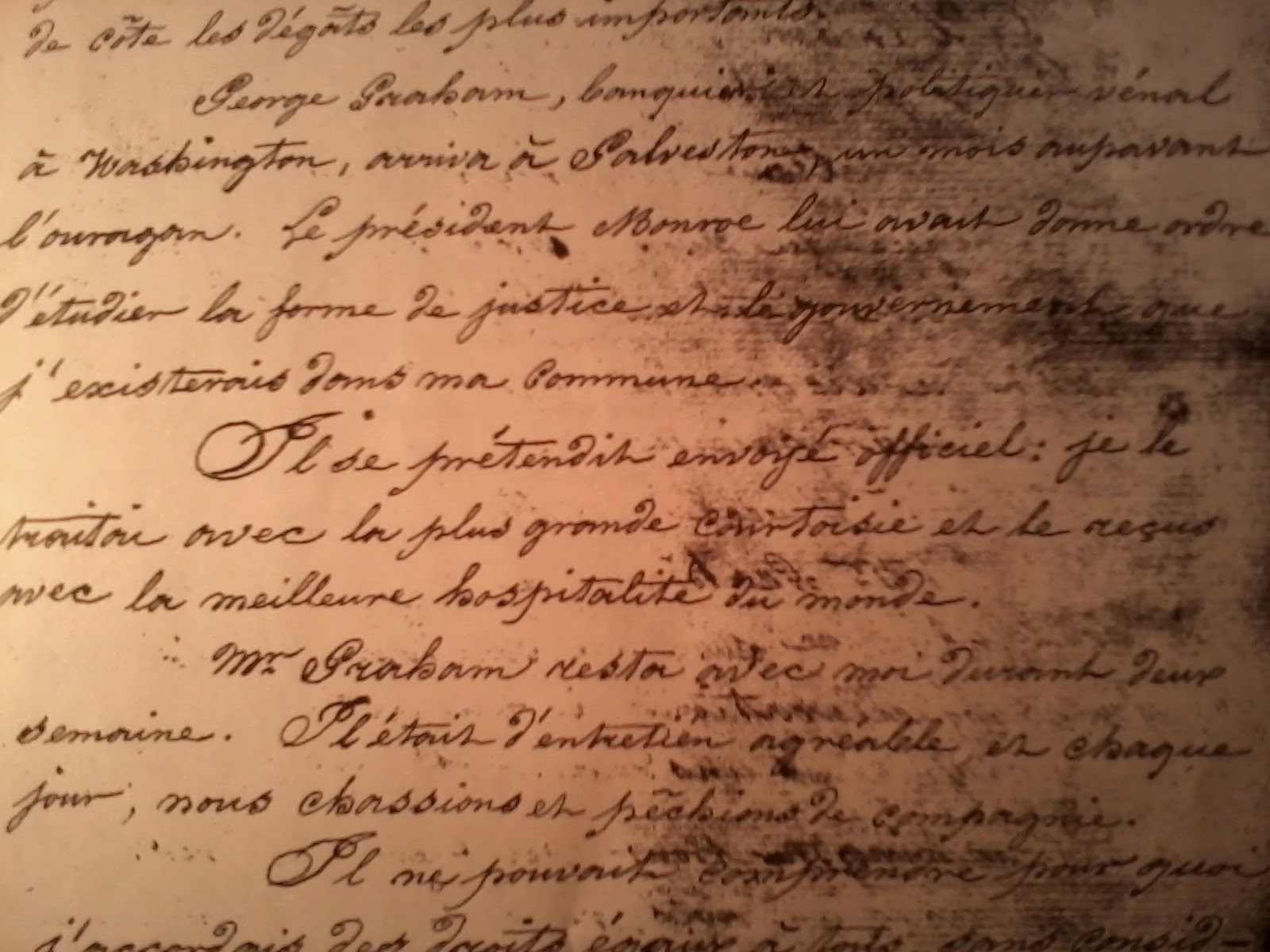
George Graham, a venal political banker in Washington, arrived at Galveston one month before the hurricane. President Monroe had given him orders to study the form of justice and of the government that existed in my commune.
 He pretended to be an official envoy. I treated him with the greatest courtesy and received him with the best hospitality in the world. 
Mr. Graham stayed with me for two weeks.  He was of an agreeable disposition, and each day we hunted and fished together.


 He could not understand why I accorded equal rights to all, without considerations of nationality or religion.
He represented exactly the same type as Alexander Hamilton, opposed to the principles of Thomas Jefferson. 
George Graham told Jean Laffite that "the territory situated to the west of the Sabine River belonged to the United States which had not authorized me to establish  a commune of my choice to the west of that river."

Concerned that there might be some official sanction behind Graham's words, Jean Laffite set out to Washington, where he met with Secretary of State John Quincy Adams. At the time, Adams was fifty-one years old and Jean Laffite was thirty-six. Adams told Laffite that he had not authorized Graham to speak to him or to ask him to clear out of Galveston. Mr Graham was acting alone and without the sanction of the United States government.


Mr. Adams affirmed that Mr. Graham was in banking, and was interested above all  in commercial loans and credit to private businesses and that he liked neither the ideas of Thomas Jefferson nor the system of Napoleon. 
Then again, John Quincy Adams can't have been all that taken with Thomas Jefferson or Napoleon, either. It would be amusing to hear with what tone of voice Adams said this.

John Quincy Adams as painted by Gilbert Stuart in 1818
from the Wikipedia

In the end, when public opinion had been turned entirely against Laffite after the Le Brave incident, and when Graham was again dispatched to tell him he must leave, this time in a more official capacity, Jean Laffite informed George Graham that his government was against England and Spain, and he would abandon Galveston only on the condition the United States would occupy the Antilles as well as Florida. George Graham replied that he was more interested in loans received from Spain than in annexing any of its territories.

From a page of the Journal that has been badly burned
Relevant text reads: "Nous informames Mr. Graham que notre gouvernment etait contre Espagne et l'Angleterre et que nous abondonerions qu'a la condition que les Etats Unis occuperaient L'Antilles et la Floridie."

Can you imagine someone more interested in the well-being of the United States than one who insists that before he can abandon his post as a bulwark against its foes,  the United States should take over more territory?

The story of Jean Laffite should stand as a warning to all external well-wishers of the American experiment, not to set too much store on the friendship of a government whose foreign policy is to neutralize its friends for the sake of doing business with its enemies.