Showing posts with label privateers. Show all posts

Sunday, January 22, 2017

The Bicentennial of the Founding of Galveston This April

This April will mark the 200th anniversary of Jean Laffite's founding of his "commune" in Galveston. Neither the city of Galveston nor the County plan to celebrate this momentous event. But for anyone interested in libertarian self-governance and anarcho-capitalism, this is a momentous occasion.

Site of  Laffite's house at Galveston
Source

Laffite called himself a governor, not a president, and the house in which he lived while he governed was La Maison Rouge -- the Red House -- rather than the White House. And he called his colony  a commune, because he was speaking in French and was influenced by the revolution and Napoleonic law and the like. But it wasn't a commune in the sense of pooled resources. Private property ruled in Laffite's world. When people worked for him, they were either paid an agreed wage or, like his privateers, they received a cut of the profits. And unlike other governments that tax their citizens for the income they make, Laffite never took a dime in tax on those who lived with him in the colony he founded. Instead, he preyed on Spanish vessels and shared the booty with his people.


Laffite was at war with the Spanish Empire and supported those who rebelled against it. But he did not finance his war at the expense of his people. He used that war to fund his government and pay those who lived in his colony for their contribution to the war effort.

Who should pay for waging war? Whoever wants to wage war and finds it profitable.

Arguably, Laffite paying his privateers to wage war against Spain is not so different from the US government paying those in the military for their services. But here is the meaningful difference: when the Federal government pays the military, it uses taxes levied from farmers, factory workers, manufacturers and every other productive individual to fund the war effort. The war effort itself shows no profit and brings in no income.  Our war effort is parasitic of everything that every other citizen does to make a living. But when Laffite paid his privateers, he did it with profits from the war effort. No farmers, shopkeepers or manufacturers were taxed to pay for the venture.

It is true that freedom isn't free. It is true that the best defense is a good offense. But what is not right is to constantly engage in wars that do no one any good, subsidizing them at the public's expense. Let him who profits from war pay for any war he profits from.

This April, think of Jean Laffite's Galveston and why the US government drove him away.


Sunday, April 10, 2016

The Argument for Privateering Today

A Blimp of the same class as the Resolute

One of the cultural features that characterized warfare in the twentieth century was the virtual absence of privateers. Arguably, there were a few privateers, but even that has been discounted recently. The current entry on privateering in the Wikipedia says:


20th century

In December 1941 and the first months of 1942, Goodyear commercial L class blimp Resolute operating out of Moffett Field in Sunnyvale, California, flew anti-submarine patrols. As the civilian crew was armed with a rifle, many thought this made the ship a privateer, and that she and sister commercial blimps were operated under letter of marque until the Navy took over operation.[32] Without congressional authorization, the Navy would not have been able to legally issue any letters of marque.
The last time I read this entry, prior to writing my novel Theodosia and the Pirates, it was much more positively in favor of the the idea that the blimp in question was issued a letter of marque. But whether or not the United States government did issue such a document authorizing the deployment of the Resolute is not the only question we should ask. Because in point of fact, historically many well known American privateers received their letters of marque from governments other than that of the United States. For instance, Jean Laffite had a letter of marque from the Republic of Cartagena. Later, he awarded other privateers letters of marque as head of the government in Galveston, as described in Theodosia and the Pirates: The War Against Spain. 

Recently, Austin Petersen, who is competing with two others for the Libertarian nomination for president of the United States, spoke at great length about the idea of issuing letters of marque and reprisal without declaring war against any nation. This way we can go after terrorists without starting a war. I am certainly in favor of that.

 Petersen mentioned the War of 1812 and American privateers, but not Jean Laffite, the most  important privateer contributor to that war on the American side. Is it because Laffite was not issued a letter of marque by the United States government? His letter of marque from the Republic of Cartagena allowed him to go after Spanish ships at a time when the United States had not declared war against Spain, even as Spain and Britain plotted together to take down the United States and return America to its status as a British colony. When Captain Lockyer approached the Baratarian privateer with an offer from the British, the letters he bore said that England had a treaty with Spain and had not an enemy in the world except the United States. He offered Laffite a chance to earn money and a position in the British Navy, but Laffite turned it down, because he wanted to be an American and an independent privateer, not a government employee. Laffite informed the United States of the British offer and of the British fleet's current location off the coast of Mobile. Instead of going after the British, the American Navy then attacked Laffite and his fleet of light privateering ships. Why? Because already privateering had gone into disrepute, and people like Commodore Daniel Patterson saw private fleets as an infringement on the career Navy officer's prerogative to a monopoly on waging war. 

Patterson did not use the ships he plundered from Laffite to fight the British. He sold them at auction to line his own pockets. But Laffite nevertheless managed to save the United States at the Battle of New Orleans by providing flints and gunpowder, which the Americans had run out of, as well as artillery and men to man it. And when his service was done, all he was granted for it was an empty pardon, and a flippant fare-thee-well. He was never compensated for his looted ships, and in the history books he has gone down as a pirate.

There are many reasons to prefer privateers over a standing army, not the least of which are these:

  • Privateers can run a fleet on a shoestring budget, and always at their own expense. It is the enemy that pays their wages, not the American people.
  • Privateers are a volunteer force, so nobody has to be drafted and nobody has to be taxed, and nobody need lose life or limb who does not get a share in the booty.
  • Privateers can take care of business while the United States maintains neutrality, but this can only work if they are allowed to use letters of marque issued by countries other than the United States.
This last point is the one under contention between those like Austin Petersen, who favors privateering, and the vast majority of the American political establishment, who are against it. Neither side is very good at articulating what the problem is, so I will spell it out for you here: We must repeal the Neutrality Act so we can go back to the state of privateering at the time when the United States came into being.


For an in depth discussion of the Neutrality Act, read the article linked above. But here is a short recap. At the time the constitution of the United States came into effect, there was nothing to keep individual US citizens from fighting on any side they wished of any war going on anywhere in the world.  Many American privateers had letters of marque from France that allowed them to wage open war against Britain on the high seas. This was legal and moral and made sense, because France had helped the United States win its war of independence against Britain.

Now the government of the United States was not at war with  Britain. In fact, they were at peace. But it was legal and lawful and right for each citizen to pursue his own foreign policy, none of them binding the United States or bringing about any breach in the peace. The constitution provides that the executive branch cannot go to war unless Congress authorizes an official declaration of war. But the constitution also provides that any powers not granted to the United States government explicitly are reserved to the States and to the people. And by "the people" the constitution does not mean "collectively" as in "People's Republic of China" where everybody has to agree in order for one person to do something. "The People" in the United States constitution refers to the individual citizens, one by one. Any of them could go to war any day they wished, so long as the US as a whole was not involved in it. And this is exactly what Americans did, until 1794 when the Neutrality Act was passed.

Who lobbied for the Neutrality Act? Why, Britain, of course! They did not want to be beset by those pesky American privateers, so they threatened the United States diplomatically, saying the peace between our two nations depended on the passage in the United States congress of a law outlawing privateering. Should we let Britain make our laws? What good was the revolutionary war, if they can dictate terms from afar?

The Neutrality Act does not outlaw privateering if the United States picks a side in a foreign war and grants letters of marque to Americans to go to war against declared enemies. But it makes it illegal for an individual American to go to war against a country with which the United States is at peace.

Jefferson initially opposed the Neutrality Act. It was Adams who wanted it, so he could pursue an undeclared Quasi-War against  France. Jefferson and Burr came to power after Adams' one single term in office, on a platform of repealing all those laws that the Federalists had put into effect in order to quash anyone who opposed Britain. But... Jefferson forgot all about that when Aaron Burr set out to conquer Mexico as a private citizen, acting at his own expense. Did you know that Burr was found not guilty of treason, but guilty of violating the Neutrality Act? When it served Jefferson's purposes, the law passed at the behest of Britain was allowed to stand.

http://www.historiaobscura.com/the-meaning-of-treason-united-states-v-aaron-burr/

Privateering came more and more under attack after the War of 1812, largely due to international accords that went contrary to the United States constitution. Today, most people do not know the difference between a pirate and a privateer. This situation will not be remedied unless we deal with the Neutrality Act head on. It is unconstitutional, as it abrogates the rights reserved to the people in that document. But you can be sure that no Supreme Court Justice, conservative or liberal, is going to rule it unconstitutional, because they are all Statists, right wing or left. So it is up to Congress to repeal it, once the Libertarian Party takes over.

Monday, October 6, 2014

The Neutrality Act of 1817

The first American Neutrality Act was passed in 1794.  It made it illegal for Americans to wage war on a country at peace with the United States. The thing to consider about this act of Congress is that prior to its passage, it was perfectly legal for an American citizen to wage war on his own against a country that the United States was not at war with. The constitution provided that the Federal government under its commander-in-chief, the President, would not be allowed to wage war unless Congress issued a declaration of war. But all the rights not granted to the Federal government were reserved to the states and to the people. So while the president of the United States was bound to remain neutral in all matters, unless Congress voted otherwise, each individual American was allowed to conduct his own foreign policy.

Take a deep breath and think about what this means. American citizens prior to 1794 were considered autonomous. They could make war on other countries in order to pursue their own interests. And, indeed, many Americans were privateers with letters of marque from foreign countries, such as France, and earning a good living by helping others in their wars against the great international empires such as Britain and Spain.


What happened in 1794 to change all that? In 1794, under the administration of George Washington, the United States signed the Jay Treaty with Britain. The Jay treaty was the brainchild of Alexander Hamilton, and it was hotly contested by the Jeffersonian-led Democratic-Republicans, who feared that this was a return to old world aristocratic tendencies and the rule of tyranny.

The other thing that happened in 1794, which I might as well also mention, was the reign of terror of Maximilien de Robespierre and his Committee of Public Safety in France. After the French revolution, Jacobins had taken over France. It was off with everybody's head and a complete deterioration of all civilized things, including private property.

Britain did not want this general lawlessness to spread to England, and George Washington and Alexander Hamilton agreed. So they decided to tie the hands of American privateers who were still working for France. They also thought this would be a good time to repudiate the American war debt to France, since, after all, that promise was made to the French monarchy that helped to free American Colonies from Britain and not to those lawless  Jacobins currently in power.

The Jay Treaty cleared the way for the Quasi-War with France under John Adams, an undeclared war that served British interests and helped the United States renege on the American promise to repay its war debts to France. During the Quasi-War with France, the president of the United States ignored the constitutional provision that required him to get clearance from Congress before starting a war. Meanwhile, the Neutrality Act, far from creating neutrality was used to make sure that no individual American fought for a side in any war that the president did not want him fighting on.

Just like the Committee for Public Safety in France, that did anything but insure public safety, the Neutrality Law was named the very opposite of what it did.

But our subject here is not the Neutrality Act of 1794. Our subject was the Neutrality Act in 1817. The original Neutrality Act was superseded by this new act that also mentioned the unrecognized governments of newly liberated Latin American countries as additional powers that American citizens were not to help anymore. Henry Clay called this an "Act for the benefit of Spain against the Republics of South America." The act prescribed penalties of three years imprisonment and three thousand dollars in fines.

Far from breeding neutrality, all these laws collectively were used to tie the hands of American privateers and to help the great empires of Britain and Spain to hold on to their dominions. But much more importantly than this, the Neutrality Act was used to subdue the independent spirit of American businessmen, who henceforth would need the permission of their government to conduct business abroad and to defend their foreign holdings.

When Jean Laffite was routed out of all his holdings in both Barataria and Galveston, this disempowerment did not happen to him alone. It happened to all Americans, who became more like subjects and less like citizens under a government that took on itself more and more power. In order to pursue its own dreams of empire, the United States government under James Monroe wanted no competition from private citizens in the international arena.

Tuesday, September 16, 2014

Ode to Privateers

Today on Historia Obscura, we have the first poem about the Battle of New Orleans.

The First Battle of New Orleans poem

Notably absent is any mention of Jean Laffite. To correct this omission, I have written a different poem about the same topic.

Sketch of Jean Laffite by Lanie Frick

Ode to Privateers

by Aya Katz

There are men who die for their nation,
    Who unselfishly give up their lives
There are men who live for their station,
    Who prevail without sacrifice.

There are women who raise up their children,
      And scrub floors and clean bottoms and nurse,
At the end of the day they want payment
      In undying love and remorse.

But the love that is true does not barter
Or require one to suffer to pay
For the care and affection a baby
Ought always to have anyway.

Now Britain was one kind of mother
Who demanded a fee for her love,
And she forced former children to serve her,
And she never accepted rebuff.

She kidnapped, indentured those sailors,
     Who had never agreed they should serve
And she thought she could live off the payments
     That others were making to her.

But Americans swore they were freemen,
      And only would work for their gain
And they never consented to fiefdom
     To serve under England or Spain.

Now Madison turned to the Congress
     And he asked that a war be declared
Against Britain, that unruly mother,
     Who forced sailors under her care.

But the coffers of war they were empty,
     And the army and navy were poor
And American patriot  menfolk
    Were not ready to set out to war.

They had sworn that they never would live for
    Another, and only alone for their gain,
And who wants to die for the right to
     Avoid paying taxes again? 

If not for the brave privateers who
Had always made war for their gain,
Who would set aside natural fear for
The right to know freedom again?

When the British approached Jean Laffite and
Required that he help them regain
Their colonial holdings, discreetly
  He sent word to Americans then.

He said:  "Though you're holding my brother,
   "In that dirty old Cabildo jail,"
"I will never agree to serve Britain,
    "And I  do want your side to prevail."

But Patterson, hearing the news that
    The British were near Mobile Point,
Instead of defending Ft. Bowyer,
    Came and ransacked closer to home.

He took all the ships that Laffite had,
   The stores were to serve as his spoils,
And he feasted on chocolate and Seegars
    And he cared not the British to foil.

So it came that when Jackson came marching
     His ragtag troops for their stint,
They were shoeless and all out of powder,
    And awfully short on the flint. 

And up spoke Laffite: "Let me help you,
      "I have men, and cannons and flint,
"I have barrels and barrels of powder,
      "We will fight for you, just let us in! "

There are men who fight for their nation,
     Because in fighting they gain,
And together they vanquished the British,
    Who were crushed so that few did remain.

And the British, they begged to be let go,
    And America won on that day,
And not because taxes or duties
   Or regular armies held sway.

For the men who have chosen no thralldom,
     And who fight every day for their bread,
Are the ones who are ready when called on,
     Who can shoot at the foe until dead.

There are men who will fight but are fearful,
     And who miss because of that fear,
But the reason we all are still here is
    Because there were once privateers.


Friday, September 12, 2014

Changing Public Perception of Privateers

Have you noticed that certain occupations, professions and trades, which used to be perfectly respectable, seem to come under fire at a particular juncture in time, and all of a sudden people find themselves under attack and on the defensive for doing something that had been perfectly fine just a short time earlier?

The moral indignation that goes with these attacks can be the most puzzling thing of all to people whose practices suddenly come under fire. New words are used as epithets or old words are conjured up to blacken their name which had never applied before.

Take the term "puppy mill". Recently it has been used to tar and feather anyone in the dog breeding business. Do you sell puppies for a living? Do you tear them away from their mother's bosom and ship them off to strangers? You must be a very bad person. Puppies, for God's sake! Why can't you find something decent to do for a living, like sell health insurance or lottery tickets, instead?

And the person thus attacked doesn't even understand what happened. Yesterday, this was a good and decent way to make a living, and all of the sudden the only right way to get a new dog is from a shelter, where they have been "rescued", And sometimes these "rescued" animals are taken by force from their owners.

I am not myself a dog breeder, nor have I ever been, nor do I plan to become one, but I know a few, and I see how their life has been made harder by the changing fashion concerning the right and the wrong of dog breeding.

The same thing happened to Jean Laffite. He was a respectable privateer, and they branded him as a pirate. But it was not just to him that it happened. It happened to many others. One day it was a respectable profession, a decent way to make a living, and then, almost overnight, it wasn't anymore.

How did that happen and why? That is going to be the topic of my talk in Galveston this October.


Thursday, June 5, 2014

When did Privateers Fall Into Disrepute?


Today's blogpost  is a transcript of a conversation  I had in the outer pen this afternoon, as depicted in this video.


When did privateering go into disrepute? I would say that it happened sometime after the War of 1812. And I would say that it wasn't a coincidence that it happened then, and that it was part of a concerted effort to change the way Americans looked at those who provided them with protection and military service.

Prior to the War of 1812, it was understood that while there was going to be a standing navy, there would not  be a standing army. And the Navy itself was  to be much smaller than the navy of a large empire, such as Great Britain. The idea was that the services provided by the American Navy could be supplemented by private enterprise, by private ship owners, private captains and private warriors who would perform the same services as the military of the competitors of the United States without affecting the taxpayer, without affecting the civil rights -- the civil liberties -- that were protected in the bill of rights. And that was why prior to War of 1812...

 -- Can I borrow this book, Bow? I want to show the people the book, okay? --

This is my second book in the Theodosia series. Bow was reading it, but he took very good care of it while he was reading it. And this is where you see the transformation happen. All of a sudden, privateers are not the good guys, anymore. And it's not just Jean Laffite, although he certainly was a victim in this change in the way the wind was blowing. But there were other privateers, American privateers, who were suffering the same fate. All of a sudden it was decided that only the government was going to be waging war, only the government would be involved in major defense or offense efforts, and that anyone who wanted to compete with the government was not welcome anymore -- even if that person, like Jean Laffite, saved the United States in the past.

[Bow starts to protest.]

--Okay. You can have the book back. You're welcome.

Saturday, April 5, 2014

The Safety Net for "Pirates"

Did you know that Jean Laffite provided an on-the-job insurance policy to all the officers and  crew members employed under him? It makes a certain amount of sense. A privateer setting out to do battle might think to himself: "But what if I lose a limb?"

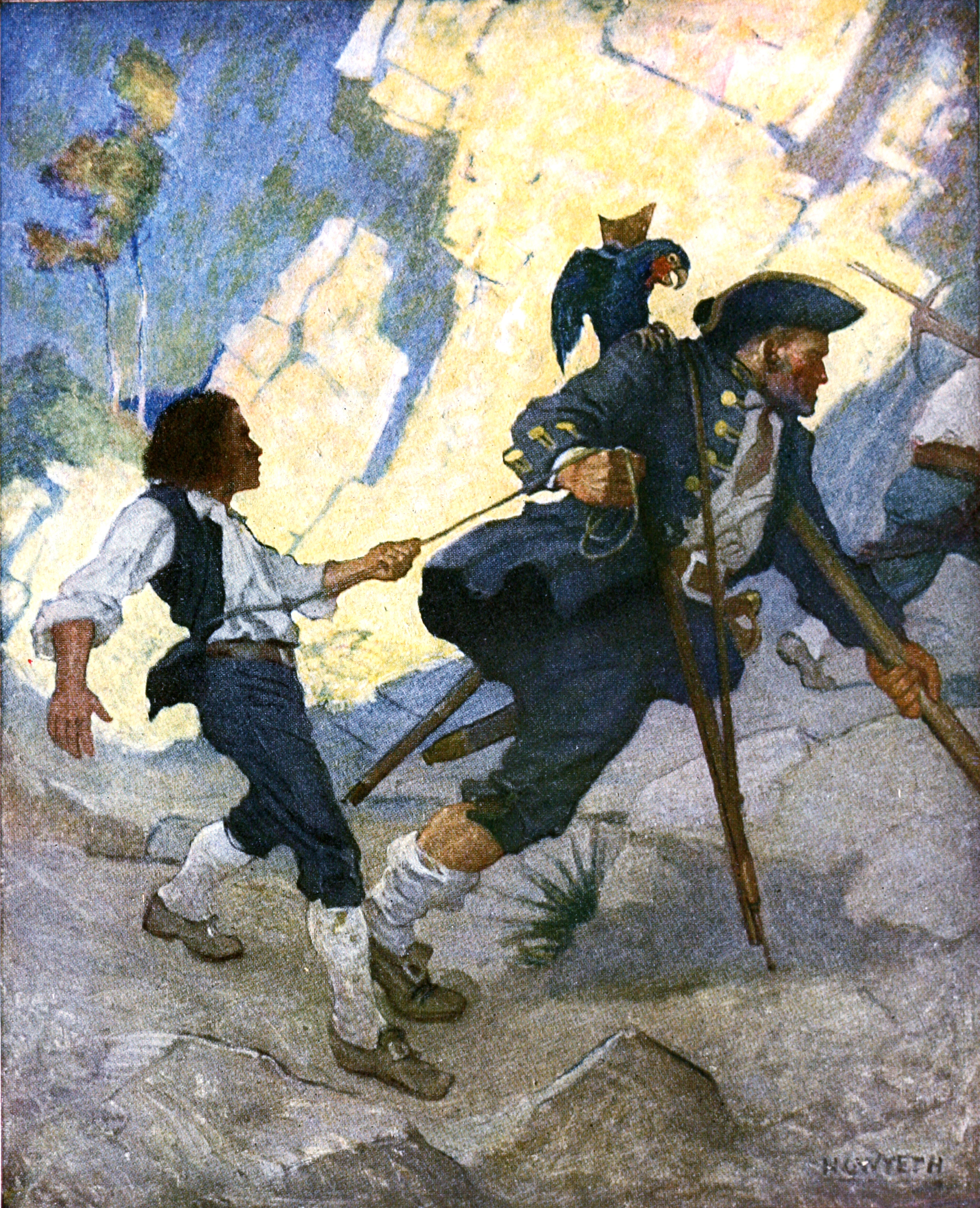
The very fictional Long John Silver leading captive Jim Hawkins despite his work  injury
from an illustration by N.C. Wyeth for a 1911 edition of Treasure Island


We have all heard of limbless pirates. A wonderful fictional example is Long John Silver in the book Treasure Island by Robert Louis Stevenson. The fact that his left leg was cut off close to hip made him all the more terrifying. It's not politically correct to admit it today, but when we see a fellow human being who has been dismembered, it scares us, because it makes us think that this might also happen to us. We feel this way, despite the fact that many of those who lost their limbs have done so while fighting for our freedom.

Jean Laffite was not a pirate. All his limbs were intact, and if you met him, you would think him a very courteous, soft spoken gentleman. However, he was also a privateer, and he drew up many contracts to equip and man privateering vessels.

According to historian William C. Davis, in his book The Pirates Laffite, Jean Laffite's standard contract for officers and crew members of his privateering vessels included compensation for loss of limbs while on the job (Davis 2005.398).
The overriding concern with profit was evident in another document handed to captains by Laffite and Humbert, a "charter for partition" that detailed the division of spoils taken from prizes, a touchy subject since the dawn of piracy. Half of everything went to the ship owner and outfitter, together with a five percent commission on the balance of the cargo brought into Galveston. The captain was to hold back another five percent of what was due to the crew pending dispensation of everything. If the crew took a vessel better than their own and abandoned their own as a result, then the new prize became entirely the property of the owner of the original privateer in order to cover the loss. All arms also went to the owner. Thereafter, in something resembling an insurance policy, Laffite detailed the special shares of profit to be given to a man should he lose an arm or a leg.  The first man to spot a prize was to get an extra share, as well as the first man to board one. The captains controlled four discretionary shares to hand out to men who performed particularly well, whereas any men who deserted or were caught stealing  from their mates should lose their shares. Then, in descending order, from the captain to the common crewmen, a division of shares by rank was detailed.

What do we learn from this? One, the profit motive is a wonderful thing, and it includes everything that is needed to keep a ship running smoothly. Two, the profit motive actually induces good entrepreneurs, like Jean Laffite, to provide insurance to those working under them under perilous conditions. Three, for all the egalitarianism that Laffite spouted, rank and personal performance played an important role in determining each person's share in the spoils. But because payment was percentage based , even the lowliest crew member was extremely motivated to work hard for his pay.

Do you think a safety net for injury on the job is something offered only under socialism? Do you think egalitarianism a la Jean Laffite requires all to be compensated equally regardless of their contribution? Think again.


Friday, March 14, 2014

What's Wrong with the Neutrality Acts of 1794, 1817 and 1976?

A neutrality act sounds on its face like a good thing -- an expedient that helps to prevent war. If a neutrality act actually prohibited the government of the United States from waging war without the consent of congress, and by extension, the American people, then it would be an innocent enough thing, and it would not add much to the requirement that the executive branch of the government should not wage war without the consent of the people through their elected representatives in Congress. But like many a mislabeled legislative package, the various neutrality laws that the United States has enacted over the years are not there to limit the government in its subrosa activities in waging clandestine or unauthorized war. Their purpose is to tie the hands of United States citizens. Instead of making the government practice a studied neutrality while Americans abroad can act as they will, the so-called neutrality laws are there to penalize ordinary Americans from acting against governments that the United States government has decided to support. That is not neutrality. That is partisanship on the part of the government! It is granting the United States government a monopoly on the right to defend American interests abroad, and it is tying the hands of citizens in their own business outside the territories of the United States.

The first neutrality act was passed by the United States Congress in 1794 under the administration of  George Washington. The continental congress had had a treaty with France, but in 1794 the Jay Treaty with Great Britain was ratified. France accused the United States of violating its treaty with them, because Great Britain and France were at war. Many Americans at the time were privateers, supporting the French Republican government. The French ambassador to the United States had been actively recruiting American privateers to fight against Spain and Great Britain, the enemies of France. All of a sudden, it was illegal for Americans to ply their trade as privateers in service of a country that had helped support their own revolution and brought about their independence!

Now one might argue that if such a policy brings about peace, the financial interests of the American privateers should be sacrificed in the name of absolute neutrality. But no such thing happened. Instead, during the administration of Washington's successor, the Federalist John Adams, the United States entered into a Quasi-War with France.

USS Constellation vs L'Insurgente -1799

from the Wikipedia

What is a Quasi-War, we may well ask? It means a war that is waged without a declaration, without ratification by Congress and by extension without the consent of the American people.

This undeclared war went on until 1800 when a peace was signed, and it was largely due to this war that Adams did not win reelection. In 1800 Thomas Jefferson and Aaron Burr won the election under the Democratic-Republican ticket. Unfortunately, their election did not lead to a repeal of the Neutrality Act of 1794, which Jefferson used against Burr in his trial of 1807. Unable to find  the civilian Burr guilty of treason because of his projected private expedition against New Spain, Jefferson did succeed in pinning him with a misdemeanor under the Neutrality Act.

And in order to keep the United States safe from the depredations of Britain, after the end of the Quasi-War with France, Jefferson resorted to the expedient of the Embargo Act. Now, not only were American citizens prohibited from waging war against other countries -- they were not even allowed to engage in international trade, because they could not defend themselves and there was no one else to defend them.

So we went from a constitution that limited the government from waging war without the consent of the people, but allowed citizens to possess any weapon for the purposes of a well-regulated militia so that the people could wage war on their own to a situation where citizens were completely disarmed in defending themselves on the open seas or even venturing forth for purposes of trade.

The constitution limited the government but left unlimited powers and rights to each citizen. But the new laws were used to do the exact opposite. This state of affairs led directly to the War of 1812. Unable to defend themselves, under the administration of James Madison, the people allowed Congress to ratify a declaration of War against Great Britain. Allowing the government to have a monopoly on waging war will always lead inevitably to war.

Who helped  the United States win that war? Privateers and smugglers acting in contravention of both the Neutrality Act and the Embargo Act. Privateers who asserted their second amendment rights to wage war, despite unconstitutional legislation. The arms they bore were not limited to muskets. They had cannons and warships, too.

If we want to understand how Neutrality Acts lead to war, and how a monopoly on waging war violates the rights of citizens under the constitution to defend themselves, then a good place to start might be with Theodosia and the Pirates.

This information is as applicable today, as it was in the 1800s. If there are interests of United States citizens that need defending abroad, hadn't we better let those citizens defend those interests with every means at their disposal, while keeping our government neutral? Let's repeal the Neutrality Act once and for all, so that we can have peace, while those who wish to wage war to defend their own interests can do so at their own expense.

Thursday, February 27, 2014

Family Values and Piracy

The second half of Theodosia and the Pirates -- The War Against Spain --  is not so much a romance, but a story about family life against a backdrop of world conquest, colonization of a new island, the meting out of justice and receiving injustice in return, exile, diminished circumstances, and a new life as a respectable, productive middle class family. This is not primarily a book about sea battles and burning buildings on the shore, although there is some of that, too. It is more about family values than it is about the fires of first love, although there is a bit of that as well.

Next month I will be revealing our new cover with a stunning illustration by Colleen Dick and everything will be gearing up for the release of the new book. But for now, let me say that I don't think people have given much thought to what it is like to be a good parent and a pirate at the same time. No, it's not  a joke. I'm perfectly serious.

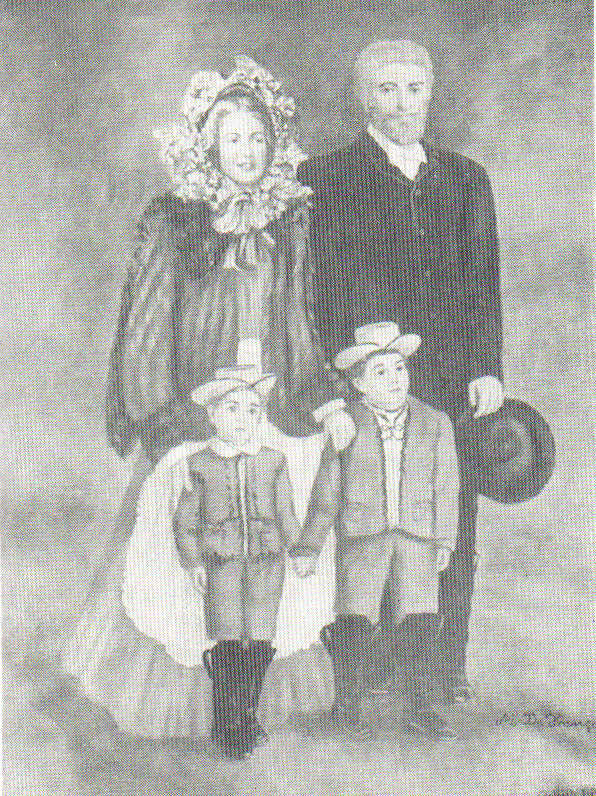
Jean Laffite was a privateer, a liberator, a protector, a husband and a father. He had three children by his first wife and two by his last wife. And there may have been some other children born on the wrong side of the blanket, but I'm not writing about that.

Jean Laffite and his second wife Emma Mortimore and their two sons, Jules and Glenn
painting by Manoel J. de Franca

Imagine being asked by your little boy why it is all right to pillage and loot. What would you answer? Would you say that you only go against evil empires, like Britain and Spain? Would you say that what you do is good, because the enemy is bad? Would you tell him that you treat women and children and the downtrodden with ultimate courtesy, but that the people you hurt deserve it? And if you said that, how much of it would you yourself believe?

Today on my Facebook feed, there was a discussion of Vikings. Apparently, the History Channel is running a series about Vikings. I have not seen it. I don't have cable. But people seem to be fascinated by the violence and the family dynamics of what they term "mafia-like" arrangements, and some of them are talking about having Viking ancestors, but at the same time saying that they were just farmers.

I don't want to make any statements about the life and morals of Vikings one way or another. But I do think that there's something that most of my acquaintances are overlooking about their own mode of making a living: almost all of them are a little like Vikings, except that there is a veneer of respectability that hides this fact.

"First do no harm." That is the mantra that most people adopt. But how many of us live by it? How many could explain to our children what we do for a living and why it is okay?

Take one of the most respected profession in the world: teachers. I have been a teacher myself, and I taught on the university level in Taiwan. But who or what paid for my fees? Even though I was working at private universities, did you know that the government of Taiwan had to authorize the universities to hire me as an assistant professor? There was so much red tape! And in the end I was issued a government document allowing me to teach . Behind all this was a complicated system that certified students, teachers and the validity of knowledge. And all at the point of a gun!

 I'm not being critical of Taiwan, when I point this out. All the countries I've ever lived in and all the countries I have visited have had some such a system, if not on the university level, then certainly for elementary education. If your work is regulated by the government and funded by taxes or coerced payments, you, my friend, are a pirate!

If you are a teacher, chances are you are profiting from some combination of government coercion and expropriation. If you are an elementary or high school teacher in a United States public school system, then you are probably paid with tax dollars, even those taken from people who have no children. If you teach at a private school, you probably still received some kind of certification that said you were allowed to teach and somebody else could not. The mandatory education laws indirectly send money into the coffers of private institutions as well as public one.

I have been a lawyer. That, too, involved government certification by the State of Texas where I practiced. I was part of a state-run monopoly on the practice of law. Are you a doctor? A registered nurse? A social worker? An insurance agent? A farmer? There are government subsidies, government monopolies and government coercion involved in all those professions. People can't help being dragged into these things, because it's everywhere.  If you are a retailer, chances are you are actively collecting sales taxes from your customers, because if you refuse, you will be shut down. We are all of us victims of piracy, but we are also willing participants. Where did your money come from? Are you sure it is clean? Would you walk the plank rather than join a government program that allows you to earn a living?

People revile welfare recipients, but they look the other way when the local grocer pockets the welfare recipient's money. It's almost impossible, in every line of business, not to somehow have gotten one's gain from someone else's illicit plunder. And even if you are clean yourself, the people you do business with are not, so that in some way we are all part of it.

"But I offer valuable services!" we may protest. "I work hard!" Doesn't everybody? "But the services I offer are needed. I help people!" Doesn't everyone?

Privateers help people, too, but they do so without leeching off the people they help. The good thing about privateers is that they do not plunder the people they are protecting. Unlike the local police officer and the military who serve us while living off our earnings without our consent, a privateer protects us from others by robbing others. Is it fair to those others? They probably don't think so. But at least it is honest.

And yet how do you explain that to a little boy? How do you teach him to respect others, not to steal or bully or abuse, when what you are doing yourself looks an awful lot like armed robbery? That's a big part of what "Theodosia and the Pirates: The War Against Spain" is all about.

So when you think of Vikings or your Viking ancestors, think of that!