Showing posts with label Galveston. Show all posts

Saturday, September 2, 2017

Reaping the Whirlwind

For many, the big news of the moment is the disaster in Houston caused by Hurricane Harvey. There is a lot of blame going around concerning how much help people are getting, and I have even heard some using the old ruse of blaming natural disasters on the iniquity of Man, only today's iniquity seems to be using too much energy and causing the planet to heat up, rather than refusing to worship a particular deity. I find that about as hard to swallow as Father de Sedella's assertion  that the hurricane of 1818 was caused by the fact that Jean Laffite refused to make the Catholic Church the State Church of Galveston.

From Theodosia and the Pirates: The War Against Spain

When the whirlwind did finally materialize, because life is after all much like a storybook, it was the Karankawa Indians, and not the Catholic Church, who helped Jean Laffite and the Champs d'Asile settlers to survive the disaster. But at least the Biblical quote from Hosea 8:7 was put to good use. In the same way, it is hardy private citizens, libertarians and profiteers, who are helping in Galveston today, people accused of being cannibals, like the Karankawa,  and not the nanny State. 


Sunday, January 22, 2017

The Bicentennial of the Founding of Galveston This April

This April will mark the 200th anniversary of Jean Laffite's founding of his "commune" in Galveston. Neither the city of Galveston nor the County plan to celebrate this momentous event. But for anyone interested in libertarian self-governance and anarcho-capitalism, this is a momentous occasion.

Site of  Laffite's house at Galveston
Source

Laffite called himself a governor, not a president, and the house in which he lived while he governed was La Maison Rouge -- the Red House -- rather than the White House. And he called his colony  a commune, because he was speaking in French and was influenced by the revolution and Napoleonic law and the like. But it wasn't a commune in the sense of pooled resources. Private property ruled in Laffite's world. When people worked for him, they were either paid an agreed wage or, like his privateers, they received a cut of the profits. And unlike other governments that tax their citizens for the income they make, Laffite never took a dime in tax on those who lived with him in the colony he founded. Instead, he preyed on Spanish vessels and shared the booty with his people.


Laffite was at war with the Spanish Empire and supported those who rebelled against it. But he did not finance his war at the expense of his people. He used that war to fund his government and pay those who lived in his colony for their contribution to the war effort.

Who should pay for waging war? Whoever wants to wage war and finds it profitable.

Arguably, Laffite paying his privateers to wage war against Spain is not so different from the US government paying those in the military for their services. But here is the meaningful difference: when the Federal government pays the military, it uses taxes levied from farmers, factory workers, manufacturers and every other productive individual to fund the war effort. The war effort itself shows no profit and brings in no income.  Our war effort is parasitic of everything that every other citizen does to make a living. But when Laffite paid his privateers, he did it with profits from the war effort. No farmers, shopkeepers or manufacturers were taxed to pay for the venture.

It is true that freedom isn't free. It is true that the best defense is a good offense. But what is not right is to constantly engage in wars that do no one any good, subsidizing them at the public's expense. Let him who profits from war pay for any war he profits from.

This April, think of Jean Laffite's Galveston and why the US government drove him away.


Saturday, September 26, 2015

Theodosia Burr Alston's Disappearance was Used in Anti-Privateer Propaganda

There are many stories about what may have happened to Theodosia Burr Alston after she boarded The Patriot on December 31, 1812. Most of those stories involve pirates: pirates forcing her to walk the plank, pirates turning her into their love slave, pirates slitting her throat because they are after her jewels. Every such story was used to hurt Theodosia's father Aaron Burr, both personally and politically,  and in the process to bolster the Neutrality Act under which he was persecuted for his expedition against Spanish held Mexico.

It is one of the practices of the political propagandist to recruit as victims of the policies they are against people near and dear to their political enemies. So it should come as no surprise that some of the people accused of killing Theodosia were not pirates at all, but rather law abiding privateers. One of these was Captain Jean DesFarges, who while working for Jean Laffite, was accused of piracy for taking as a prize a Spanish ship named the Filomena . This occurred about seven years after Theodosia's disappearance. The purpose of the prosecution and later hanging of DesFarges and his crew was to discredit Jean Laffite and his privateering establishment in Galveston. As part of the general smear campaign,  a baseless story was published to the effect that DesFarges had confessed to murdering Theodosia.

The following newspaper account, countering the "pirate" story, from The Famer's Repository, Charleston, W. Vrginia, August 30, 1820 was provided to me by Pam Keyes;

The New Orleans Advetiser of August 21 contradicts the story in the New York prints of June 1820, of certain pirates, executed at New Orleans, having confessed they composed part of the crew of the pilot boat Patriot who murdered Mrs. Alston. The Advertiser discredits the whole account: and upon the testimony of the Rev. Mr. Larned, who attended them in prison from the day of condemnation to the moment of their being swung from the gallows, "It did not appear that they had ever stained their hands with blood."

Nevertheless, the legend of Theodosia having been done away with by pirates lives on. And very few people understand that DesFarges and his crew were not pirates. Likewise, Jean Laffite is known as a pirate, and Aaron Burr, while acquitted of treason, is known as a traitor.  This is how political operatives kill two birds with one stone.

Friday, October 17, 2014

Slide Show from Presentation before the Laffite Society


I gave a talk before the Laffite Society this Tuesday. It was all about how the changing laws concerning privateering -- and also filibustering -- affected the career of Jean Laffite. I am not going to set forth the content of my talk here, as I plan to submit that by the end of the year to Laffite Society for publication. However, the talk was accompanied by a slide show, and I will share some of the slides to give you some idea of what the talk covered. I will also comment on the content of the slides from the perspective of how this information was acquired, and how it relates to my own life and my process as a writer.


The next slide actually shows something from one of my many notebooks that helps to document the trajectory of my interest in Jean Laffite. I had been planning to write a book entitled Theodosia and the Pirates for a very long time, ever since I read Gore Vidal's Burr when I was sixteen. But it was not the first thing on my list. I was thinking that it would be kind of a light book, after I had finished writing all the truly important books about justice and honor and freedom. So it was always planned to be something that I would write toward the end of my life, as a kind of reward to myself. I knew that Theodosia was going to be the heroine. But which pirate should she meet?


Here in this notebook, while I was still engaged in writing the first half of Our Lady of Kaifeng, I jotted some notes about what I wanted Theodosia and the Pirates to be about.

Theodosia Burr Alston
Find a famous real life pirate from that era and relate the events of his life to the story of Theodosia after she was lost at sea. 
This is the story of what happens when none of our dreams come true and we have to give up World Conquest. 
It is about the life of contentment  and spontaneous happiness that is possible only after everything else goes wrong and we lose all hope.

 That was written on May 12, 2007. At the time, my daughter was almost eight, and Bow, the chimpanzee, was five. We had not had the breakthrough yet that catapulted him to literacy. The scribbling on the top right hand page from the notebook was by Bow. He always wanted to write if I was writing, although one could not make out anything in what he scribbled.We had just moved into the pen system, and both Bow and I were feeling depressed.

That was in May of 2007. By July of that same year, Bow had an enormous breakthrough. Though my original online article about this has been de-indexed, you can still read it on the Reddit Mirror.

http://www.redditmirror.cc/cache/websites/hubpages.com_7q880/hubpages.com/hub/Bow-and-Literacy.html

After Bow's breakthrough, I was busy documenting everything that happened with his language acquisition and submitting an article to Nature. I was also attending conferences with other primatologists and discussing my findings, and for a while there was great excitement in the air about Bow. And then all of that fizzled out. I could prove nothing, and it was all dismissed as Clever Hans.

In the meanwhile, I finished writing the first half of Our Lady of Kaifeng, and eventually I rediscovered my writing notebook with the entry on Theodosia and the Pirates. And somehow or other I went back to thinking about poor Theodosia, lost at sea, and how I needed a pirate to save her.

That is why on the right hand page, right under all that scribbling by Bow, I ended up writing this on  April 6, 2009: "The real life pirate will be Jean LaFitte."

I still knew very little about him. I could not even spell his name correctly. But I knew it could be nobody else. And that's when my focus, which up till then had been on Bow's literacy and on the inmates of an internment camp in Shandong Province in World War II, began to shift. And all of the sudden I absolutely needed to know everything there was to know about Jean Laffite. I ordered The Journal of Jean Laffite in the original from the library in Liberty, Texas and I read and re-read William C. Davis's The Pirates Laffite, and everything else that I could get my hands on concerning Laffite. And gradually it dawned on me: he was not a pirate! And what's more, I had met him before somewhere. He was familiar. He felt like home.


I suddenly began to understand that a momentous change had happened in the interpretation of the constitutional provisions of how war was to be waged and financed and what powers belonged to the government and what powers belonged to the people.  I began to see how it was that right at first, prior to the passage of the first Neutrality Act in 1794, Congress had to grant the right to declare war to the US government, but private citizens did not need permission from anybody to wage war, since all powers not granted to the Federal government were reserved to the states and to the people.


And then one day the Neutrality Act of  1794 was passed, to make it easier for the United States to please Britain in the Jay Treaty.


I never liked the Neutrality Act, because of how it affected Aaron Burr's plans to become emperor of Spain. But it was not against Aaron Burr that this law was actually designed. Both the Federalists and the British were deeply afraid of the Jacobins who were now running rampant in France under Maximilien de Robespierre, and they wanted to make sure the madness did not spread to England and beyond.  The Neutrality Act was, among other things, meant to discourage American privateers under a letter of marque from France from harrying the British when they were at peace with the United States, and it was invoked by John Adams in his undeclared Quasi-War against France.

The American privateers who had private interests in conflict with the foreign policy of the president  of the United States were not pirates. Or were they? And what exactly was the difference?


Jean Laffite, when he met Theodosia in my book,  on New Year's Day  1813, had a privateering license from Cartagena. No, not the one in Spain. The one in Colombia. Only there was no Colombia then, and the Republic of Cartagena had only in 1811 become free of Spain.


Of course, before that, before he had a privateering license from Cartagena, Jean Laffite had been a smuggler under the Embargo Act of 1807, which was Thomas Jefferson's way of keeping the United States out of war.


The public hated the Embargo Act. It destroyed American commerce.


But with smugglers like the Laffites operating to fill the gap, it was still possible to shop for cheap goods at Barataria. It was because he was such an independent privateer and smuggler that Jean Laffite was able to provide the United States with the flint and the gunpowder and the artillery and men that won the Battle of New Orleans for the American side. But no recognition was given him, because the tide of history had already gone the other way. When James Monroe came to power, the Neutrality Act was amended to make it even more damaging to American privateers and filibusters, and Jean Laffite was forced to give up Galveston, just as he had earlier given up Barataria. Not only that, but when he sought to serve in Simon Bolivar's Colombia, he had to take on a commission as Colombian naval officer. The Americans had pressured Bolivar to outlaw privateering in return for recognition of his government. So he nationalized all the privateering vessels, and he allowed their captains to stay on as government employees. When Jean Laffite disappeared from the historical record, he was no longer a privateer. He was a "brave Colombian naval officer" serving as a government's hired hand.


There was a lot more to my talk and many more slides, but there in a nutshell is the story. Why does it appeal to me? Why was it such an epiphany for me to discover the real Jean Laffite, rather than the pirate with a heart of gold that he was portrayed as by the media and the childhood history books? Because it all ties in. Everything in life is interconnected. Not only do Laffite's grievances and Theodosia Burr's complaints against the government match, it also fits into my own life story.

Today, there are no more privateers, and the government has a monopoly on waging war. But in almost every other field, government encroachment into private affairs is likewise felt. I am the only private ape language researcher remaining. All the others have fallen under a network of laws that has all but nationalized chimpanzee research. Whether they work for the government, a university or a non-profit, they are not allowed to make decisions on their own which are at odds with national policy on chimpanzees.

Jean Laffite is a hero who appeals to me on so many levels. He is much more than a plot device to save Theodosia Burr. And the two novels that I wrote about him and Theodosia are not light romances, as I originally thought they would be. They are an in-depth look at what happened to an entire nation very soon upon its formation. What happened to Jean Laffite happened to all America -- to all of us. It is our loss.


Sunday, October 12, 2014

Invitation to Attend a Talk about Jean Laffite and Privateering

If you happen to be in Galveston, Texas on October 14, 2014 at about six pm, you might like to attend my talk at the Meridian Towers.


Thursday, September 25, 2014

The Oath of Loyalty and National Identity

At one point, Jean Laffite required an oath of loyalty of all his privateers operating out of Galveston. Why was that necessary? Did he think an oath would make them more loyal? Or did it have more to do with the shifting laws concerning privateering?

After the War of 1812 the American admiralty courts began regarding any privateering vessel manned by multinational crews to be a pirate ship. Multinational crews on ships are a very common thing. Because ships travel from one destination to another, none of the people on a ship will typically remain in the territorial waters of their own country all of the time. This is true of passenger vessels, ships that transport goods, and to some extent even of fishing vessels. That's just the nature of the work. Because of this, crews can be recruited in many different locations and can return to their home port periodically to be with their families. The fact that people belonging to different nations work together on the same ship is not a good indication that it is engaged in piracy.

However, to understand the issue of  multinational versus single nation crews, we need to better acquaint ourselves with the difference between piracy and privateering as generally understood at the time:

   Broadly defined, piracy was the unlawful taking of one vessel by another one. It was simple highway robbery on the seas. In time of war, however, the merchant trade of each combatant became the legitimate prey not only of its' opponents warships, but also of private armed vessels, or privateers. In order to finance its war efforts while damaging the economy of its enemies, a government issued letters of marque and reprisal to qualified vessels. The owners -- and often they were whole syndicates of investors -- armed, equipped, and crewed their ships at their own expense, and posted a hefty cash bond as guarantee that they would observe the rules of warfare and respect civilian life. The vessels were supposed to be commissioned in the home port of the commission-granting country. Their crews were supposed to be made up of a majority of men native to that country. They were to bring their prizes into the port of the commissioning country or a friendly country, where a court of admiralty would examine papers and other evidence to decide whether the prize was eligible for capture and lawfully taken. If the court awarded possession of the prize to its captors, the prize ship and its cargo were sold and the proceeds shared between the crew, the investors and the government whose flag the privateer flew. (Davis, The Pirates Laffite, pp. 28-29)
This is how Jean Laffite spelled Carthagena in his letter to Madison
What would it mean that a crew consisted of a "majority of men native" to a particular country?  This question is trickier than one would suppose, especially with new countries, such as Cartagena and the United States, the majority of whose adult citizens at the time were all born as the subjects of a European country (Britain or Spain) long before the new country came into being. Let us remember that in 1812, the United States was only 36 years old, and anyone below that age could not possibly have been born an American citizen. The Republic of Cartagena, whose independence was won in 1811, was only a year old at the time. Jean Laffite had a letter of marque from Cartagena, and he was not a native of that country, nor had he ever lived there when he accepted that commission.

The flag of Cartagena

The fact of the matter is that multinational crews typically worked on most private vessels, and that countries at war with each other do not always even recognize each others'  rights to grant citizenship. Britain was kidnapping and "impressing" American sailors all the time before war was declared, on the theory that "once a British subject, always a British subject."

How did you become a citizen of a country that only just now had come into being? One way was to have been born there. Another was naturalization. Some countries, like Switzerland, make it next to impossible for someone not born there to become a citizen. Others, like the United States, make people jump through a series of hoops, involving a combination of legal residence, affidavits by sponsoring citizens, a test on civics that has to be passed and ultimately an oath of loyalty. Other countries, such as Columbia during the period when Jean Laffite later came to live there (the 1820s), make it much easier to become a citizen. You merely have to show up and evince your willingness to serve.

How much should you have to give up in order to become a citizen? Can you still have other loyalties? Or should you have to tear from your heart all love and tenderness for your country of origin? Should you have to give up your language, your religion, your customs and your traditions? Theodore Roosevelt seemed to think so.

"In the first place we should insist that if the immigrant who comes here in good faith becomes an American and assimilates himself to us, he shall be treated on an exact equality with everyone else, for it is an outrage to discriminate against any such man because of creed, or birthplace, or origin. But this is predicated upon the man's becoming in very fact an American, and nothing but an American...There can be no divided allegiance here. Any man who says he is an American, but something else also, isn't an American at all. We have room for but one flag, the American flag, and this excludes the red flag, which symbolizes all wars against liberty and civilization, just as much as it excludes any foreign flag of a nation to which we are hostile...We have room for but one language here, and that is the English language...and we have room for but one sole loyalty and that is a loyalty to the American people." Theodore Roosevelt, 1919.
When America was first founded, everyone was a new American, and people from other countries besides England, such as DuPont de Nemours, were welcomed with open arms. In the national archives, there is a letter from DuPont de Nemours in French to President Madison thanking him  for a Navy commission granted his grandson. President Madison was happy to help DuPont, and he did not lecture him about how maybe he should learn English first. Ironically, that letter is right next to the letter by Jean Laffite asking to be reimbursed for his stolen ships. Laffite's letter was in English, but it did contain a lot of misspellings. Laffite was trying to fit in, and DuPont was not.  Clearly something else was at play here when Laffite was rebuffed, but DuPont was rewarded than Theodore Roosevelt's linguistic jingoism. Nobody thought at the time that you had to speak English exclusively in order to be a good American.

Letter from Dupont to Madison


But as things progressed, fear of being overwhelmed by a majority of non-British immigrants began to upset many powerful people, and prejudice against others who spoke different languages at home or who belonged to a different religion became acceptable. It was not unusual for Catholics to be held in suspicion, because of their loyalty to the Pope, which was thought to conflict with their citizenship, or for Jews to have their religion cited as a reason why they could not serve in diplomatic positions abroad. The French speaking population of Louisiana was forced to stop speaking French by punishment for same in the public schools and many native American tribes suffered the same.

As this issue of nationality versus citizenship began to hold a more prominent place in the American imagination, Jean Laffite was faced with a quandary in his rulership over Galveston. How could he show that the crews of his vessels were not pirates, despite the fact that the sailors came from different races or nations and spoke different languages and believed in different creeds? The answer was a simple legalistic one: make them all swear loyalty to Jean Laffite's country and its flag.

Was Jean Laffite a tyrant when he did this? Not at all. He was an extremely tolerant man. He had no desire to change the people who worked for him into carbon copies of himself. He thought it was fine for them to speak different languages and worship different gods, as long as they served him well. But the legalistic expedient of the loyalty oath was a way to present a united front to the American legal system, which wanted to make sure everybody belonged to the same nation when they served together.

Which attitude was more truly American in spirit, Laffite's openness or the progressively more stifling stance of the American legal system?

Friday, August 1, 2014

Should Smaller Countries Rely on the Beneficence of the United States?

If there is any lesson to be learned from the way Jean Laffite was treated by representatives of the United States goverment at Galveston, it is this: A very small country cannot expect to survive long if it chooses to become a satellite of the United States.

There are many reasons for this, not the least of which is the fact that in the tit-for-tat of diplomatic negotiation, the United States tends to make concessions to countries whose behavior and goals it sees as problematic and even threatening, while taking for granted that well-behaved satellites will stay in line.

My father, back when he still hoped that Israel would stop relying on US assistance,  explained it like this:

An excerpt from ISRAEL: WHENCE AND WHITHER
the entire article can be read in facsimile here:http://www.pinterest.com/ayakatz/israel-whither-and-whence/

When Uri goes to school, the teacher, Bracha, tells him that discipline, quiet and order are the keys to success. If Uri asked for my advice, I would tell him to ignore the teacher and do whatever he feels like. I know what the teacher learned in her pedagogical seminar: take the wildest boy, give him a position of authority, give him responsibility, imbue him with importance,  and he will help you to rule over the class. You will be able to handle the obedient children either way. Uri knows all that. He does not need my advice.
I'm not saying that it has to be this way. It is possible to manage a class, a family, a country or the world another way, too. The teacher, the head of the family, the government of the country,  the international authority can do so. But it's not up to Uri. He can only study the responses of Mrs. Bracha and learn that it is not the one who obeys her who is rewarded. In the area of international relations, it is not in Israel's hands. Israel can only determine that it is not in its best interest to obey international powers, even if their intention is for the good. The international powers have interests that are in conflict with those of Israel; at times the great powers do not even understand what is their own best interest. For its own sake, and at times even for the sake of the great power whose commands it disobeys, Israel must break out on its own.
 This same advice holds in every relationship, even the intimate ones. Those who are most secure in our love and most sure of our allegiance to them are the ones who tend to take advantage of us. Often family members show greater deference and concern toward strangers they are wary of than to those whom they trust and rely on. In a romantic relationship, the person who is most committed is the one with the least leverage. In business negotiation and at the diplomatic conference table,  it is the least well-behaved participant who has more of a chance to get what he wants.

http://www.amazon.com/Theodosia-Pirates-The-Against-Spain/dp/1618790099

In Theodosia and the Pirates: The War Against Spain, we learn this lesson over and over again. From the opening pages, where Theodosia's love for Jean leaves her unable to demand anything for herself, not even that he break his ties with the treacherous General James Wilkinson, to the many different moments when Jean offers his allegiance and his services to the United States only to be told that they would rather do business with Spain or Britain, to the final negotiations by Pierre for a safe conduct pass, which is only granted when Pierre hints that Jean could just hand over Galveston to Spain, we see how it all works. The one who loves the most is rarely found on top, and the United States gives in to empires it is afraid of and not to the friends that are helping it to resist them.

Could it be otherwise? Could unconditional love ever be rewarded? Could a pater familias, a governor or a ruler ever punish the disobedient and reward the good? Could justice be swift and unerring, and could there ever be someone we can count on not to betray our trust once we give it?

We do see that in the actions of Jean Laffite as he governs his own family, his captains and his  own little country. But Jean Laffite was not a world power, and he was fighting too many enemies on too many fronts, while not having enough allies he could count on. If the United States had feared Jean Laffite more, it would have respected him better. Because they knew they could always count on his loyalty, they were able to completely disarm him. In the long run, this was not in the best interest of the United States.

Friday, July 25, 2014

Champ d'Asile: Immigration, Asylum and Assistance

Today, we hear a lot about new immigrants coming to this country, seeking asylum and assistance. We don't know the facts about what is happening, and many of the stories we are hearing are alarming. It is hard to have any kind of perspective on what is going on right now, with most news stories being colored by the ideology of either the right or the left. Is this an invading force of belligerents out to claim our land, our surplus and our livelihoods? Or are we seeing a ragtag group of unaccompanied children in need of asylum and assistance? Or  is it something else altogether?

This is not the first time we have had mixed signals concerning a group of immigrants coming to the United States. Do you know the story of Champ d'Asile?

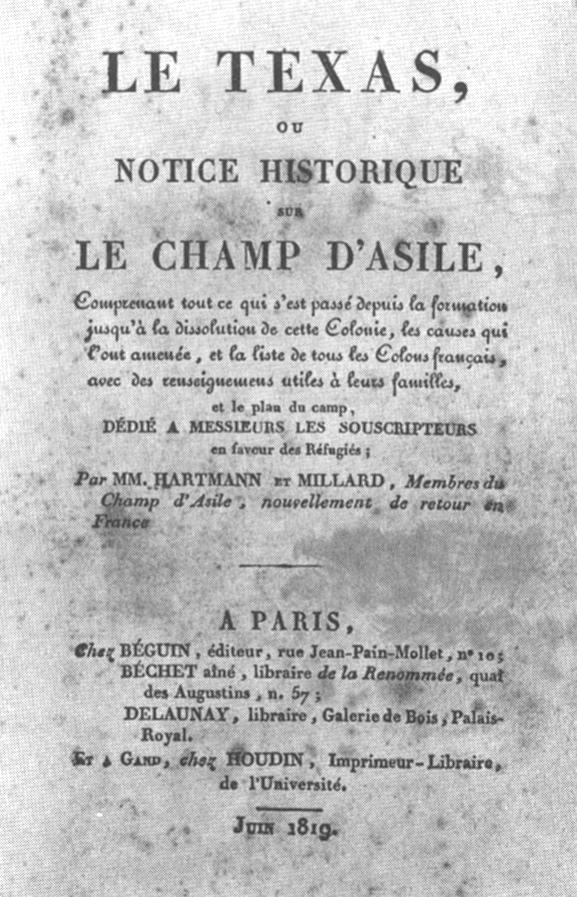
A History of  Champ D'Asile shortly after it was abandoned
Champ D'Asile was a settlement of Napoleonic French exiles in Texas led by General Charles Lallemand. But before they came to Galveston which was then ruled by Jean Laffite, they tried to find acceptance in the United States, during the administration of James Monroe. Here is a brief account of what happened.

Napoleon had lost his last big battle and was imprisoned for good on the Island of St. Helena. The monarchy in France had been restored. This left a large group of French families, men, women and children, displaced and without a home. They wanted to settle in America. However, when they brought their Society for the Cultivation of the Vine and Olive to Alabama Territory, Secretary of State John Quincy Adams, fearing that their true aim was military rather than agricultural, asked them to leave. Having nowhere to go, they searched far and wide for someone who would accept them. The benefactor who allowed them to settle was none other than Jean Laffite.

Jean Laffite welcomed them in Galveston, and there they founded their Champ d'Asile, but its very name a place of asylum. Their experiences included failed crops, encounters with the Karankawa Indians and with alligators and the hurricane of September of 1818. They eventually gave up and were evacuated before the start of 1819.

During the time when the settlers of  Champ d'Asile were in Jean Laffite's territory of Galveztown, the privateer assisted them in several different ways. He offered military protection, fortifications and even a grounded battleship to protect them. He also supplied them with some basic nourishment at a time when they might have otherwise starved. Some people think that was generous, and others feel that Laffite did not do enough. In my opinion, what he did was just right.

When a group of people want to join an already existing commune -- and by "commune" I am using Laffite's usage of the word -- they need to offer something of value to the already established people, but they also need to be offered an opportunity to better their own condition. There were no farmers among Laffite's men. They were mostly privateers who made their living off war and commerce. Every country that is going to be viable in the long run needs to make a stab at growing its own food. So it made sense for Laffite to welcome farmers. It made sense for him to offer them protection from those who would displace them, with the understanding that sooner or later they would start to pay their own way by growing their own food and creating a surplus of crops to sell cheaply to the locals. When the French settlers fell on hard times, Laffite even shared his own supplies to keep them alive. But he did not give them enough for them to feel satisfied and for their stomachs to be full. This was a good policy, because it gave the settlers an incentive to keep working for their own subsistence. Laffite also allowed them to come and go at will, and when the settlers deemed their agricultural experiment a failure, they were free to leave.

In every case of  legal immigration, as opposed to armed invasion, there has to be incentive on both sides for the inclusion of new people in an already existing settlement. The newcomers must offer some value, and those who welcome them need to understand that the transition might be difficult. But most of all, the experiment of trying to live together must be provisional. If the new people are not happy, they should be free to go. If their hosts are not happy with their contribution, it should also be possible to expel them. Like every business transaction, immigration needs to be two-sided and voluntary. The immigrants should not be imprisoned and kept from leaving, and the populace among whom they settle must be free to decide how much or how little help they wish to give them. Nothing should be taken by force on either side of the transaction.


Wednesday, April 2, 2014

President Monroe's First Address to Congress

James Monroe by Samuel Morse
from the wikipedia
Even before George Graham arrived in Galveston, President James Monroe had already decided that Jean Laffite should be asked to leave. As early as December of 1817, he said so in his first address to Congress. After describing the Amelia Island Incident, which culminated in the capture of that independent island by an American naval force, President Madison went on to say this:

A similar establishment was made at an earlier period by persons of the same description in the Gulf of Mexico at a place called Galvezton, within the limits of the United States, as we contend, under the cession of Louisiana. This enterprise has been marked in a more signal manner by all the objectionable circumstances which characterized the other, and more particularly by the equipment of privateers which have annoyed our commerce, and by smuggling. These establishments, if ever sanctioned by any authority whatever, which is not believed, have abused their trust and forfeited all claim to consideration. A just regard for the rights and interests of the United States required that they should be suppressed, and orders have been accordingly issued to that effect. The imperious considerations which produced this measure will be explained to the parties whom it may in any degree concern.
  To obtain correct information on every subject in which the United States are interested; to inspire just sentiments in all persons in authority, on either side, of our friendly disposition so far as it may comport with an impartial neutrality, and to secure proper respect to our commerce in every port and from every flag, it has been thought proper to send a ship of war with three distinguished citizens along the southern coast with these purpose. With the existing authorities, with those in the possession of and exercising the sovereignty, must the communication be held; from them alone can redress for past injuries committed by persons acting under them be obtained; by them alone can the commission of the like in future be prevented.
President Monroe's use of the term "impartial neutrality" belies his assertion that he has the right to "suppress" the establishment at Galveston, when Galveston is outside the territorial claims of the United States at that time. His questioning of whether these establishments were ever "sanctioned by any authority whatever" begs the question by what authority the government of any country, and especially an upstart like the United States,  is sanctioned.

To conquer a territory outside your own borders requires a declaration of war against those who hold it. To tell an established government that it must be suppressed is an act of war. You would think that if this is what James Monroe had in mind, he would be asking Congress for a declaration of war against the currently established government at Galveston. Instead, he informs Congress that he has sent a ship of war.

Jean Laffite had a policy engraved in stone not to make war on the United States, whom he regarded as his ally. But the United States more than once made war on him, without a declaration.

Tuesday, March 25, 2014

American Diplomacy in the Wake of War

Diplomacy is  just one of the tools of war. At the bargaining table, many a nation has won more territory than it could possibly have conquered in a pitched battle. At the bargaining table, many a victor's gains have been squandered. Sadly, the United States has a long history of dumping friends in order to make "peace" with bullies.

Neutrality would be a very fine thing, if it meant not getting involved in other people's disputes. But under the pretext of maintaining "neutrality" the United States has often broken with its natural allies in order to appease its more powerful enemies.

Can you imagine going to war with France to help Britain, when only a few years earlier France helped you win your independence from Britain? That's what the administration of John Adams did without a declaration of war.

Or how about the way the Soviet Union ended up our ally in World War II and FDR divided up the world between himself and Stalin at Yalta? Was that in the best interest of US citizens? How?

 Or the way in which Israel is constantly being pressured to give up territory for the sake of peace, while simultaneously being offered bribes in the form of American financial aid at taxpayer expense? Would a powerful Israel not be a good thing for the US? How does using taxpayer money to bribe Israel not to defend itself from forces unfriendly to the US help American citizens? Does it make the price of oil go down? I don't think so.

 Or exactly why was it that  we severed diplomatic relations with our friend Taiwan in order to make peace with Mainland China? Wouldn't "neutrality" have demanded that we treat both China and Taiwan just exactly the same? Why do we have to stop being friends with Taiwan in order to offer friendship to China? Would a real friend ever ask that of us?

All of these actions are part of a pattern that was established very early on in the history of the United States. There is nothing new under the sun, except that diplomacy as practiced by the US State Department does not tend to promote the natural interests of the United States and often penalizes United States citizens who are taxed to support policies inimical to their own interests.

The treatment of Jean Laffite by the United States, both at Barataria and at Galveston, is a case in point. Having driven Laffite out of his territory at Barataria when he helped defend New Orleans from the British invaders, when he moved to Galveston where he served as a buffer against Spain the United States went on to demand that he leave again, and not so that United States forces could take possession, either. It was so that Spain could retain its holdings in Texas, and so that the United States could maintain its fragile "friendship" with Spain. Is that neutrality? Siding with the local bully against the underdog who is friendly to you?

This is my take on it. But what did Jean Laffite think? A few well chosen snippets from his journal will give us an idea.

In this section of the Journal, Jean Laffite is talking about the events that precipitated his expulsion from Galveston. They involve the Spanish Ambassador de Onis putting pressure on President Monroe.
Ambassador de Onis protested more violently and thus forced President Monroe to send agents to Texas to verify the settlement of French refugees without the power of General Lallemand and to prevent him from settling in United States territory.
George Graham, who gave himself the honors, was chosen for the mission.  Mr. Graham was involved in banking matters in Washington, and he was always ready for placement when the occasion presented itself. Mr. Graham did not sympathize with Luis de Onis.
So then Mr. de Onis protested to Secretary John Quincy Adams on the subject of the French invasion of Texas. Mr de Onis and Mr. Adams were able to come to an agreement on their points.
John Quincy Adams, like his father John Adams, sympathized with the British against the French. He was perhaps more nearly neutral about Spanish interests, but Ambassador de Onis knew Adams the younger rather well, and he knew how to manipulate him to see things his own way.

Mr. Adams did not make much noise on the subject of my commune, but when he learned that my corsairs seized British ships, then along with the rest of his cabinet, he protested.

Like his father before him, John Quincy Adams, then secretary of state under President Monroe, sympathized with the British. It was a historic preference inherited from his father, the second president. The Federalist John Adams favored Britain, while Democratic-Republican Jefferson had been sympathetic to  France. Nobody seemed to be neutral, each faction having its own preferences in the European power struggle. In fact, throughout the career of Jean Laffite, it seems that the struggle between the Federalists and the Anti-Federalists, even when it seemingly culminated in the demise of the Federalist party, was still a factor.  There are echoes of this in the Journal of Jean Laffite.


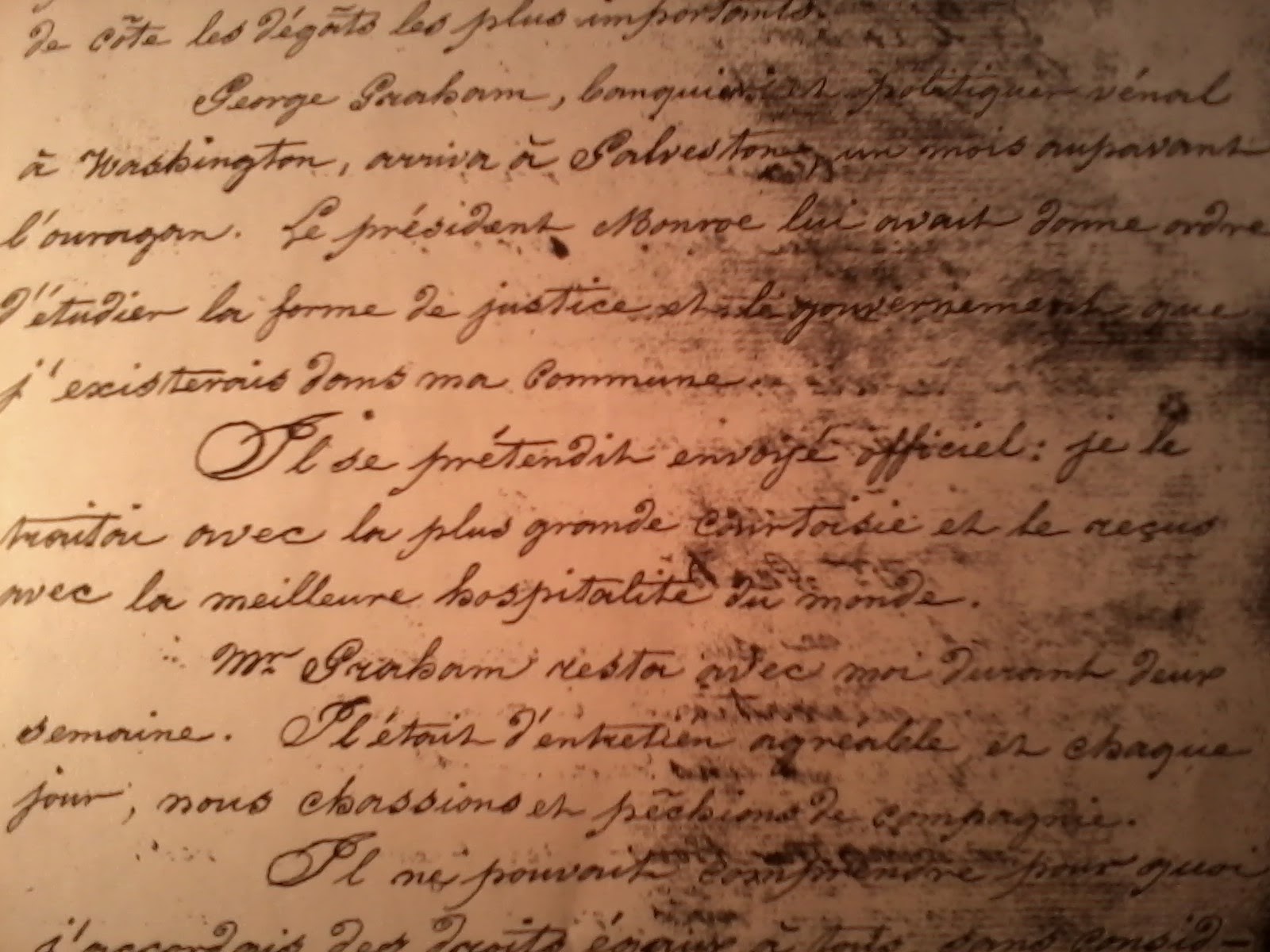
Jean Laffite writes:

George Graham, a venal political banker in Washington, arrived at Galveston one month before the hurricane. President Monroe had given him orders to study the form of justice and of the government that existed in my commune.
 He pretended to be an official envoy. I treated him with the greatest courtesy and received him with the best hospitality in the world. 
Mr. Graham stayed with me for two weeks.  He was of an agreeable disposition, and each day we hunted and fished together.


 He could not understand why I accorded equal rights to all, without considerations of nationality or religion.
He represented exactly the same type as Alexander Hamilton, opposed to the principles of Thomas Jefferson. 
George Graham told Jean Laffite that "the territory situated to the west of the Sabine River belonged to the United States which had not authorized me to establish  a commune of my choice to the west of that river."

Concerned that there might be some official sanction behind Graham's words, Jean Laffite set out to Washington, where he met with Secretary of State John Quincy Adams. At the time, Adams was fifty-one years old and Jean Laffite was thirty-six. Adams told Laffite that he had not authorized Graham to speak to him or to ask him to clear out of Galveston. Mr Graham was acting alone and without the sanction of the United States government.


Mr. Adams affirmed that Mr. Graham was in banking, and was interested above all  in commercial loans and credit to private businesses and that he liked neither the ideas of Thomas Jefferson nor the system of Napoleon. 
Then again, John Quincy Adams can't have been all that taken with Thomas Jefferson or Napoleon, either. It would be amusing to hear with what tone of voice Adams said this.

John Quincy Adams as painted by Gilbert Stuart in 1818
from the Wikipedia

In the end, when public opinion had been turned entirely against Laffite after the Le Brave incident, and when Graham was again dispatched to tell him he must leave, this time in a more official capacity, Jean Laffite informed George Graham that his government was against England and Spain, and he would abandon Galveston only on the condition the United States would occupy the Antilles as well as Florida. George Graham replied that he was more interested in loans received from Spain than in annexing any of its territories.

From a page of the Journal that has been badly burned
Relevant text reads: "Nous informames Mr. Graham que notre gouvernment etait contre Espagne et l'Angleterre et que nous abondonerions qu'a la condition que les Etats Unis occuperaient L'Antilles et la Floridie."

Can you imagine someone more interested in the well-being of the United States than one who insists that before he can abandon his post as a bulwark against its foes,  the United States should take over more territory?

The story of Jean Laffite should stand as a warning to all external well-wishers of the American experiment, not to set too much store on the friendship of a government whose foreign policy is to neutralize its friends for the sake of doing business with its enemies.

Friday, March 21, 2014

Meanwhile, back in Baltimore...

In the good old days of the nineteenth century, every time a failed revolutionary faced a firing squad in Mexico City, back in Baltimore there were people crying. No, they were not his family. They were the investors who financed his unsuccessful coup.

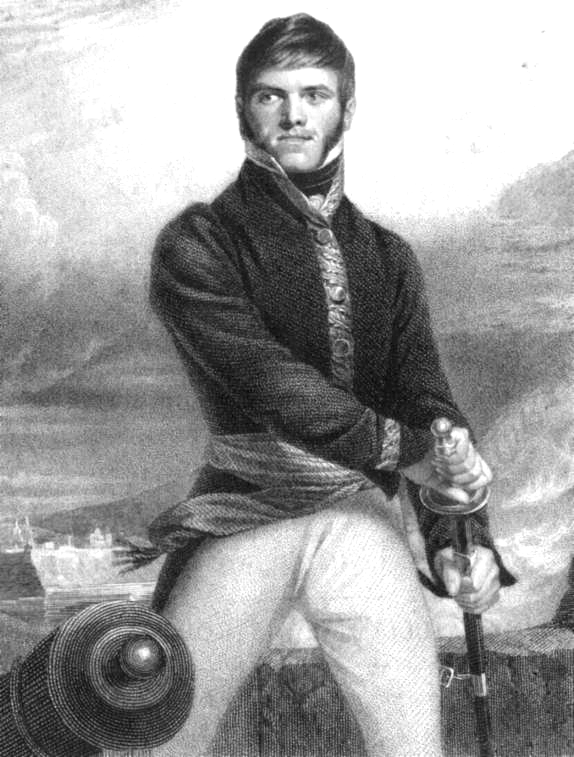
Francisco Xavier Mina, Spanish soldier, Mexican revolutionary
from the Wikimedia Commons: public Domain, Artist Unknown
Sometimes, years later, when a grateful independent Mexico decided to repay the debt it owed to the American investors and to people who had since gone bankrupt due to lack of payment or who had died of old age, their creditors or their heirs were denied payment, because of the Neutrality Act. This is what happened when Xavier Mina left his base in Galveston on an ill-fated mission to liberate Mexico from its Spanish oppressors in 1817.

Mina was a loyal Spanish subject born in Otao, Navarre, and  he acquired experience in guerilla warfare against the French occupation force in 1808. From an initial guerilla force of only ten men, under Mina's leadership his followers grew to 1,200 infantry and 150 cavalry. He made inroads into the French occupation but was captured in 1810 and sent to prison in France and was released n 1814. By then King Ferdinand VII of Spain was on the throne again, and Napoleon was exiled in Elba. King Ferndinand made Mina a Colonel in his army. But Mina was not happy with King Ferdinand. Why? Because the King had abolished the democratic constitution of 1812.

And so, the idealist Mina, who had fought so hard for the restoration of his King under the French oppressor now decided he wanted to liberate Mexico from Spain. Some English lords financed his voyage to Baltimore.

...there  [Mina]   entered into a contract with certain gentlemen of that place, who associated themselves under the name of the "Baltimore Mexican Company," for the purchase of a quantity of arms, ammunition &c., to fit out an expedition against the then government of Mexico. On account of the risk attending their delivery and the uncertainty of the payment, it was agreed that Mina should pay one hundred percent on the cost of the articles, and interest. The goods were shipped for Mexico and delivered according to contract, but were not paid for by General Mina, as he was soon after taken prisoner and shot. Gill v. Oliver's Executors, 52 U.S. 529 (1850)

That's right. Mina was taken before a firing squad and summarily shot. He was twenty-seven years old at the time of his death. It was November 11, 1817. But that's just the beginning of the story. The good men do is buried with them, but their debts live on forever, or at least until they are paid or discharged in bankruptcy.

Back in Baltimore, the investors who outfitted the expedition were crushed. One of them, Lyde Goodman, filed for discharge in bankruptcy, and he transferred all his right and title to a share in the Baltimore Mexican Company to the trustee in the bankruptcy proceeding. The trustee, a certain Mr. Brown, then transferred all his right to that share to Robert Oliver in 1825. By this time Mina had been moldering in his grave for eight years, his debts to the Baltimore investors still unpaid.

Then one day a grateful Mexican Nation decided to repay its debts. Spain had finally been driven out.

In 1825, Mexico had achieved her independence, and after much solicitation the government was persuaded to acknowledge the justice of this claim, and assume the payment of it by an act of Congress passed to pay the debts of Mina. But notwithstanding the recognition of this claim as a debt, its payment was delayed for many years, and seemed almost hopeless.Gill v. Oliver's Executors, 52 U.S. 529 (1850)


Finally, in 1839 the money became available, but there was now a dispute as to which of two trustees in bankruptcy of Lyde Goodman was entitled to collect. Did this claim to money from the government of Mexico exist as far back as 1816, when the expedition was outfitted in contravention of the Neutraility Act? Or did it only arise in 1825 when the government of Mexico decided to honor the promises that Mina had made back in 1816 when passing through Baltimore?

Was the void and illegal contract with Mina, made in 1816, such a chose in action as would pass by such insolvent law in 1817? Or did it first become an assignable claim after it was acknowledged by Mexico in 1825, and, as a new acquisition of Lyde Goodwin after his insolvency, pass by his assignment to Oliver. Gill v. Oliver's Executors, 52 U.S. 529 (1850)


Well, the Supreme Court took the easy way out. They decided they had no jurisdiction over the matter. They dismissed the case. So why am I telling you this story? Because it's something to think about if you are a supporter of the Neutrality Act.

Should American investors help revolutionaries in other countries to overthrow their government? If you said "No, that should be illegal", think about this: if only the government of the United States has the right to overthrow foreign governments, then only the friends of the President and other powerful politicians will be allowed to profit from investing in war. Do we really want crony capitalism to allow only certain people  to become war profiteers? Do we want to give the government a monopoly on military contracts?

The Neutrality Act does not prevent war. It does not prevent investors from gambling on war. It does not prevent politicians from profiting from war. All it does is hand a monopoly to people in the government. So now if we bet on the wrong horse, all of us have to pay for our mistake and not just a few unlucky investors in Baltimore.