 |
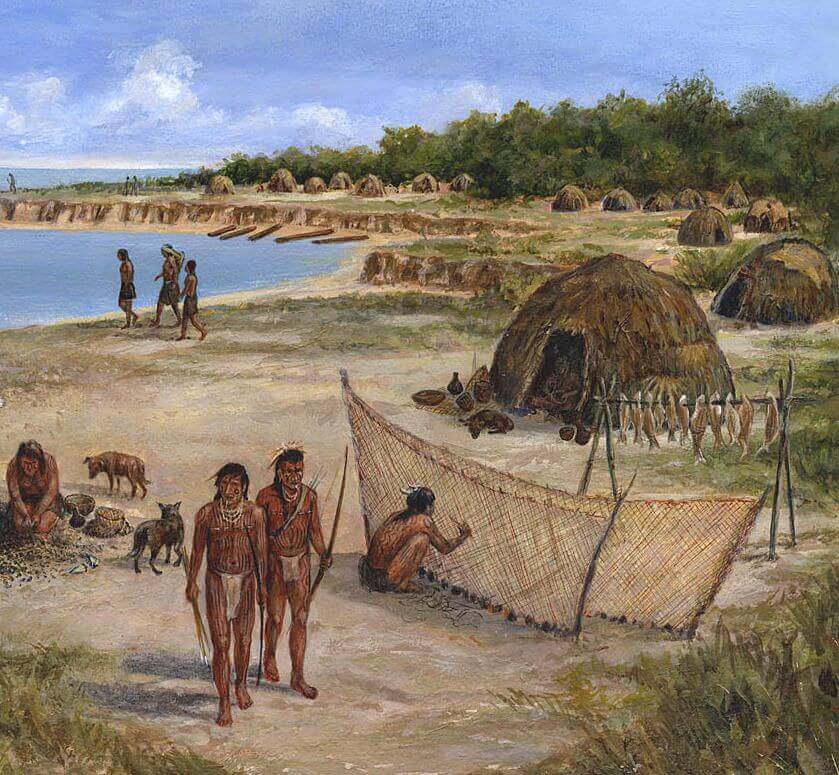
| Karankawa encampment image from http://www.indigenouspeople.net/images/guadalupe.jpg |
Without any modern technology or medical care, the Karankawa were an amazingly hardy people. Cabeza de Vaca, who served as their slave for a time, observed that they could go out in the heat of the sun completely unaffected. In the winter, they bathed in frozen water, breaking the ice with their bodies. The elements did not seem to trouble them at all.
The word Karankawa means "dog-lover", and the Karankawa always had dogs with them. The dogs were a fox and coyote hybrid, ad they shared in the food of the Karankawa.
The Karankawa used dugout canoes to fish and hunt for oysters, clams, mollusks,turtles and porpoises, as well as the more common types of fish. When they went inland, they also hunted for deer, bear, and ducks. They were nomadic and changed their location according to the seasons and where food was most plentiful at the time.
Some people accused them of being cannibals, but that is not true. In fact, when Cabeza de Vaca related that his shipwrecked crew resorted to eating dead members, the Karankawa were quite shocked. They would never eat their own people. They did occasionally eat certain organs of beaten enemies, but that was not as a food source. That was to magically gain the power of their enemies.
This is something we should think about for a moment, because it is a problem we are dealing with even now as we speak. People forget the true meaning of cannibalism. It means eating your own kind, feeding on members of your own group. It does not mean eating somebody who is outside your group.
Many people are confused about this, not the least the Buddhists and those "enlightened souls" who recognize that other living beings have feelings. There is the circle of life, where being feeds on being. And then there is the circle of those we offer protection and whom we consider our peers.
It is not cannibalism to eat a cow, even though we understand that cows have intelligence and feeling. It is cannibalism to eat a member of your own family, tribe or larger group with which you are identified, such as all humans. The circle that you extend your protection to and claim as your own may be small, or larger, but it cannot include all living things, because life feeds on life.
Here is an article written by my father, Amnon Katz, that explains this better:
http://aya-katz.hubpages.com/hub/Liberty-and-Justice-Why--How-and-for-Whom
This brings us back to the meaning of piracy. Piracy would mean preying on your own. Privateering means preying on enemy ships. The whole difference between the two is where you draw the circle. If the Spanish are your allies, then preying on them is piracy. If they are your legally acknowledged enemies, it is privateering.
When the government of the United States chased Jean Laffite away from Barataria and later from Galveston, they were choosing piracy over privateering, or cannibalism over eating their enemies' organs. They preferred to fund their military expansionist ambitions by taxing their own people, instead of allowing their friends and allies and their own people to prey on acknowledged enemies. They were siding with Britain and Spain against the American people.
And that in a nutshell is the difference between feeding on the in-group and feeding on those outside the circle.
If we go against cattle ranchers and independent farmers, if we save all the marine life, and give land only to large factories that will exploit it to the max, in the end there will be nothing left to eat but each other.
The Karankawa Indians were not exterminated because they ate too much, used too many resources or destroyed the land. It is because they were too modest in their aspirations that they were not allowed to exist at all. The same is true for Jean Laffite and his establishment, and the privateering way of life.
RELATED ARTICLES
