Showing posts with label diplomacy. Show all posts

Friday, August 1, 2014

Should Smaller Countries Rely on the Beneficence of the United States?

If there is any lesson to be learned from the way Jean Laffite was treated by representatives of the United States goverment at Galveston, it is this: A very small country cannot expect to survive long if it chooses to become a satellite of the United States.

There are many reasons for this, not the least of which is the fact that in the tit-for-tat of diplomatic negotiation, the United States tends to make concessions to countries whose behavior and goals it sees as problematic and even threatening, while taking for granted that well-behaved satellites will stay in line.

My father, back when he still hoped that Israel would stop relying on US assistance,  explained it like this:

An excerpt from ISRAEL: WHENCE AND WHITHER
the entire article can be read in facsimile here:http://www.pinterest.com/ayakatz/israel-whither-and-whence/

When Uri goes to school, the teacher, Bracha, tells him that discipline, quiet and order are the keys to success. If Uri asked for my advice, I would tell him to ignore the teacher and do whatever he feels like. I know what the teacher learned in her pedagogical seminar: take the wildest boy, give him a position of authority, give him responsibility, imbue him with importance,  and he will help you to rule over the class. You will be able to handle the obedient children either way. Uri knows all that. He does not need my advice.
I'm not saying that it has to be this way. It is possible to manage a class, a family, a country or the world another way, too. The teacher, the head of the family, the government of the country,  the international authority can do so. But it's not up to Uri. He can only study the responses of Mrs. Bracha and learn that it is not the one who obeys her who is rewarded. In the area of international relations, it is not in Israel's hands. Israel can only determine that it is not in its best interest to obey international powers, even if their intention is for the good. The international powers have interests that are in conflict with those of Israel; at times the great powers do not even understand what is their own best interest. For its own sake, and at times even for the sake of the great power whose commands it disobeys, Israel must break out on its own.
 This same advice holds in every relationship, even the intimate ones. Those who are most secure in our love and most sure of our allegiance to them are the ones who tend to take advantage of us. Often family members show greater deference and concern toward strangers they are wary of than to those whom they trust and rely on. In a romantic relationship, the person who is most committed is the one with the least leverage. In business negotiation and at the diplomatic conference table,  it is the least well-behaved participant who has more of a chance to get what he wants.

http://www.amazon.com/Theodosia-Pirates-The-Against-Spain/dp/1618790099

In Theodosia and the Pirates: The War Against Spain, we learn this lesson over and over again. From the opening pages, where Theodosia's love for Jean leaves her unable to demand anything for herself, not even that he break his ties with the treacherous General James Wilkinson, to the many different moments when Jean offers his allegiance and his services to the United States only to be told that they would rather do business with Spain or Britain, to the final negotiations by Pierre for a safe conduct pass, which is only granted when Pierre hints that Jean could just hand over Galveston to Spain, we see how it all works. The one who loves the most is rarely found on top, and the United States gives in to empires it is afraid of and not to the friends that are helping it to resist them.

Could it be otherwise? Could unconditional love ever be rewarded? Could a pater familias, a governor or a ruler ever punish the disobedient and reward the good? Could justice be swift and unerring, and could there ever be someone we can count on not to betray our trust once we give it?

We do see that in the actions of Jean Laffite as he governs his own family, his captains and his  own little country. But Jean Laffite was not a world power, and he was fighting too many enemies on too many fronts, while not having enough allies he could count on. If the United States had feared Jean Laffite more, it would have respected him better. Because they knew they could always count on his loyalty, they were able to completely disarm him. In the long run, this was not in the best interest of the United States.

Tuesday, March 25, 2014

American Diplomacy in the Wake of War

Diplomacy is  just one of the tools of war. At the bargaining table, many a nation has won more territory than it could possibly have conquered in a pitched battle. At the bargaining table, many a victor's gains have been squandered. Sadly, the United States has a long history of dumping friends in order to make "peace" with bullies.

Neutrality would be a very fine thing, if it meant not getting involved in other people's disputes. But under the pretext of maintaining "neutrality" the United States has often broken with its natural allies in order to appease its more powerful enemies.

Can you imagine going to war with France to help Britain, when only a few years earlier France helped you win your independence from Britain? That's what the administration of John Adams did without a declaration of war.

Or how about the way the Soviet Union ended up our ally in World War II and FDR divided up the world between himself and Stalin at Yalta? Was that in the best interest of US citizens? How?

 Or the way in which Israel is constantly being pressured to give up territory for the sake of peace, while simultaneously being offered bribes in the form of American financial aid at taxpayer expense? Would a powerful Israel not be a good thing for the US? How does using taxpayer money to bribe Israel not to defend itself from forces unfriendly to the US help American citizens? Does it make the price of oil go down? I don't think so.

 Or exactly why was it that  we severed diplomatic relations with our friend Taiwan in order to make peace with Mainland China? Wouldn't "neutrality" have demanded that we treat both China and Taiwan just exactly the same? Why do we have to stop being friends with Taiwan in order to offer friendship to China? Would a real friend ever ask that of us?

All of these actions are part of a pattern that was established very early on in the history of the United States. There is nothing new under the sun, except that diplomacy as practiced by the US State Department does not tend to promote the natural interests of the United States and often penalizes United States citizens who are taxed to support policies inimical to their own interests.

The treatment of Jean Laffite by the United States, both at Barataria and at Galveston, is a case in point. Having driven Laffite out of his territory at Barataria when he helped defend New Orleans from the British invaders, when he moved to Galveston where he served as a buffer against Spain the United States went on to demand that he leave again, and not so that United States forces could take possession, either. It was so that Spain could retain its holdings in Texas, and so that the United States could maintain its fragile "friendship" with Spain. Is that neutrality? Siding with the local bully against the underdog who is friendly to you?

This is my take on it. But what did Jean Laffite think? A few well chosen snippets from his journal will give us an idea.

In this section of the Journal, Jean Laffite is talking about the events that precipitated his expulsion from Galveston. They involve the Spanish Ambassador de Onis putting pressure on President Monroe.
Ambassador de Onis protested more violently and thus forced President Monroe to send agents to Texas to verify the settlement of French refugees without the power of General Lallemand and to prevent him from settling in United States territory.
George Graham, who gave himself the honors, was chosen for the mission.  Mr. Graham was involved in banking matters in Washington, and he was always ready for placement when the occasion presented itself. Mr. Graham did not sympathize with Luis de Onis.
So then Mr. de Onis protested to Secretary John Quincy Adams on the subject of the French invasion of Texas. Mr de Onis and Mr. Adams were able to come to an agreement on their points.
John Quincy Adams, like his father John Adams, sympathized with the British against the French. He was perhaps more nearly neutral about Spanish interests, but Ambassador de Onis knew Adams the younger rather well, and he knew how to manipulate him to see things his own way.

Mr. Adams did not make much noise on the subject of my commune, but when he learned that my corsairs seized British ships, then along with the rest of his cabinet, he protested.

Like his father before him, John Quincy Adams, then secretary of state under President Monroe, sympathized with the British. It was a historic preference inherited from his father, the second president. The Federalist John Adams favored Britain, while Democratic-Republican Jefferson had been sympathetic to  France. Nobody seemed to be neutral, each faction having its own preferences in the European power struggle. In fact, throughout the career of Jean Laffite, it seems that the struggle between the Federalists and the Anti-Federalists, even when it seemingly culminated in the demise of the Federalist party, was still a factor.  There are echoes of this in the Journal of Jean Laffite.


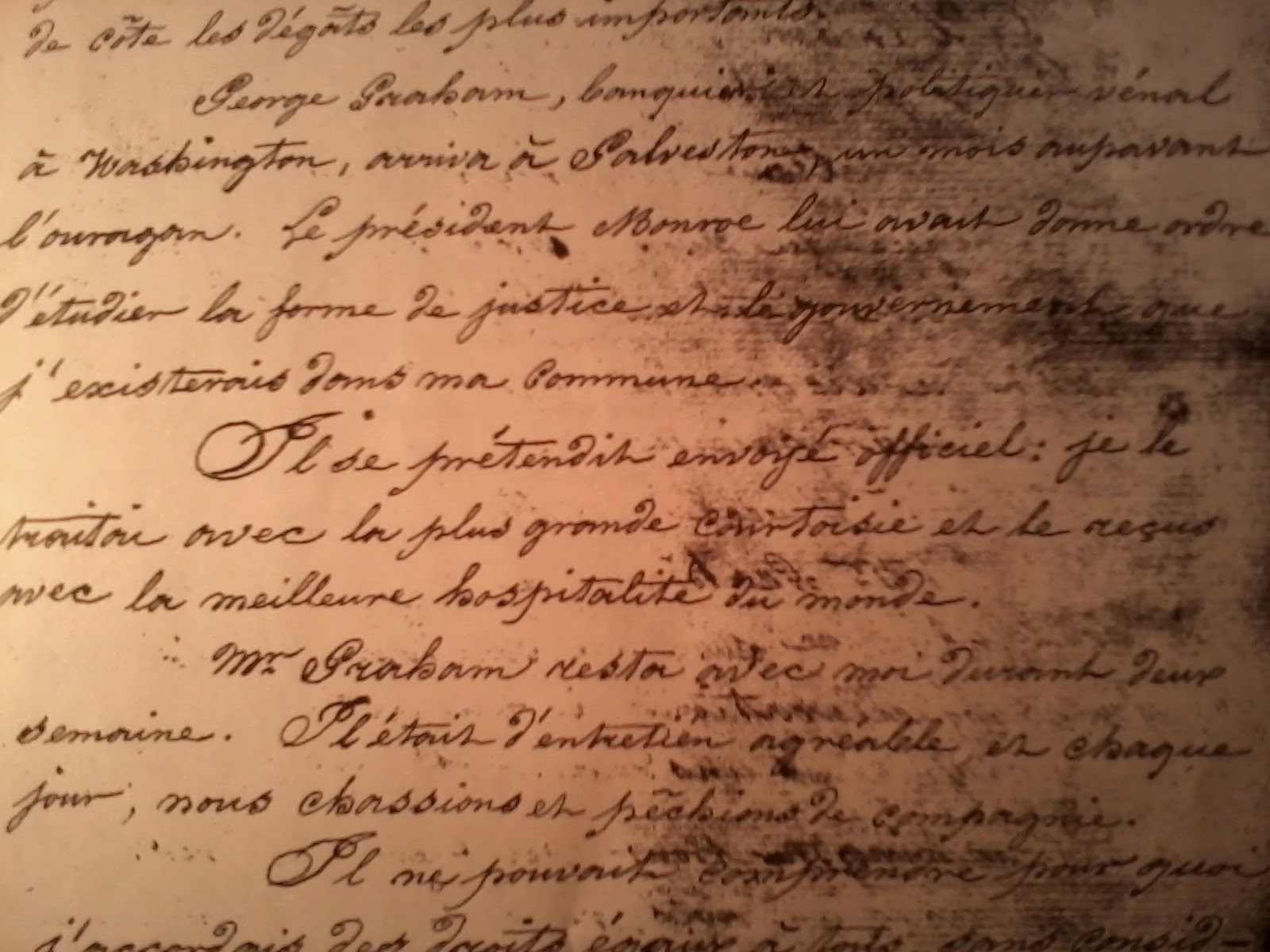
Jean Laffite writes:

George Graham, a venal political banker in Washington, arrived at Galveston one month before the hurricane. President Monroe had given him orders to study the form of justice and of the government that existed in my commune.
 He pretended to be an official envoy. I treated him with the greatest courtesy and received him with the best hospitality in the world. 
Mr. Graham stayed with me for two weeks.  He was of an agreeable disposition, and each day we hunted and fished together.


 He could not understand why I accorded equal rights to all, without considerations of nationality or religion.
He represented exactly the same type as Alexander Hamilton, opposed to the principles of Thomas Jefferson. 
George Graham told Jean Laffite that "the territory situated to the west of the Sabine River belonged to the United States which had not authorized me to establish  a commune of my choice to the west of that river."

Concerned that there might be some official sanction behind Graham's words, Jean Laffite set out to Washington, where he met with Secretary of State John Quincy Adams. At the time, Adams was fifty-one years old and Jean Laffite was thirty-six. Adams told Laffite that he had not authorized Graham to speak to him or to ask him to clear out of Galveston. Mr Graham was acting alone and without the sanction of the United States government.


Mr. Adams affirmed that Mr. Graham was in banking, and was interested above all  in commercial loans and credit to private businesses and that he liked neither the ideas of Thomas Jefferson nor the system of Napoleon. 
Then again, John Quincy Adams can't have been all that taken with Thomas Jefferson or Napoleon, either. It would be amusing to hear with what tone of voice Adams said this.

John Quincy Adams as painted by Gilbert Stuart in 1818
from the Wikipedia

In the end, when public opinion had been turned entirely against Laffite after the Le Brave incident, and when Graham was again dispatched to tell him he must leave, this time in a more official capacity, Jean Laffite informed George Graham that his government was against England and Spain, and he would abandon Galveston only on the condition the United States would occupy the Antilles as well as Florida. George Graham replied that he was more interested in loans received from Spain than in annexing any of its territories.

From a page of the Journal that has been badly burned
Relevant text reads: "Nous informames Mr. Graham que notre gouvernment etait contre Espagne et l'Angleterre et que nous abondonerions qu'a la condition que les Etats Unis occuperaient L'Antilles et la Floridie."

Can you imagine someone more interested in the well-being of the United States than one who insists that before he can abandon his post as a bulwark against its foes,  the United States should take over more territory?

The story of Jean Laffite should stand as a warning to all external well-wishers of the American experiment, not to set too much store on the friendship of a government whose foreign policy is to neutralize its friends for the sake of doing business with its enemies.