Showing posts with label Alexander Hamilton. Show all posts

Friday, May 26, 2017

Not Anti-War But Anti-Tyranny

War can be hell. But it is also something that many young men look forward to so they can test their mettle, men like Alexander Hamilton, who in a 1769 letter to a friend wrote: "I wish there was a war." (He apparently had not yet mastered the subjunctive.) In times of peace, young men often wish for war. In times of war, all men wish for peace.

Here is a song by Leslie Fish explaining why the wish for total peace, if granted, would lead to tyranny. We all want peace, but not at the price of a one world government.


Is it wrong to long for a war to break out just to gratify one's personal wish to go to war? Well, it is if you start a war just to make that happen! It is if you conscript and/or tax others to serve in that war without their consent. But it's not wrong,  if you are a privateer or a mercenary, and you offer your services to those who want them and would be willing to pay.

Who should pay for waging war? Those who want to wage war. That way we can put a cap on it. But it is not wrong for a young warrior to long to serve. It is not wrong for men and women who have that calling to pursue it.

In the video embedded below, I read from Nathan Alterman's poem "אמרה חרב הנצורים" --"Said the Sword of the Besieged".  The poem is from the point of view of a sword being wielded in a hopeless last battle, in which the warrior is killed.

In the discussion that ensues after the reading, my father, Amnon Katz, says: "The sword's entire purpose is battle. And it is happy to fulfill its purpose. Even under these tragic circumstances. But we get the impression that also the one who wields the sword is privy to these values and to this experience, to the glory of this bitter and awful hour." Is it wrong for a young man to long for battle? To sign up for voluntary military service? To hope for glory?

Both Aaron Burr and Alexander Hamilton served in the American Revolution. Both distinguished themselves. But Aaron Burr wanted always to be on the front lines, so when he was offered a desk job by George Washington, he turned it down. Hamilton was ambitious for advancement, so he took that job.

Both Jean Laffite and Aaron Burr served the US as volunteers. Neither of them did it for a "free" college education or for a salary. Laffite was never reimbursed for his contribution or for those things that were taken from him by force. For years, Aaron Burr was destitute after being persecuted by Jefferson, but as a veteran he was not entitled to a military pension. Finally, when Burr was very old, President Jackson granted him a small pension.

Is all war bad? Or only some wars? Is getting paid for war always bad? Shouldn't our soldiers be paid?

There are some Libertarians who seem to have serious problems with the idea that military service could be entered into in the hopes of going into battle or for pay.  In the video embedded below. Austin Petersen and Larry Sharpe discuss a recent anti-military statement by the Vice Chair of the Libertarian Party.


Not all libertarians are anti-military or anti-war. "Did you agree to kill people for money?" Austin Petersen asks Larry Sharpe.  Sharpe replied "War is evil. War is bad. ...Would I join now? No. I'm also not 17 years old anymore."

But is it wrong to be 17 years old and long to serve? I don't think so.  Should soldiers expect always to be penniless and to go begging when they are in want?


Why do we honor our soldiers only when we see them as poor and without compensation for their service? Why do we think that they deserve less than teachers or doctors? Is it because we are uncomfortable with the work they do? Or is it because public funding for anything corrupts?

Let us honor our soldiers and work toward a free country where they can ply their trade with their heads held high and with compensation that is not dependent on taxation.  We do not want a standing army, but we do need to have warriors who are well trained and ready to fight for us. If we repeal the Neutrality Act and the Logan Act, we can restore the freedom that volunteer soldiers like Aaron Burr fought for in the Revolutionary War!


RELATED


Monday, January 2, 2017

New Year, New Goals and a Video on Burr

In 2017, my goal is to refrain from writing new books, but to spend more time promoting the books I have already written or published. I also plan to support and promote the work of other writers, dead or alive, whose contributions I value.

With that in mind, I would like to share this video from the year 2000 of  Roger G. Kennedy talking about his book  Burr, Hamilton, and Jefferson: A Study in Character.


The video takes an hour to watch, and I hope you will set aside that time to watch it. For me, highlights from Kennedy's talk include his mention of the following points:


  • at the time when Burr was successfully campaigning as an abolitionist, free blacks and women who owned property could vote in the state where Burr was soliciting their vote.
  • when Burr suggested to Jefferson that women should be allowed to hold high office, Jefferson wrote back that this was something for which neither the public nor he himself were prepared.
  • while Burr was promiscuous and insolvent -- vices he shared with Hamilton and Jefferson -- he was never mean or cruel to anyone. 
  • Hamilton projected onto Burr all his own issues, and he used Burr as a means to commit suicide.
  • Burr was a war hero as soon as the war began and preferred to serve in active combat than on George Washington's staff -- for which Washington never forgave him.
  • Thomas Jefferson personally indicted Aaron Burr of treason. There was no grand jury. There was no inquiry or investigation. It was the one and only presidential indictment in American history.
  • Burr was tried for treason three times, and all three juries acquitted him. One of those juries also indicted Jefferson for even bringing such baseless charges against Burr.
  • People remember the charges leveled at Burr more than they remember the outcome of the cases brought against him
  • The second historian was a revisionist. Any true historian looks for the truth, rather than repeating what someone else has written about the past.
Roger G. Kennedy was a great and engaging speaker, as well as a persuasive and scholarly writer. He died in 2011. When asked in the year  2000 what contemporary politician reminded him of Burr, he said "Adlai Stevenson." This rather startled me. For one thing, I don't even think of Adlai Stevenson as contemporary. For another, the man was a progressive Democrat  -- not my cup of tea. But Roger Kennedy was on Dwight D. Eisenhauer's campaign staff, so Stevenson was a contemporary of his. And Kennedy also worked for Bill Clinton, so he seems to have been quite versatile, ideologically speaking.

Realizing that I am well out of my depth in evaluating Kennedy's life and politics, I nevertheless submit that he has made a meaningful contribution to Aaron Burr scholarship. For this I commend him. 


Wednesday, September 9, 2015

The Presidential Election of 1800

Even though the framers of the constitution did not make any mention of political parties, the party system emerged very early on in the history of American politics, and by the  fourth quadrennial presidential election two parties dominated the scene: the Federalists, whose leaders were John Adams and Alexander Hamilton, and the Democratic-Republicans, led by Thomas Jefferson and Aaron Burr.

Because the framers of the constitution did not anticipate the rise of political parties, they provided that each member of the Electoral College could cast two votes for president, and that the person with the highest number of votes would be the new president, and the person with the second highest number of votes would be the new vice president. The reasoning behind this rule was that it would maximize the possibility that a person with a majority of national support would be elected president. (When people vote by the party and not by the person, the possibility of getting a majority is much greater, as electors never even consider voting for people that the major parties have not thrown their support behind.) It was thus that in 1800 the incumbent president was John Adams, a Federalist, and the incumbent Vice President, Thomas Jefferson was his rival, a Democratic-Republican.


In preparation for the election, each of the two major parties had a plan and a "ticket". Despite the fact that the constitution expected each candidate to run on his own and for the second runner up to be vice president, that is not at all how the major players in the election of 1800 organized themselves. Each party had a presidential candidate and a chosen running mate.

John Adams chose Charles Cotes Pinckney of South Carolina as his running mate. (He could not have chosen Alexander Hamilton, because Hamilton was foreign born, and thus ineligible to hold the office of president .) Thomas Jefferson chose Aaron Burr, of New York, as his running mate. Notice that they tried to keep things even between the North and the South: the presidential candidate from the North, Adams, chose a southerner for his running mate. The presidential candidate from the South, Thomas Jefferson, chose a northerner for his running mate. But make no mistake about it: despite the provisions in the constitution, there was a presidential ticket for each party that included a presidential and a vice presidential candidate. And in order to make sure that the right guy wound up president from their own slate, each party instructed one of their electors to vote against the vice presidential candidate of their choice, lest he get the exact same numbers as the presidential candidate.

But in 1800 something went wrong.  Things did not go as planned at party headquarters. The person on the Democratic-Republican side who had been instructed to vote against Aaron Burr forgot or changed his mind, and Jefferson and Burr tied for president, each with 73 electoral votes. In the Federalist party, Hamilton and Adams were not acting in unison, which may be one of the reasons why the Federalists lost their hold on the presidency.

The issues in the election centered on the Federalist support of England against France, which resulted in the use of the Neutrality Act to prevent American privateers from serving the French interests, while the American government was engaged in a Quasi-War with France. And to make sure that people did not complain about this, the Federalists had passed the Alien and Sedition Acts. All of these were highly unpopular measures, which is why the Democratic-Republicans were the clear winners. But while everybody was tired of the tyranny of the Adams administration, and most Americans did not want to be satellites of England, there was also concern that Thomas Jefferson might be a Jacobin, and that his presidency might result in a loss of property rights as was suffered by the bourgeoisie under the French Revolution. That is why certain people, some of them Federalists,  were campaigning behind closed doors to make Aaron Burr the president, and Thomas Jefferson the Vice President.

However, that was not Aaron Burr's doing, and he was an honorable man. He had promised to run with Jefferson as the vice presidential candidate, and though he had a chance to grab the presidency, he did not. He instructed his supporters in the House of Representatives to throw in their votes for Thomas Jefferson in the follow-up election of 1801. At this point, the Federalist supporters of Adams had been voting for Burr, while the faction of the Federalists that Hamilton controlled voted for Jefferson. Abigail Adams, in one of her letters, expressed the thought that Burr would make a pretty good president.

Thomas Jefferson, even though he did win the election, never forgave Burr for almost upstaging him, and the next time he ran for president, he did not choose Burr as a running mate. Another, far more permanent result of this election was that the constitution was amended. No more was the vice president to be the person with the second  highest number of votes for president. From now on, vice presidents would be elected separately from presidents, thereby acknowledging the practical power of the political party.

Today, most people do not know about any of this. Some say it's a shame we have political parties, since that was not envisioned by the founding fathers. Not envisioned perhaps, but all the founding fathers who ran for office were involved in political parties, so while they may not have wanted them to exist for the other side, they certainly did use them when they themselves were running. People also do not remember that Burr and Jefferson were running mates on the same political party slate. Some contrarians even remember that the president and vice president were elected in the same election, but they do not remember that in order to get around the rules they themselves had made, founding fathers like Adams and Jefferson instructed their political flunkies to cast one vote for somebody they did not want elected at all, just so there would be a clear presidential winner on their party slate distinct from the vice presidential winner.

The historical facts can be quite astonishing. Sometimes it pays to revisit them.


RELATED ARTICLES


Monday, October 6, 2014

The Neutrality Act of 1817

The first American Neutrality Act was passed in 1794.  It made it illegal for Americans to wage war on a country at peace with the United States. The thing to consider about this act of Congress is that prior to its passage, it was perfectly legal for an American citizen to wage war on his own against a country that the United States was not at war with. The constitution provided that the Federal government under its commander-in-chief, the President, would not be allowed to wage war unless Congress issued a declaration of war. But all the rights not granted to the Federal government were reserved to the states and to the people. So while the president of the United States was bound to remain neutral in all matters, unless Congress voted otherwise, each individual American was allowed to conduct his own foreign policy.

Take a deep breath and think about what this means. American citizens prior to 1794 were considered autonomous. They could make war on other countries in order to pursue their own interests. And, indeed, many Americans were privateers with letters of marque from foreign countries, such as France, and earning a good living by helping others in their wars against the great international empires such as Britain and Spain.


What happened in 1794 to change all that? In 1794, under the administration of George Washington, the United States signed the Jay Treaty with Britain. The Jay treaty was the brainchild of Alexander Hamilton, and it was hotly contested by the Jeffersonian-led Democratic-Republicans, who feared that this was a return to old world aristocratic tendencies and the rule of tyranny.

The other thing that happened in 1794, which I might as well also mention, was the reign of terror of Maximilien de Robespierre and his Committee of Public Safety in France. After the French revolution, Jacobins had taken over France. It was off with everybody's head and a complete deterioration of all civilized things, including private property.

Britain did not want this general lawlessness to spread to England, and George Washington and Alexander Hamilton agreed. So they decided to tie the hands of American privateers who were still working for France. They also thought this would be a good time to repudiate the American war debt to France, since, after all, that promise was made to the French monarchy that helped to free American Colonies from Britain and not to those lawless  Jacobins currently in power.

The Jay Treaty cleared the way for the Quasi-War with France under John Adams, an undeclared war that served British interests and helped the United States renege on the American promise to repay its war debts to France. During the Quasi-War with France, the president of the United States ignored the constitutional provision that required him to get clearance from Congress before starting a war. Meanwhile, the Neutrality Act, far from creating neutrality was used to make sure that no individual American fought for a side in any war that the president did not want him fighting on.

Just like the Committee for Public Safety in France, that did anything but insure public safety, the Neutrality Law was named the very opposite of what it did.

But our subject here is not the Neutrality Act of 1794. Our subject was the Neutrality Act in 1817. The original Neutrality Act was superseded by this new act that also mentioned the unrecognized governments of newly liberated Latin American countries as additional powers that American citizens were not to help anymore. Henry Clay called this an "Act for the benefit of Spain against the Republics of South America." The act prescribed penalties of three years imprisonment and three thousand dollars in fines.

Far from breeding neutrality, all these laws collectively were used to tie the hands of American privateers and to help the great empires of Britain and Spain to hold on to their dominions. But much more importantly than this, the Neutrality Act was used to subdue the independent spirit of American businessmen, who henceforth would need the permission of their government to conduct business abroad and to defend their foreign holdings.

When Jean Laffite was routed out of all his holdings in both Barataria and Galveston, this disempowerment did not happen to him alone. It happened to all Americans, who became more like subjects and less like citizens under a government that took on itself more and more power. In order to pursue its own dreams of empire, the United States government under James Monroe wanted no competition from private citizens in the international arena.

Tuesday, March 25, 2014

American Diplomacy in the Wake of War

Diplomacy is  just one of the tools of war. At the bargaining table, many a nation has won more territory than it could possibly have conquered in a pitched battle. At the bargaining table, many a victor's gains have been squandered. Sadly, the United States has a long history of dumping friends in order to make "peace" with bullies.

Neutrality would be a very fine thing, if it meant not getting involved in other people's disputes. But under the pretext of maintaining "neutrality" the United States has often broken with its natural allies in order to appease its more powerful enemies.

Can you imagine going to war with France to help Britain, when only a few years earlier France helped you win your independence from Britain? That's what the administration of John Adams did without a declaration of war.

Or how about the way the Soviet Union ended up our ally in World War II and FDR divided up the world between himself and Stalin at Yalta? Was that in the best interest of US citizens? How?

 Or the way in which Israel is constantly being pressured to give up territory for the sake of peace, while simultaneously being offered bribes in the form of American financial aid at taxpayer expense? Would a powerful Israel not be a good thing for the US? How does using taxpayer money to bribe Israel not to defend itself from forces unfriendly to the US help American citizens? Does it make the price of oil go down? I don't think so.

 Or exactly why was it that  we severed diplomatic relations with our friend Taiwan in order to make peace with Mainland China? Wouldn't "neutrality" have demanded that we treat both China and Taiwan just exactly the same? Why do we have to stop being friends with Taiwan in order to offer friendship to China? Would a real friend ever ask that of us?

All of these actions are part of a pattern that was established very early on in the history of the United States. There is nothing new under the sun, except that diplomacy as practiced by the US State Department does not tend to promote the natural interests of the United States and often penalizes United States citizens who are taxed to support policies inimical to their own interests.

The treatment of Jean Laffite by the United States, both at Barataria and at Galveston, is a case in point. Having driven Laffite out of his territory at Barataria when he helped defend New Orleans from the British invaders, when he moved to Galveston where he served as a buffer against Spain the United States went on to demand that he leave again, and not so that United States forces could take possession, either. It was so that Spain could retain its holdings in Texas, and so that the United States could maintain its fragile "friendship" with Spain. Is that neutrality? Siding with the local bully against the underdog who is friendly to you?

This is my take on it. But what did Jean Laffite think? A few well chosen snippets from his journal will give us an idea.

In this section of the Journal, Jean Laffite is talking about the events that precipitated his expulsion from Galveston. They involve the Spanish Ambassador de Onis putting pressure on President Monroe.
Ambassador de Onis protested more violently and thus forced President Monroe to send agents to Texas to verify the settlement of French refugees without the power of General Lallemand and to prevent him from settling in United States territory.
George Graham, who gave himself the honors, was chosen for the mission.  Mr. Graham was involved in banking matters in Washington, and he was always ready for placement when the occasion presented itself. Mr. Graham did not sympathize with Luis de Onis.
So then Mr. de Onis protested to Secretary John Quincy Adams on the subject of the French invasion of Texas. Mr de Onis and Mr. Adams were able to come to an agreement on their points.
John Quincy Adams, like his father John Adams, sympathized with the British against the French. He was perhaps more nearly neutral about Spanish interests, but Ambassador de Onis knew Adams the younger rather well, and he knew how to manipulate him to see things his own way.

Mr. Adams did not make much noise on the subject of my commune, but when he learned that my corsairs seized British ships, then along with the rest of his cabinet, he protested.

Like his father before him, John Quincy Adams, then secretary of state under President Monroe, sympathized with the British. It was a historic preference inherited from his father, the second president. The Federalist John Adams favored Britain, while Democratic-Republican Jefferson had been sympathetic to  France. Nobody seemed to be neutral, each faction having its own preferences in the European power struggle. In fact, throughout the career of Jean Laffite, it seems that the struggle between the Federalists and the Anti-Federalists, even when it seemingly culminated in the demise of the Federalist party, was still a factor.  There are echoes of this in the Journal of Jean Laffite.


Jean Laffite writes:

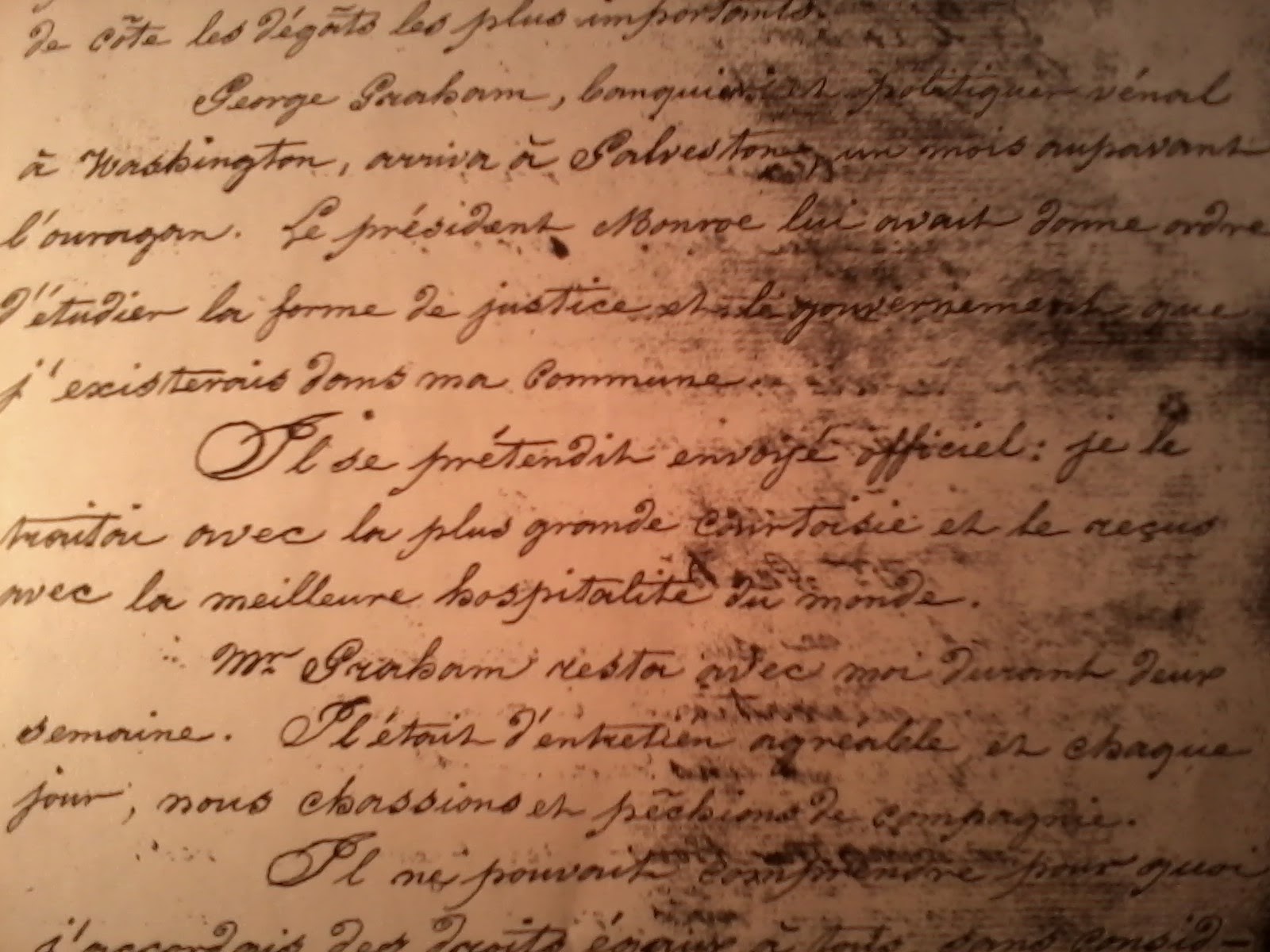
George Graham, a venal political banker in Washington, arrived at Galveston one month before the hurricane. President Monroe had given him orders to study the form of justice and of the government that existed in my commune.
 He pretended to be an official envoy. I treated him with the greatest courtesy and received him with the best hospitality in the world. 
Mr. Graham stayed with me for two weeks.  He was of an agreeable disposition, and each day we hunted and fished together.


 He could not understand why I accorded equal rights to all, without considerations of nationality or religion.
He represented exactly the same type as Alexander Hamilton, opposed to the principles of Thomas Jefferson. 
George Graham told Jean Laffite that "the territory situated to the west of the Sabine River belonged to the United States which had not authorized me to establish  a commune of my choice to the west of that river."

Concerned that there might be some official sanction behind Graham's words, Jean Laffite set out to Washington, where he met with Secretary of State John Quincy Adams. At the time, Adams was fifty-one years old and Jean Laffite was thirty-six. Adams told Laffite that he had not authorized Graham to speak to him or to ask him to clear out of Galveston. Mr Graham was acting alone and without the sanction of the United States government.


Mr. Adams affirmed that Mr. Graham was in banking, and was interested above all  in commercial loans and credit to private businesses and that he liked neither the ideas of Thomas Jefferson nor the system of Napoleon. 
Then again, John Quincy Adams can't have been all that taken with Thomas Jefferson or Napoleon, either. It would be amusing to hear with what tone of voice Adams said this.

John Quincy Adams as painted by Gilbert Stuart in 1818
from the Wikipedia

In the end, when public opinion had been turned entirely against Laffite after the Le Brave incident, and when Graham was again dispatched to tell him he must leave, this time in a more official capacity, Jean Laffite informed George Graham that his government was against England and Spain, and he would abandon Galveston only on the condition the United States would occupy the Antilles as well as Florida. George Graham replied that he was more interested in loans received from Spain than in annexing any of its territories.

From a page of the Journal that has been badly burned
Relevant text reads: "Nous informames Mr. Graham que notre gouvernment etait contre Espagne et l'Angleterre et que nous abondonerions qu'a la condition que les Etats Unis occuperaient L'Antilles et la Floridie."

Can you imagine someone more interested in the well-being of the United States than one who insists that before he can abandon his post as a bulwark against its foes,  the United States should take over more territory?

The story of Jean Laffite should stand as a warning to all external well-wishers of the American experiment, not to set too much store on the friendship of a government whose foreign policy is to neutralize its friends for the sake of doing business with its enemies.