Showing posts with label John Adams. Show all posts

Thursday, October 1, 2015

Grammar, Manners and Politics

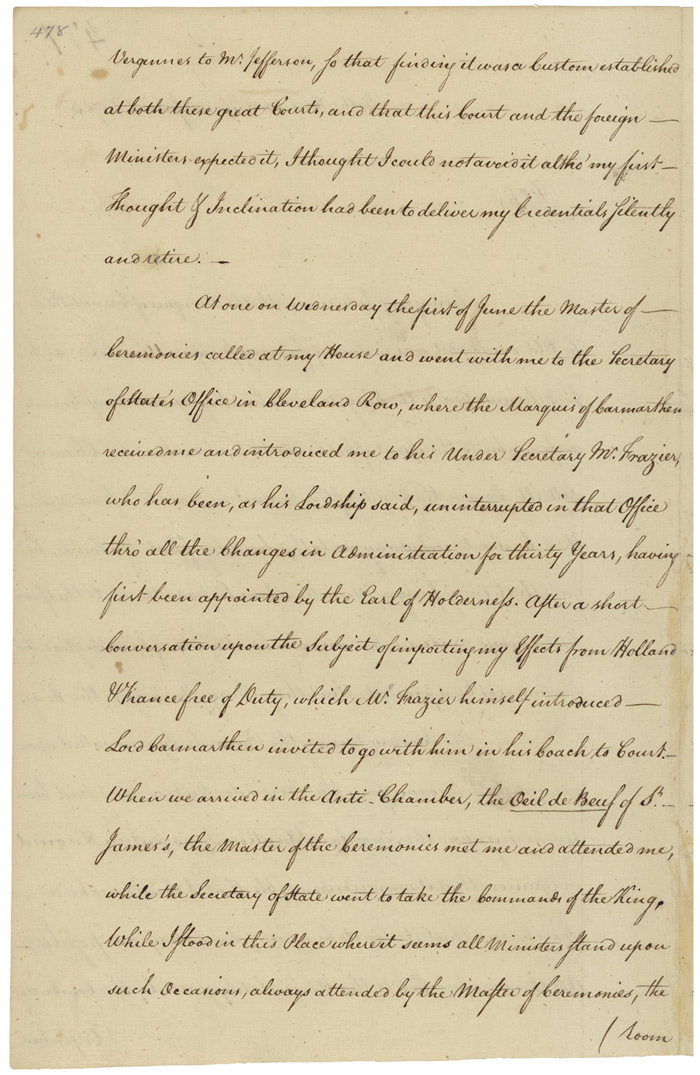
Part of a Letter from John Adams to John Jay, reporting on his audience with King George III
source:http://www.archives.gov/exhibits/eyewitness/html.php?section=19

Manners and grammar have a great deal to do with politics, in the sense that every language reflects its primary culture, and every culture is shaped by the political realities of how power is allocated in a given society. To a free people, unaccustomed to bowing and scraping, the requirement of showing deference by lowering themselves and changing their posture can be quite humiliating. The Europeans and Americans in the internment camp at Weihsien, Shandong Province, China, during WWII felt deeply abased by having to bow to their Japanese captors, as this was an "alien" practice to the societies from which they came. They thought that no free person, least of all an American, should ever have to bow down to another person. But did you know that the custom of bowing and scraping before others was actually an integral  part of the culture from from which they sprang less than two centuries earlier?

John Adams, as Minister to Britain, was required to execute a number of courtly bows before King George III.  That he felt a little silly doing this is illustrated by the following clip in which the meeting is dramatized:


Here are some of the words spoken by John Adams to King George III:


“Sir, The United States of America have appointed me their Minister Plenipotentiary to your Majesty . . . It is in Obedience to their express Commands that I have the Honor to assure your Majesty of their unanimous Disposition and Desire to cultivate the most friendly and liberal Intercourse between your Majesty’s Subjects and their Citizens . . . The appointment of a Minister from the United States to your Majesty’s Court, will form an Epocha in the History of England & of America. I think myself more fortunate than all my fellow Citizens in having the distinguished Honor to be the first to stand in your Majesty’s royal Presence in a diplomatic Character . . .”

Notice the grammatical agreement between the noun phrase "The United States of America" and the verb "to have" -- the verb being conjugated in the plural.  Also, the possessive pronoun "their" agrees with the plural noun phrase in number. At the time, it was understood that the United States were States which had chosen to be united, and it was clear that they were also divisible.  Over time, and especially after the Civil War, as the 10th amendment lost its power, the United States came to be a noun phrase that took singular agreement. Today we usually say "The United States is" and not "The United States are".

http://itre.cis.upenn.edu/~myl/languagelog/archives/002663.html

Language changes slowly over time, so that the distinction between a plural "United States  of America" and a singular did not actually arise all in one fell swoop after the Civil War, but some examples of singular can be found before, and some examples of plural remain even to this day in the set phrase "these United States". Nevertheless, a change in the balance of power between the States and the Federal government is clearly reflected in the way Americans use grammatical agreement.

Excerpt from Ping & the Snirkelly People


This change in the way the term "United States" is conceptualized can be confusing to innocent language learners and to people who do not understand the entire history of the United States. Likewise, the assertion that the United States are/is indivisible can be confusing to innocent bystanders unaware of political dogma. In my children's book, Ping & the Snirkelly People, the issue comes up unexpectedly when a Chinese girl in an American first grade class room is trying to understand the difficult words in the Pledge of Allegiance, when it is clear that none of the native speaker six-year-olds  in her class have any idea what they are chanting each morning.


The division of the United States into independent, sovereign states had been all but forgotten by the time of Lyndon B. Johnson's presidency, when Ping was visiting the country and learning about its ways.


Often, it is the people who are caught up in the change of manners and grammar of their ambient culture who are least aware of the changes. It is easier for an outsider to see what has happened. In order to understand our language, we need to step outside our language. In order to see our culture clearly, sometimes we need to look at it through the eyes of a foreigner.

Ping & the Snirkelly People


Wednesday, September 9, 2015

The Presidential Election of 1800

Even though the framers of the constitution did not make any mention of political parties, the party system emerged very early on in the history of American politics, and by the  fourth quadrennial presidential election two parties dominated the scene: the Federalists, whose leaders were John Adams and Alexander Hamilton, and the Democratic-Republicans, led by Thomas Jefferson and Aaron Burr.

Because the framers of the constitution did not anticipate the rise of political parties, they provided that each member of the Electoral College could cast two votes for president, and that the person with the highest number of votes would be the new president, and the person with the second highest number of votes would be the new vice president. The reasoning behind this rule was that it would maximize the possibility that a person with a majority of national support would be elected president. (When people vote by the party and not by the person, the possibility of getting a majority is much greater, as electors never even consider voting for people that the major parties have not thrown their support behind.) It was thus that in 1800 the incumbent president was John Adams, a Federalist, and the incumbent Vice President, Thomas Jefferson was his rival, a Democratic-Republican.


In preparation for the election, each of the two major parties had a plan and a "ticket". Despite the fact that the constitution expected each candidate to run on his own and for the second runner up to be vice president, that is not at all how the major players in the election of 1800 organized themselves. Each party had a presidential candidate and a chosen running mate.

John Adams chose Charles Cotes Pinckney of South Carolina as his running mate. (He could not have chosen Alexander Hamilton, because Hamilton was foreign born, and thus ineligible to hold the office of president .) Thomas Jefferson chose Aaron Burr, of New York, as his running mate. Notice that they tried to keep things even between the North and the South: the presidential candidate from the North, Adams, chose a southerner for his running mate. The presidential candidate from the South, Thomas Jefferson, chose a northerner for his running mate. But make no mistake about it: despite the provisions in the constitution, there was a presidential ticket for each party that included a presidential and a vice presidential candidate. And in order to make sure that the right guy wound up president from their own slate, each party instructed one of their electors to vote against the vice presidential candidate of their choice, lest he get the exact same numbers as the presidential candidate.

But in 1800 something went wrong.  Things did not go as planned at party headquarters. The person on the Democratic-Republican side who had been instructed to vote against Aaron Burr forgot or changed his mind, and Jefferson and Burr tied for president, each with 73 electoral votes. In the Federalist party, Hamilton and Adams were not acting in unison, which may be one of the reasons why the Federalists lost their hold on the presidency.

The issues in the election centered on the Federalist support of England against France, which resulted in the use of the Neutrality Act to prevent American privateers from serving the French interests, while the American government was engaged in a Quasi-War with France. And to make sure that people did not complain about this, the Federalists had passed the Alien and Sedition Acts. All of these were highly unpopular measures, which is why the Democratic-Republicans were the clear winners. But while everybody was tired of the tyranny of the Adams administration, and most Americans did not want to be satellites of England, there was also concern that Thomas Jefferson might be a Jacobin, and that his presidency might result in a loss of property rights as was suffered by the bourgeoisie under the French Revolution. That is why certain people, some of them Federalists,  were campaigning behind closed doors to make Aaron Burr the president, and Thomas Jefferson the Vice President.

However, that was not Aaron Burr's doing, and he was an honorable man. He had promised to run with Jefferson as the vice presidential candidate, and though he had a chance to grab the presidency, he did not. He instructed his supporters in the House of Representatives to throw in their votes for Thomas Jefferson in the follow-up election of 1801. At this point, the Federalist supporters of Adams had been voting for Burr, while the faction of the Federalists that Hamilton controlled voted for Jefferson. Abigail Adams, in one of her letters, expressed the thought that Burr would make a pretty good president.

Thomas Jefferson, even though he did win the election, never forgave Burr for almost upstaging him, and the next time he ran for president, he did not choose Burr as a running mate. Another, far more permanent result of this election was that the constitution was amended. No more was the vice president to be the person with the second  highest number of votes for president. From now on, vice presidents would be elected separately from presidents, thereby acknowledging the practical power of the political party.

Today, most people do not know about any of this. Some say it's a shame we have political parties, since that was not envisioned by the founding fathers. Not envisioned perhaps, but all the founding fathers who ran for office were involved in political parties, so while they may not have wanted them to exist for the other side, they certainly did use them when they themselves were running. People also do not remember that Burr and Jefferson were running mates on the same political party slate. Some contrarians even remember that the president and vice president were elected in the same election, but they do not remember that in order to get around the rules they themselves had made, founding fathers like Adams and Jefferson instructed their political flunkies to cast one vote for somebody they did not want elected at all, just so there would be a clear presidential winner on their party slate distinct from the vice presidential winner.

The historical facts can be quite astonishing. Sometimes it pays to revisit them.


RELATED ARTICLES


Wednesday, March 11, 2015

Should We Repeal the Logan Act?

Source: https://pbs.twimg.com/media/B_zmPSrW8AAXC3A.jpg

It's funny how obscure laws passed during the administration of John Adams keep surfacing at the oddest of times. John Adams was a British-leaning, one term president who signed into law a very unpopular legislation package called the Alien and Sedition Act of 1798.

John Adams Source: Wikipedia


The Sedition Act, which was a part of this package, provided for a punishment of up to two years imprisonment for "opposing or resisting any law of the United States or writing or publishing false, scandalous and malicious writing about the President of the United States or Congress, but not about the Vice President."(Source: Wikipedia)  Opposing any law of the United States under the Sedition Act did not mean violating that law: it meant campaigning to have it repealed. Writing scandalous and malicious things about the President did not mean, apparently, just libel and defamation, as there were already measures against that. It meant writing things about them which may be true, though scandalous. (The "and" in "false, scandalous and malicious" was interpreted as an "or".) The Vice President, on the other hand, was not shielded by these laws from having scandalous but true things written about him, because the Vice President at the time was Adams' chief rival, Thomas Jefferson. When Jefferson came to power, he allowed the Alien and Sedition Act to expire, and he compensated all the people who were harmed by it.

However, the Logan Act, passed during the same period,(January 30, 1799) was not ever repealed. It has also not ever been successfully prosecuted, and its constitutionality is in question. 

The Logan  Act is named for Dr. George Logan of Pennsylvania, who during Adams' undeclared and unconstitutional war with France, took it upon himself to try to improve matters between the two countries. According to Kevin Kearney:

Upon his arrival in Paris, he met with various French officials, including Talleyrand. During these meetings, he identified himself as a private citizen, discussed matters of general interest to the French, and told his audience that anti-French sentiment was prevalent in the United States. Logan's conversation with Merlin de Douai, who occupied the highest political office in the French republic, was typical. Logan stated that he did not intend to explain the American government's position, nor to criticize that of France. Instead, he suggested ways in which France could improve relations with the United States, to the benefit of both countries. He also told Merlin that pro-British propagandists in the United States were portraying the French as corrupt and anxious for war, and were stating that any friend of French principles necessarily was an enemy of the United States. Within days of Logan's last meeting, the French took steps to relieve the tensions between the two nations; they lifted the trade embargo then in place, and released American seamen held captive in French jails.
The Federalist Party, and John Adams at its head, were very jealous about the praise showered on Dr. Logan for his successful negotiation with the French, so  they passed a law forbidding any American from ever doing something like that again. Logan was later elected to Congress, during Jefferson's term of office, but for some reason, he was never able to get the Logan Act repealed, though he did try. 

Only one person was ever indicted under the Logan Act and that was in 1803. Nobody has ever been convicted under it. Its constitutionality has never been upheld. 

Should we repeal the Logan Act? Or is this legacy from John Adams restricting Americans from speaking on behalf of other Americans to foreign governments to be upheld? Was what Dr, Logan did in France really so very bad?


References

 Kearney, Kevin M. (1987). "Private Citizens in Foreign Affairs: A Constitutional Analysis". Emory Law Journal. 36. (winter)

https://en.wikipedia.org/wiki/Alien_and_Sedition_Acts


Monday, October 6, 2014

The Neutrality Act of 1817

The first American Neutrality Act was passed in 1794.  It made it illegal for Americans to wage war on a country at peace with the United States. The thing to consider about this act of Congress is that prior to its passage, it was perfectly legal for an American citizen to wage war on his own against a country that the United States was not at war with. The constitution provided that the Federal government under its commander-in-chief, the President, would not be allowed to wage war unless Congress issued a declaration of war. But all the rights not granted to the Federal government were reserved to the states and to the people. So while the president of the United States was bound to remain neutral in all matters, unless Congress voted otherwise, each individual American was allowed to conduct his own foreign policy.

Take a deep breath and think about what this means. American citizens prior to 1794 were considered autonomous. They could make war on other countries in order to pursue their own interests. And, indeed, many Americans were privateers with letters of marque from foreign countries, such as France, and earning a good living by helping others in their wars against the great international empires such as Britain and Spain.


What happened in 1794 to change all that? In 1794, under the administration of George Washington, the United States signed the Jay Treaty with Britain. The Jay treaty was the brainchild of Alexander Hamilton, and it was hotly contested by the Jeffersonian-led Democratic-Republicans, who feared that this was a return to old world aristocratic tendencies and the rule of tyranny.

The other thing that happened in 1794, which I might as well also mention, was the reign of terror of Maximilien de Robespierre and his Committee of Public Safety in France. After the French revolution, Jacobins had taken over France. It was off with everybody's head and a complete deterioration of all civilized things, including private property.

Britain did not want this general lawlessness to spread to England, and George Washington and Alexander Hamilton agreed. So they decided to tie the hands of American privateers who were still working for France. They also thought this would be a good time to repudiate the American war debt to France, since, after all, that promise was made to the French monarchy that helped to free American Colonies from Britain and not to those lawless  Jacobins currently in power.

The Jay Treaty cleared the way for the Quasi-War with France under John Adams, an undeclared war that served British interests and helped the United States renege on the American promise to repay its war debts to France. During the Quasi-War with France, the president of the United States ignored the constitutional provision that required him to get clearance from Congress before starting a war. Meanwhile, the Neutrality Act, far from creating neutrality was used to make sure that no individual American fought for a side in any war that the president did not want him fighting on.

Just like the Committee for Public Safety in France, that did anything but insure public safety, the Neutrality Law was named the very opposite of what it did.

But our subject here is not the Neutrality Act of 1794. Our subject was the Neutrality Act in 1817. The original Neutrality Act was superseded by this new act that also mentioned the unrecognized governments of newly liberated Latin American countries as additional powers that American citizens were not to help anymore. Henry Clay called this an "Act for the benefit of Spain against the Republics of South America." The act prescribed penalties of three years imprisonment and three thousand dollars in fines.

Far from breeding neutrality, all these laws collectively were used to tie the hands of American privateers and to help the great empires of Britain and Spain to hold on to their dominions. But much more importantly than this, the Neutrality Act was used to subdue the independent spirit of American businessmen, who henceforth would need the permission of their government to conduct business abroad and to defend their foreign holdings.

When Jean Laffite was routed out of all his holdings in both Barataria and Galveston, this disempowerment did not happen to him alone. It happened to all Americans, who became more like subjects and less like citizens under a government that took on itself more and more power. In order to pursue its own dreams of empire, the United States government under James Monroe wanted no competition from private citizens in the international arena.

Tuesday, August 19, 2014

Suspending Habeas Corpus: A Longstanding American Tradition

The right to a writ of  habeas corpus  has been suspended in 21st century America. Again. For some patriots, this is a shocking turn of events, but to most people, it is business as usual. And, in fact, it keeps happening over and over again and is an ongoing American tradition. Likewise, it is equally traditional, every time it happens, for those who care about the loss of civil liberties to act as if this is the first time it has ever happened.

When George W. Bush first suspended the right to petition for a writ of habeas corpus as part of his "War Against Terror", a war that his successor has kept in effect, government experts pointed out that Abraham Lincoln had done the same.

http://usgovinfo.about.com/od/rightsandfreedoms/a/habeuscorpus.htm

Not everybody, however, is surprised that Lincoln did this, as a sizable group of Americans feel that President Lincoln is known for overreaching and taking power for the executive branch, in contravention of constitutional guarantees. But most of those people would be shocked to learn that Thomas Jefferson was guilty of the same.


Recently, I came across a pamphlet consisting of two letters attributed to Joseph Alston, Theodosia Burr Alston's husband, and privately published in South Carolina in 1807. I am not going to reproduce everything in the pamphlet here, but I will provide a sample:

A few months since, and I hardly should have been persuaded that the subject of this letter could ever have engaged the pen of an American citizen. When I read the afflicting details of individual oppression, and of military violence which disgrace the history of almost every other country, I turned involuntarily to contemplate the delightful contrast provided by the admirable provisions of our constitution and laws, for the security of the citizen, and the strict subordination of the military to the civil authority. Unaffectedly as I sympathized with the victims of arbitrary power, strong as was my indignation against the oppressor, I could not avoid mingling with these generous feelings, something like the emotion of him, who  encircled by his family, and seated before the blazing hearth of his comfortable mansion, hears the pelting storm impotently rattle against his windows, or listens to the piercing blast, as it whistles along the distant heath.
At this point one might suppose one is reading a fictional work by one of the Brontës, possibly Charlotte in Jane Eyre. Were there really any heaths in post-colonial America?  The writer sounds so British and the prose is a bit purple. But no, it was Joseph Alston of South Carolina, or some member of his household, who wrote this.

When I extended my view from the constitution to the Laws to the disposition, the manners, the habits that characterise my countrymen, I beheld other and still nobler pillars supporting the temple which liberty had erected to justice, and in the conscious exultation of my heart, have not unfrequently exclaimed-- "Here we are safe! Unhappy man, whom flight has rescued from oriental or occidental despotism, wretched fugative [sic] from the north or the south, repose without fear in the sanctuary which heaven has provided for you. Here, here, oppression dare not, cannot show her hideous form!"
One can well imagine Joseph Alston frequently exclaiming this on his rice plantation. But I can't also help but wonder: did he really write this himself?

Little did I imagine that from meditations like these I should be roused by the daring and atrocious scenes lately acted in New-Orleans! Little did I imagine that I should so soon behold the constitution, upon which I proudly rested, bleeding under the poignards of its military assassins; the laws, to which I looked for protection, trampled upon;  the civil authority annihilated. Mark, Sir, the picture which General Wilkinson has presented to our contemplation! Encamped with his army, within sight of the enemy who had invaded our territories, he suddenly concludes with them an armistice and withdraws the troops. The surrounding country is astonished, but astonishment is quickly succeeded by  feelings of a different nature. By forced marches he proceeds to New-Orleans; --he arrives-- treason! rebellion! are sounded --and in an instant the whole city is in one scene of confusion, amaze and consternation. The approach of an army of 20,000 insurgents in announced! Camps are formed, the militia are enrolled, pickets are hastily thrown up, entrenchments made, spots marked up for batteries, in a word preparations for battle strike every eye and fill every heart with emotion. Armed vessels are equipped and dispatched up the river, guards are stationed at different points, with strict orders to suffer none to pass without  a permit from the General! Military law prevails!
The imposition of Martial Law is always the precursor to other, more specific violations of civil liberties. We see this happen today more often than is comfortable. It was not essentially different back in 1807. It starts with harassing the press.

The press ventures a comment about these measures, and it is put down; to doubt the reality of the danger is to be an accessory to the conspiracy, general words, long spoken, and perhaps misunderstood, or falsely  reported by malice, are conjured up as strong presumption of guilt, every man is surrendered to the mercy of his enemy, since to have a letter addressed to him is to be constituted a criminal. The people, agitated and full of suspense regard in awful silence the portentous looks of this new arbiter of their destinies, and tremble at every movement.
In this last paragraph, there is reference to several events that are explained in the margins. For instance the sentence about how having a letter addressed to a person  makes him a criminal refers to a draft drawn on Edward Livingston by Aaron Burr. Livingston owed Burr money. Burr needed the money repaid, so he had Erich Bollman deliver a letter from Burr to Livingston requesting payment. Livingston liquidated some assets and paid the debt to Bollman. When this happened, both Livingston and Bollman were accused of plotting to overthrow of the government. This event is described in detail in the biography of Edward Livingston. As to the words long spoken which are used as evidence, the footnote refers to a letter by General Wilkinson to President Jefferson in which he says: "writs of habeas corpus have been issued for the bodies of Bollman, Swartwout and Ogden, the two latter by Judge Workman, who is strongly suspected for being concerned with Burr in his conspiracy, as I have proof this man declared sometime since that the republican who possessed power and did not use it to establish a despotism is a fool." And so, based on this kind of evidence, various persons were summarily arrested,  and locked away. and shipped to Washington City by the General, in order to prevent them from establishing a "despotism". And one of the lawyers who attempted to defend the accused, a Mr.  Alexander, "was dispatched with others at a stormy and dangerous season, on a voyage to the U. States: happily for him he arrived safe: he was instantly discharged on a Writ of Habeas Corpus, and left at liberty to return to his business at Orleans, having merely been interrupted in his professional pursuits, for a few months, imprisoned part of the time, exposed to the dangers of a winter's passage from and to Orleans, put to some little expense, and obliged to traverse a distance of between two and three thousand miles."

--He issues his mandate, and various citizens of the United States are arrested: two gentlemen at the bar have the courage to demand a Writ of Habeas Corpus in their favor -- and one of them shares the fate of those he would have rescued from the prosecution, the other is denounced as a  traitor! The Judge, to whom the application was made, has virtue and spirit enough, in spite of the military despotism that surrounds him, to grant the writs, and the subjects of these writs, excepting one, are immediately removed to remote and secret places of confinement, and the court is insulted with the most trifling, unsatisfactory and illegal returns. The prisoner for whose removal there had not yet been time, is at length brought up, no cause for his confinement is shewn, and he is liberated. The Judge who has committed this daring outrage upon the orders of the commander in chief, is immediately declared to be strongly suspected of being himself a conspirator, and the prisoner he had liberated is again  arrested with new victims of suspicion and malice. Writs of Habeas Corpus are again applied for, again issued: Wilkinson, emboldened by the tame submission of the civil executive, which willingly crouches at his feet, no longer evades, but openly defies the order; 
What reason did General Wilkinson give for openly defying court orders to turn over the "bodies" of those arrested? He declared that the country was "menaced by insurrection" and that he would take and seize all others "of whose guilt he is assured."

And here, after recounting these facts, the letter turns to what should by now be the familiar lament of all freedom loving people when it turns out that the freedom they believed was theirs is not guaranteed or automatic or even eventually forthcoming:

Gracious God! In what times, in what country do we live? Have we been transported to the land of our ancestors? Has the elder Charles been restored to us, and is this an edict from the Star Chamber? Do we enjoy, in France, the halcyon days of that Louis whom the folly of posterity has surnamed the Great, and is this the new formula of a captilatory in justification of Lettres de Cachet?Or is it in poor, devoted Ireland that the sanguinary administration of the murderer of Orr and the prosecutor of Finnerty is restored, and is this a proclamation from the castle, announcing to a degraded and insulted people the return of the horrors of '97 and '98? Espionage systematised and encouraged, rewards offered for perjury, secret denunciations, arbitrary imprisonment and military law! No, we are neither in England nor in France, nor in Ireland. It is neither the sceptered Charles, the Great Louis nor the Earl of Camden who thus daringly tramples upon all law, and without trial, without even preferring an  accusation before any constituted tribunal,  consigns to prison, or the dungeon, the unhappy object of his suspicion or the unsuspecting victim of his malice. America -- America, the abode of Liberty, the empire of the laws -- is the scene of these outrages, the period of their perpetration the beginning of the nineteenth century! The perpetrator an officer of the United States Army!
Doesn't that sound like every lament against the recent loss of liberty we currently read on Facebook? It's the beginning of the 19th century, people! This shouldn't be happening.

Who wrote this little pamphlet? It is signed Agrestis,  but the attribution in the copy that I got is to Joseph Alston.


And yet I cannot help but wonder if Theodosia had a hand in writing this. There are a lot of learned references to the ancients, many quotes in Latin, and other scholarly touches that seem less likely to come from Joseph, the college drop-out,  than from his more erudite wife.

Was it in a moment of peace with the whole world, of profound domestic tranquility, in the midst of a people faithful to themselves and to their country that the cruel  and atrocious scenes acted in ancient Sicily were necessarily renewed in an American province? And is the salus populi now to be urged in vindication or the modern Verres under whose Praetorship, the unhappy objects of his tyranny, like the persecuted Sicilians neque suas leges neque nostra senatus consulta neque communia iura tenuerunt? Yes-- this plea has been urged! This plea has been advanced! A President of the United States condescends to be the apologist of these outrages, continues the offender in the high military command that enabled him to effect them, and Wilkinson triumphs in his guilt! Sacred Spirit of '76! Sleepest thou in the grave with Washington, Adams and their generous compatriots? Or dost thou  still linger in our land?
For a translation of that bit in Latin, probably by Cicero, you might refer to this site:

http://quizlet.com/17771251/ecce-58-a-translation-flash-cards/

John Adams was still alive in 1807, so the part about him being in the grave with Washington seems a little premature. However, that's a mistake a contemporary might easily have made.

To be fair to Jefferson, the president referred to above as condescending to be an apologist for outrages,  he was not actually the first president to have violated the Spirit of '76. That would be Washington with his actions during the Whiskey Rebellion. And Adams was not much better, conducting an undeclared Quasi-War against France and promoting the Alien and Sedition Act  But when you are fighting to condemn the actions of one president, there is a temptation to paint all the others as saints. Unfortunately, we see that happening today, where if the current president is to be condemned, then the previous one is to be lauded, and vice versa,  when both are guilty of very similar behavior, though they belong to different parties.

The fact that America was only on its third president and already a constitutional crisis was at hand may have left the pamphleteer very little American history to rely on for argument's sake. But who has the author of this pamphlet chosen to  compare  General Wilkinson with? Gaius Verres, born 120 B.C. died 43 B.C. who, among his many corrupt practices,  used to accuse the slaves of wealthy landowners of conspiring with Spartacus in his slave rebellion. Is this likely to have been a preoccupation of Joseph Alston, the slaveholder and plantation owner? Or is it more likely to be something that his abolitionist, Latin-reading wife was thinking about?

The moral indignation and emotional tone also remind me of the letter Theodosia wrote to Dolley Madison later, when her father was in exile:

http://www.pubwages.com/26/lobbying-the-madisons-letters-to-james-and-dolley


The offenses against which the person signing only as Agrestis complains were real. They did happen. It was as wrong then as it is now for the military to summarily arrest, indefinitely detain and deny a right to trial. But it is unclear whether the arguments made were effective, despite the obvious erudition and ardor of the writer. How many American voters regularly read Cicero in the original, even in 1807? What did most slaveholders think about Spartacus? Could Aaron Burr and his supporters have used a more populist writer to defend them?

Who do you think wrote that pamphlet? Is there any hope today for the vanished Spirit of '76?


Theodosia and the Pirates

If you want to read this pamphlet for yourself, it is available from Amazon:
A Short Review etc

Tuesday, March 25, 2014

American Diplomacy in the Wake of War

Diplomacy is  just one of the tools of war. At the bargaining table, many a nation has won more territory than it could possibly have conquered in a pitched battle. At the bargaining table, many a victor's gains have been squandered. Sadly, the United States has a long history of dumping friends in order to make "peace" with bullies.

Neutrality would be a very fine thing, if it meant not getting involved in other people's disputes. But under the pretext of maintaining "neutrality" the United States has often broken with its natural allies in order to appease its more powerful enemies.

Can you imagine going to war with France to help Britain, when only a few years earlier France helped you win your independence from Britain? That's what the administration of John Adams did without a declaration of war.

Or how about the way the Soviet Union ended up our ally in World War II and FDR divided up the world between himself and Stalin at Yalta? Was that in the best interest of US citizens? How?

 Or the way in which Israel is constantly being pressured to give up territory for the sake of peace, while simultaneously being offered bribes in the form of American financial aid at taxpayer expense? Would a powerful Israel not be a good thing for the US? How does using taxpayer money to bribe Israel not to defend itself from forces unfriendly to the US help American citizens? Does it make the price of oil go down? I don't think so.

 Or exactly why was it that  we severed diplomatic relations with our friend Taiwan in order to make peace with Mainland China? Wouldn't "neutrality" have demanded that we treat both China and Taiwan just exactly the same? Why do we have to stop being friends with Taiwan in order to offer friendship to China? Would a real friend ever ask that of us?

All of these actions are part of a pattern that was established very early on in the history of the United States. There is nothing new under the sun, except that diplomacy as practiced by the US State Department does not tend to promote the natural interests of the United States and often penalizes United States citizens who are taxed to support policies inimical to their own interests.

The treatment of Jean Laffite by the United States, both at Barataria and at Galveston, is a case in point. Having driven Laffite out of his territory at Barataria when he helped defend New Orleans from the British invaders, when he moved to Galveston where he served as a buffer against Spain the United States went on to demand that he leave again, and not so that United States forces could take possession, either. It was so that Spain could retain its holdings in Texas, and so that the United States could maintain its fragile "friendship" with Spain. Is that neutrality? Siding with the local bully against the underdog who is friendly to you?

This is my take on it. But what did Jean Laffite think? A few well chosen snippets from his journal will give us an idea.

In this section of the Journal, Jean Laffite is talking about the events that precipitated his expulsion from Galveston. They involve the Spanish Ambassador de Onis putting pressure on President Monroe.
Ambassador de Onis protested more violently and thus forced President Monroe to send agents to Texas to verify the settlement of French refugees without the power of General Lallemand and to prevent him from settling in United States territory.
George Graham, who gave himself the honors, was chosen for the mission.  Mr. Graham was involved in banking matters in Washington, and he was always ready for placement when the occasion presented itself. Mr. Graham did not sympathize with Luis de Onis.
So then Mr. de Onis protested to Secretary John Quincy Adams on the subject of the French invasion of Texas. Mr de Onis and Mr. Adams were able to come to an agreement on their points.
John Quincy Adams, like his father John Adams, sympathized with the British against the French. He was perhaps more nearly neutral about Spanish interests, but Ambassador de Onis knew Adams the younger rather well, and he knew how to manipulate him to see things his own way.

Mr. Adams did not make much noise on the subject of my commune, but when he learned that my corsairs seized British ships, then along with the rest of his cabinet, he protested.

Like his father before him, John Quincy Adams, then secretary of state under President Monroe, sympathized with the British. It was a historic preference inherited from his father, the second president. The Federalist John Adams favored Britain, while Democratic-Republican Jefferson had been sympathetic to  France. Nobody seemed to be neutral, each faction having its own preferences in the European power struggle. In fact, throughout the career of Jean Laffite, it seems that the struggle between the Federalists and the Anti-Federalists, even when it seemingly culminated in the demise of the Federalist party, was still a factor.  There are echoes of this in the Journal of Jean Laffite.


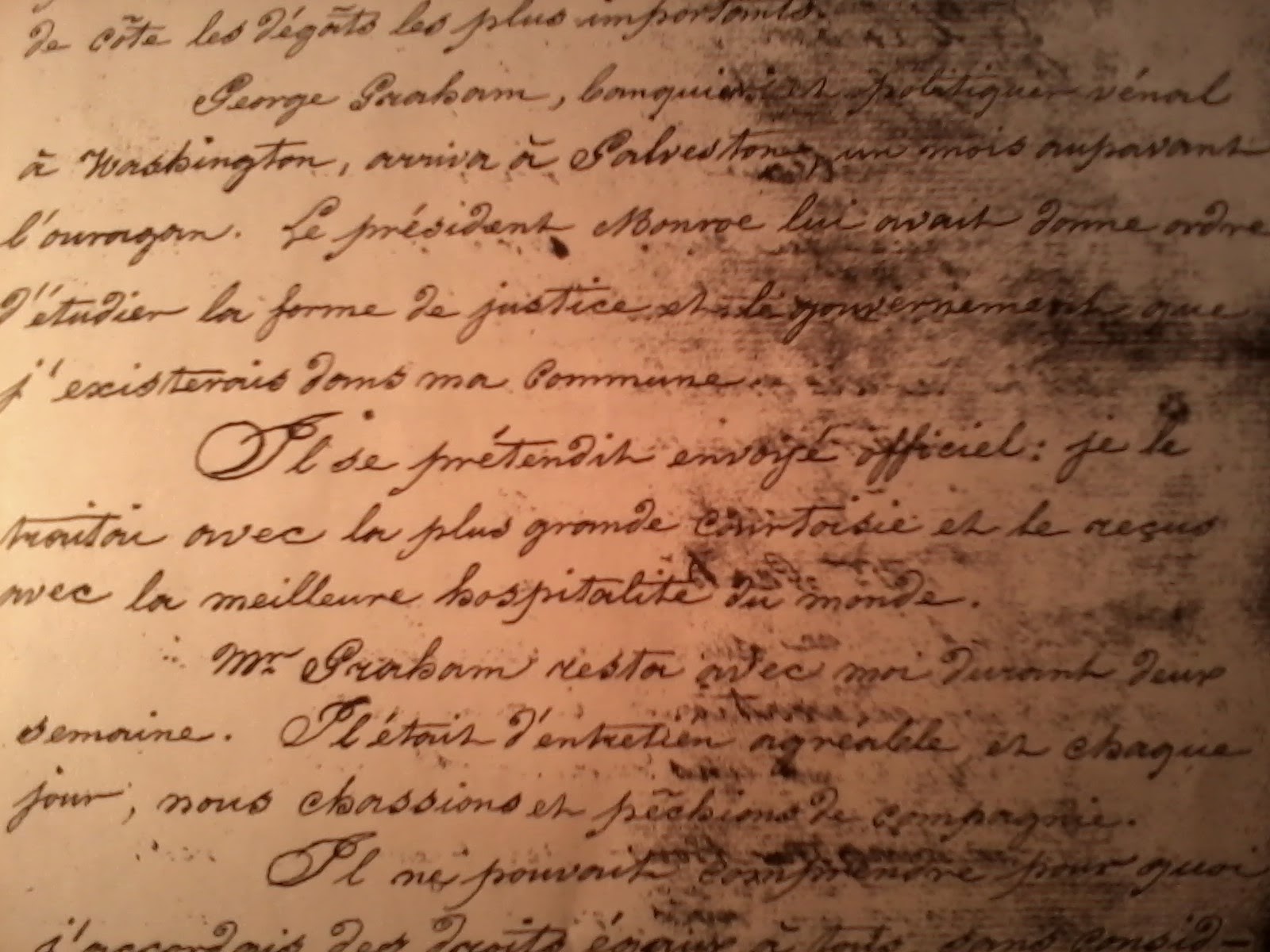
Jean Laffite writes:

George Graham, a venal political banker in Washington, arrived at Galveston one month before the hurricane. President Monroe had given him orders to study the form of justice and of the government that existed in my commune.
 He pretended to be an official envoy. I treated him with the greatest courtesy and received him with the best hospitality in the world. 
Mr. Graham stayed with me for two weeks.  He was of an agreeable disposition, and each day we hunted and fished together.


 He could not understand why I accorded equal rights to all, without considerations of nationality or religion.
He represented exactly the same type as Alexander Hamilton, opposed to the principles of Thomas Jefferson. 
George Graham told Jean Laffite that "the territory situated to the west of the Sabine River belonged to the United States which had not authorized me to establish  a commune of my choice to the west of that river."

Concerned that there might be some official sanction behind Graham's words, Jean Laffite set out to Washington, where he met with Secretary of State John Quincy Adams. At the time, Adams was fifty-one years old and Jean Laffite was thirty-six. Adams told Laffite that he had not authorized Graham to speak to him or to ask him to clear out of Galveston. Mr Graham was acting alone and without the sanction of the United States government.


Mr. Adams affirmed that Mr. Graham was in banking, and was interested above all  in commercial loans and credit to private businesses and that he liked neither the ideas of Thomas Jefferson nor the system of Napoleon. 
Then again, John Quincy Adams can't have been all that taken with Thomas Jefferson or Napoleon, either. It would be amusing to hear with what tone of voice Adams said this.

John Quincy Adams as painted by Gilbert Stuart in 1818
from the Wikipedia

In the end, when public opinion had been turned entirely against Laffite after the Le Brave incident, and when Graham was again dispatched to tell him he must leave, this time in a more official capacity, Jean Laffite informed George Graham that his government was against England and Spain, and he would abandon Galveston only on the condition the United States would occupy the Antilles as well as Florida. George Graham replied that he was more interested in loans received from Spain than in annexing any of its territories.

From a page of the Journal that has been badly burned
Relevant text reads: "Nous informames Mr. Graham que notre gouvernment etait contre Espagne et l'Angleterre et que nous abondonerions qu'a la condition que les Etats Unis occuperaient L'Antilles et la Floridie."

Can you imagine someone more interested in the well-being of the United States than one who insists that before he can abandon his post as a bulwark against its foes,  the United States should take over more territory?

The story of Jean Laffite should stand as a warning to all external well-wishers of the American experiment, not to set too much store on the friendship of a government whose foreign policy is to neutralize its friends for the sake of doing business with its enemies.